Multinationals, international institutions hail China’s commitment to multilateralism, free trade at WEF
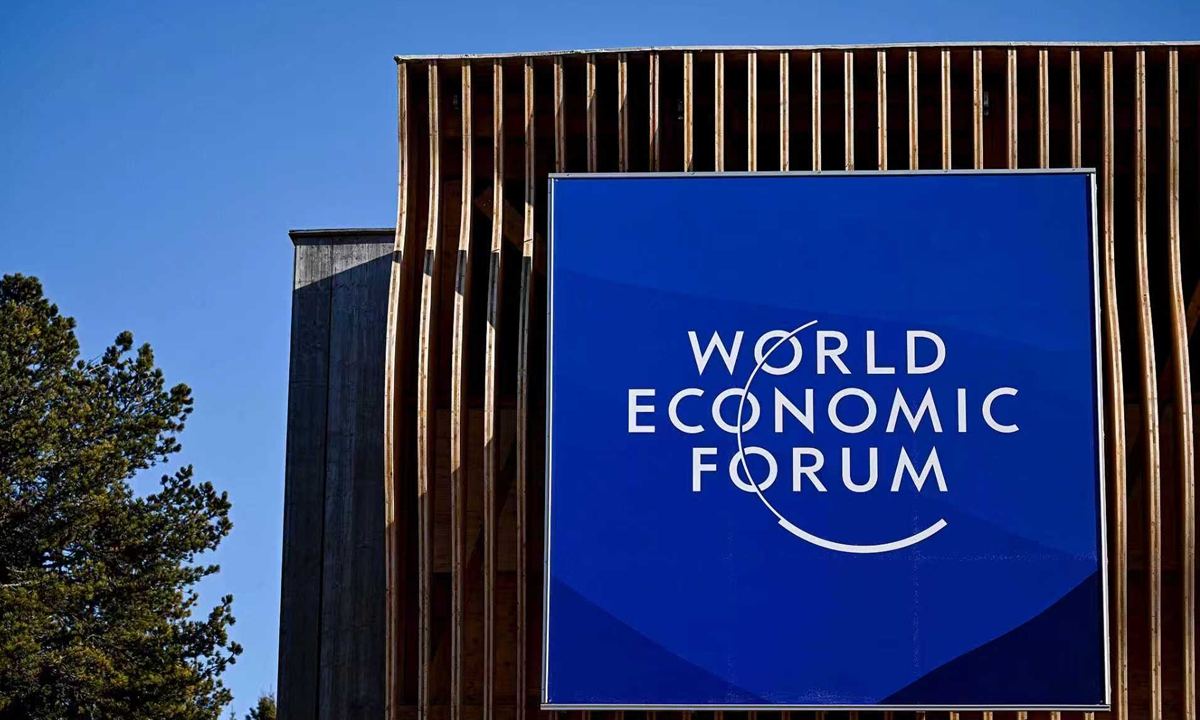
The World Economic Forum Annual Meeting 2026 takes place in Davos from January 19 to January 23, 2026. Photo: VCG
China's participation in the ongoing World Economic Forum (WEF) Annual Meeting 2026, including a special address by Chinese Vice Premier He Lifeng, highlighted its advocacy for multilateralism, free trade, and an open global economy, positioning the country as a reliable partner committed to inclusive globalization, positions that are being hailed by multinationals and international institutions.
China called on the global community to firmly support multilateralism and free trade, and stay committed to win-win cooperation, Chinese Vice Premier He Lifeng said on Tuesday in his address at the WEF Annual Meeting in Davos, Switzerland, the Xinhua News Agency reported.
This year's WEF, under the theme "A Spirit of Dialogue," has brought together nearly 3,000 representatives from more than 130 countries and regions. Key topics include how to cooperate in a more contested world, how to unlock new sources of growth, and how to deploy innovation at scale and responsibly, according to the WEF.
ABB, a Swiss tech giant, is one of the WEF partners. Morten Wierod, chief executive officer of ABB, previously said that China offers enormous opportunities, the Global Times learned from the company.
"As China advances green development, the Chinese market is experiencing significant growth, and the company hopes to do more in China in the future," Wierod said.
According to the Global Trade Observatory Annual Outlook Report 2026 released on Wednesday at the Davos forum by DP World, a Dubai-based multinational logistics company, 17 percent of surveyed executives pointed to China when asked where trade growth potential would be greatest in 2026, with 22 percent pointing to Europe,followed by Asia Pacific (14 percent) and North America (13 percent).
The findings were based on a survey of 3,500 senior supply chain and logistics executives across eight industries and 19 countries, conducted ahead of the WEF Annual Meeting in Davos, DP World told the Global Times in a statement.
"I think people are realizing that China could be a big growth area over the next decade," Mitchell Green, founder and managing partner of Lead Edge Capital, told Bloomberg during the WEF on Wednesday.
WEF President and CEO Borge Brende noted that China is witnessing increased growth in frontier technologies and is doubling down on investment in research, development and innovation.
"Technologies can represent huge opportunities for productivity gains and also growth in the years to come, and China is a major contributor to that," said Brende, according to Xinhua.
"China has been underlining the importance of multilateralism. A multilateral system, centered on the United Nations, is needed for the world to address key global challenges," Brende said.
"Amid persistent global geopolitical tensions and rising risks of economic fragmentation, China's transition from high-speed to high-quality development is delivering much-needed momentum and stability to the global economy," said Maroun Kairouz, managing director of the WEF, according to Xinhua.
Kairouz also pointed out that China's reforms not only strengthen its own economic resilience but also create new global opportunities in clean energy, technology and trade in 2026 and beyond. This progress helps address shared challenges in an uncertain global environment.
As the world's second-largest economy, China continues to attract significant attention for its demonstrated resilience and substantial contributions to global growth, even amid external pressures and domestic transitions, Hu Qimu, deputy secretary-general of Forum 50 for Digital-Real Economies Integration, told the Global Times.
Hu noted that China's strong foundations, advantages in manufacturing supply chains, and leadership in the green and digital sectors, would provide much-needed stability and momentum worldwide.
"In a world marked by profound volatility and uncertainty, global concerns about future development are widespread. Yet China has demonstrated remarkable certainty and stability, which is of critical importance to the stability and healthy development of the global economy and technological progress," said Hu.
Confidence about China's market was shared among multinationals.
A KPMG survey published in December revealed that 94 percent of surveyed multinational corporations continued to invest in and bet on the Chinese market, while 75 percent planned to maintain or increase investments in the Chinese mainland in 2026.
According to the China Business Climate Survey (BCS) Report released last week by the American Chamber of Commerce in China (AmCham China), US companies cited China's strategic importance and long-term market potential as the primary drivers of expanded investment, with 52 percent of respondents ranking China among their top three global investment destinations in 2026.
Meanwhile, 71 percent of companies reported no intention to relocate operations overseas, citing China's strategic market position as a primary anchor, read the BCS report.
The success stories of US companies in China demonstrate that cooperation benefits both sides in the China-US relationship, and that promoting the stable, healthy, and sustainable development of China-US relations is in the common interest of both sides, Chinese Foreign Ministry spokesperson Guo Jiakun said on Monday,
"We welcome companies from all countries, including the US, to seize the 'opportunity list' of China's high-quality development and share the 'super dividends' of its trillion-dollar market," Guo said.
RELATED ARTICLES