TEPCO restarts Kashiwazaki-Kariwa nuclear plant amid local opposition; operation unacceptable as Fukushima nuclear accident’s accountability unsolved: Japanese civil group
By and Xing Xiaojing Published: Jan 21, 2026 10:26 PM

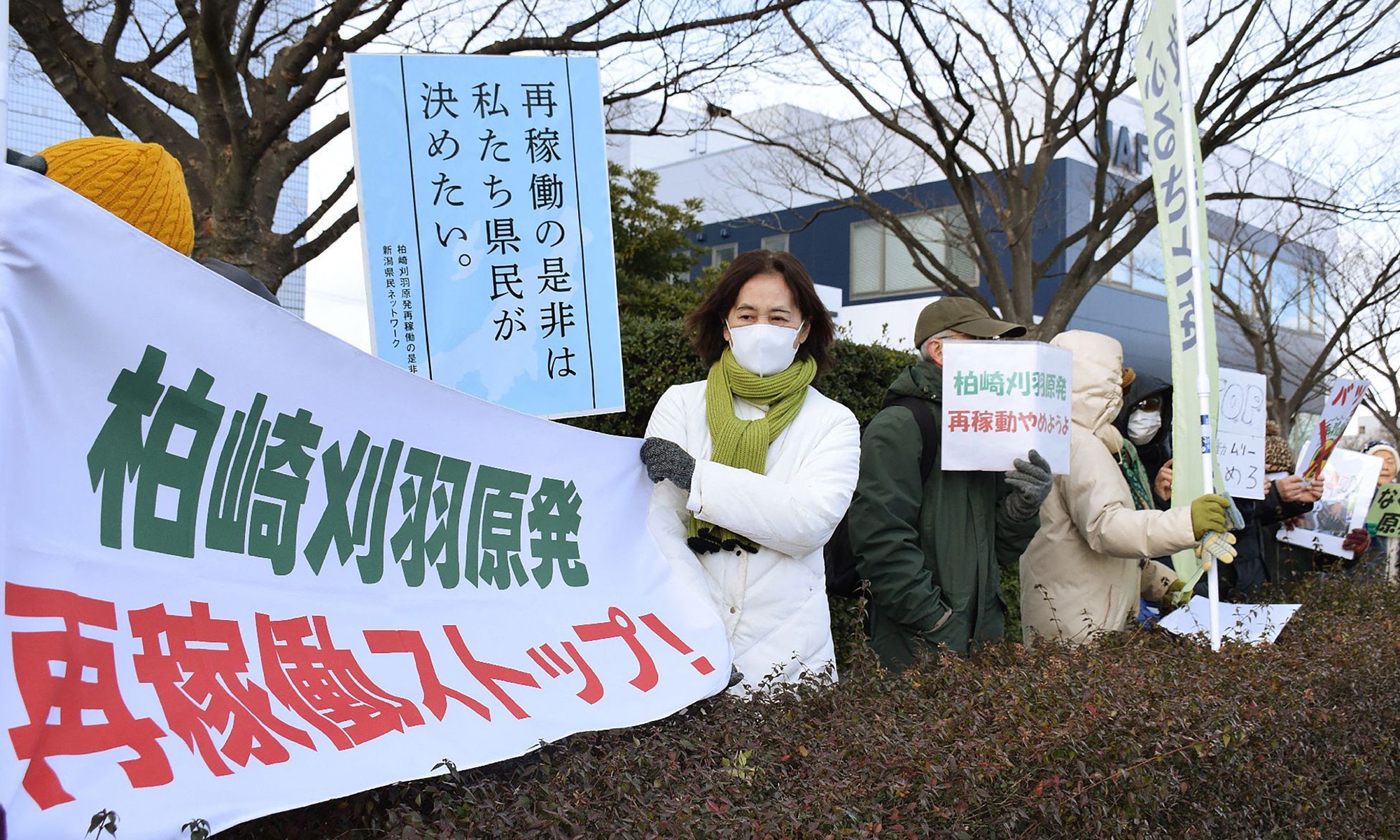
Residents protest the restart of Tokyo Electric Power Company's Kashiwazaki-Kariwa nuclear power plant in Niigata Prefecture on January 21, 2026. The world's biggest nuclear power plant was restarted January 21, 2026 for the first time since the Fukushima Daiichi nuclear accident in 2011, its Japanese operator said, despite persistent safety concerns among residents. Photo: VCG
Japan's Tokyo Electric Power Company (TEPCO) on Wednesday restarted the No. 6 reactor at its Kashiwazaki-Kariwa nuclear plant in Niigata Prefecture despite local opposition, marking the first operated by TEPCO to go back online since the 2011 Fukushima nuclear disaster, the Xinhua News Agency reported.
Regarding No. 6 reactor at its Kashiwazaki-Kariwa nuclear plant, TEPCO had originally planned to restart operations on Tuesday, but during tests conducted on Saturday of this month on equipment known as control rods—used to start up and shut down the reactor—a malfunction was discovered in which an alarm failed to sound, prompting a postponement, NHK reported.
NHK also noted that this marks the first time a TEPCO nuclear power plant has been restarted since the Fukushima Daiichi nuclear accident in 2011.
Regarding the restart of the Kashiwazaki-Kariwa nuclear plant, TEPCO, as the party involved in the previous nuclear accident, faces close scrutiny over operating a nuclear plant again. The question is whether it can enhance the plant's safety while restoring public trust, NHK added.
After 14 years, the restart of the nuclear plant has stirred mixed feelings of both anticipation and concern among the prefecture's residents. Local businesses hope for a revival of the city's bustle, while citizen groups have voiced their protests, according to local media reports.
On Wednesday evening, the Global Times also received a joint protest statement from the international environmental NGO FoE Japan, citizens' nuclear regulation watch committee, and the Niigata Prefecture nuclear regulation and oversight committee, expressing "strong protest against the restart of the Kashiwazaki-Kariwa Nuclear Power Plant." In addition, the organizations held a protest rally in front of the Japan Nuclear Regulation Authority that same evening.
In another email sent to the Global Times on Wednesday evening, the international environmental NGO FoE Japan stated that recent repeated control rod malfunctions at the No. 6 reactor at its Kashiwazaki-Kariwa nuclear plant nuclear have once again raised public doubts about the "self-regulation by companies" model.
Previously exposed incidents, such as the falsification of seismic design data at the Hamaoka Nuclear Power Plant, have fully revealed that the Nuclear Regulation Authority and related nuclear watchdog in Japan heavily rely on data submitted by companies, without effectively verifying its accuracy, the NGO said.
The joint protest statement reads that the Kashiwazaki-Kariwa Nuclear Power Plant and the Fukushima Daiichi Nuclear Power Plant are both under TEPCO. Insisting on restarting another nuclear plant while TEPCO has yet to take full responsibility for the Fukushima nuclear accident and its aftermath remains unresolved is absolutely unacceptable.
Meanwhile, in front of TEPCO's Niigata headquarters in Niigata City, several citizen groups opposing the restart of the nuclear plant gathered, calling for "No Restart of the Nuclear Plant," Japanese media Jiji reported on Wednesday.
Since first taking office in 2018, Niigata Governor Hideyo Hanazumi has been caught between the prefecture's residents, the Japanese government, and TEPCO on the issue of the restart, Mainichi reported. On Wednesday, after the Nuclear Regulation Authority issued the "trial operation approval" required to start the reactor, Hanazumi spoke to reporters as he left the prefectural government office.
Hanazumi said that this is the first time in over a decade that the reactor has been started, so "caution and safety first"—That is all. Today is just the 'entry point,' just the startup. It will take about a month to reach commercial operation. There is still a long way to go, Hanazumi said, adding that he will continue to monitor development, per Mainichi.
Despite the many problems that exist with regard to the nuclear facilities, such as their dysfunction, chaotic management and ineffective supervision, the Japanese side still decided to restart the Kashiwazaki-Kariwa nuclear power plant that once experienced water overflow from the spent fuel pool. This decision is met by opposition and protests from the Japanese people, the Chinese Foreign Ministry spokesperson Lin Jian said in a press conference on December 24, 2025.
China urges the Japanese side to fully learn the lessons of the Fukushima nuclear accident, fulfill its responsibility on nuclear safety, provide a timely explanation of the incident and swiftly address it, properly handle the decommissioning of nuclear power plants and treatment of radioactive waste, and voluntarily receive international oversight, so as to alleviate concerns of the international community, Lin said.
RELATED ARTICLES