ARTS / CULTURE & LEISURE
Chinese U23 team now a serious title contender for Asian Cup
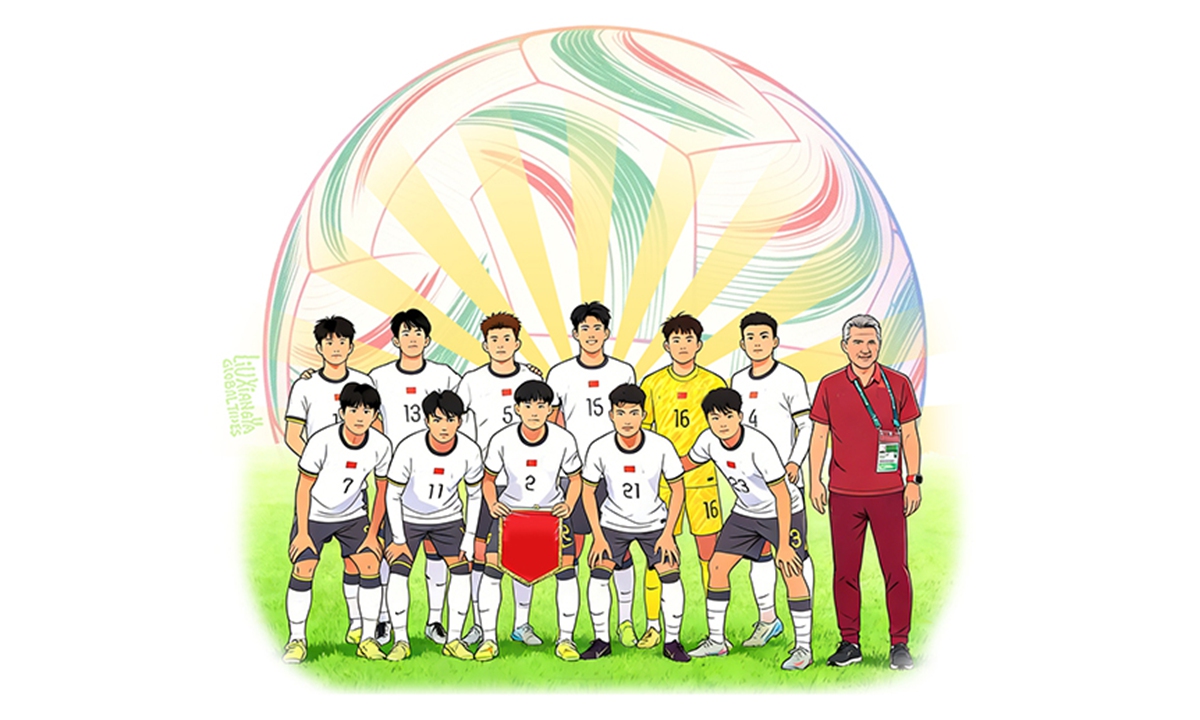
Illustration: Liu Xiangya/GT
The news of the Chinese national under-23 football team qualifying for the U23 Asian Cup final dominated discussions on Chinese social media Wednesday, after their decisive 3-0 victory over Vietnam in the semifinals.
This milestone, marking the first time a Chinese men's football team at any level has reached the final of a continental tournament in 22 years, is not just a result on the pitch, but also a potential turning point for a national football program long criticized for stagnation and underachievement.
Several Chinese U23 players, including forwards Baihelamu Abuduwaili and Wang Yudong, posted on social media: "Change of plan, fight for the final," showing the young Chinese footballers have already set their sights on winning the championship.
There are compelling reasons to believe China's U23 team is genuinely competitive on the continental stage rather than thinking they were just "lucky" to qualify.
Perhaps the most striking element of the semifinal was how China's approach contrasted with earlier matches and outsiders' expectations. For much of this tournament, the Chinese team has been perceived as tactically conservative, prioritizing defense over offense.
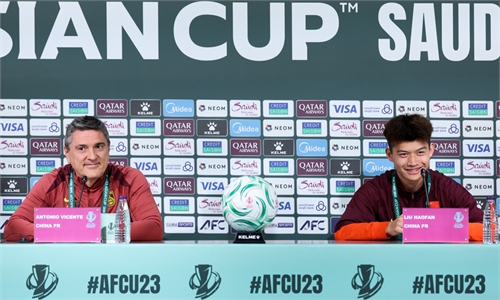
Yet in the semifinal match against a Vietnamese side that entered with confidence after successive wins and solid scoring power, the Chinese team's head coach Antonio Puche broke with convention. His massive lineup changes with six starting players and shift of the team's tactical emphasis resulted in a team actively seeking control and attacking opportunities, tactics rarely seen in their earlier games.
The outcome was emphatic. China maintained a dominant second-half performance, scoring through Peng Xiao's header shortly after halftime, followed by goals from Xiang Yuwang and substitute Wang, with the latter sealing the result deep into stoppage time. What makes this performance noteworthy is not just the scoreline but how it was achieved: The Chinese team managed control and tempo and executed set plays and built attacks that unsettled a confident Vietnamese team.
This tactical flexibility, particularly a willingness to rotate starting personnel and modify systems, challenges the media narrative of Chinese youth teams being overly cautious. During Saturday's quarterfinal match against Uzbekistan, the Chinese team had advanced only via a penalty shootout after a scoreless draw, but even then demonstrated defensive resilience and organization, keeping a clean sheet through open play for four games before the semifinal explosion.
If the assurance that Puche has instilled at this level is genuine, the semifinal result could be seen as the payoff for his longer-term work with China's youth national teams since taking over at the junior level in 2018. Trust in a coach's philosophy, even one that diverges from popular expectations, rarely produces instant results in international tournaments. Here, though, strategic consistency appears to be yielding returns.
The semifinal win and China's U23 run cannot be fully appreciated without understanding the broader context of Chinese football development over the past two to three years. Since 2023, the Chinese Football Association (CFA) has increased emphasis on youth training and competitive exposure, including arranging more international youth tournaments and friendlies. Theses events have provided vital experience for playing against diverse playing styles.
This push stems from an acknowledgment that domestic league competition alone cannot prepare young players for the pressures and tactical variety of international football. By facing multiple foreign teams in structured competitions, the Chinese prospects have been exposed to different approaches.
That exposure appears to be paying dividends. Several players in this U23 squad have not only performed well at the U23 Asian Cup; some players, like Baihelamu and Wang as well as defender Hu Hetao, have already featured for the senior national team in the World Cup Asian qualifiers, suggesting that age-graded success is translating upward, a key indicator of sustainable development.
Building such continuity, from youth levels to full international representation, is a general practice of effective football development systems globally. Countries with strong youth pipelines, such as Spain, France and England, don't just produce technically gifted players but also cultivate competitive maturity. That similar maturity was palpable in China's semifinal performance, where composure and tactical clarity under pressure helped the team dismantle their dynamic opponents.
China will face Japan in the final. Historically, Japan is one of the strongest nations at the U23 level in Asia, having won the tournament twice and a third-place finish in six appearances. However, this U23 Asian Cup does not carry Olympic qualification pressure, so Japan did not send their strongest U23 squad to the tournament. Rather, the current Japanese squad in Saudi Arabia are all under 21, an eligible squad fit for the 2028 Los Angeles Olympics. However, though the squad is young, the Japanese team has scored 12 goals in the tournament. China, meanwhile, has yet to concede a single goal.
Even if the China team enters as the underdogs, their performance trajectory suggests they are far from outclassed in this tournament. China's U23 team now stands on the path to its first continental title thanks to strategic tactical innovation, genuine international preparation and a young squad increasingly comfortable on big stages. Whatever the outcome against Japan, this campaign embodies a departure from past narratives of stagnation.
The author is a reporter with the Global Times. life@globaltimes.com.cn
RELATED ARTICLES