China to strengthen emerging, future industries in 2026-2030: official; AI, humanoid robots, 6G as future growth drivers

6G Photo: VCG
China's industrial economy moved forward steadily in 2025, achieving effective improvements in quality alongside reasonable growth in quantity, with the main annual targets successfully completed, despite profound and complex changes in both the domestic and international landscape, a Chinese government official said at a press conference held by the State Council Information Office on Wednesday.
China's industrial economy has gained strong momentum with faster technological innovation and continued improvements in the market environment and policy support, a Chinese expert said. Moreover, the country's complete industrial and supply chains, abundant application scenarios and openness to international cooperation have underpinned the growth of new quality productive forces, which are expected to continue injecting momentum not only into China's, but also to the global economy in 2026, the first year of the nation's 15th Five-Year Plan (2026-30), the expert said.
Looking ahead into 2026, several emerging technology sectors, including artificial intelligence (AI), humanoid robots and 6G, are expected to be among the key drivers of future growth, officials and experts said.
Fruitful outcomes
At Wednesday's press conference, officials from China's Ministry of Industry and Information Technology (MIIT) reviewed achievements in the development of industrial and information technology last year and outlined expectations for 2026, the opening year of the 15th Five-Year Plan.
The official noted that during the 14th Five-Year Plan (2021-2025), which concluded last year, China's industrial economy made new and significant progress, with its resilience, growth potential and vitality further strengthened, expressing confidence that the industrial economy will maintain a steady and positive momentum in 2026.
Despite profound and complex changes in both the domestic and international landscape, the main annual targets were successfully achieved, Zhang Yunming, vice minister of the MIIT, said at the press conference.
Looking back at industrial and information technology development in 2025, China's industrial economy exhibited several notable trends.
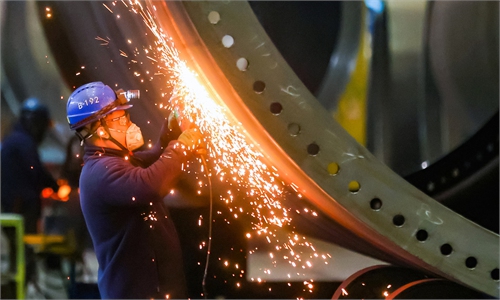
Zhang said that China has remained committed to anchoring economic growth in the real economy, rolling out a new round of growth-stabilization measures for 10 key industries and supporting major industrial provinces in playing a leading role, which has effectively driven steady growth in the industrial economy.
For example, in 2025, the value added of industrial enterprises above the designated size rose by 5.9 percent year-on-year. The share of manufacturing value added in GDP remained stable, and China's manufacturing sector is expected to retain its position as the world's largest for a 16th consecutive year, according to the MIIT.
The industrial and information technology sector contributed more than 40 percent to overall economic growth, effectively serving as a stabilizing anchor, the ministry said.
Among the data released on Wednesday, rapid growth in core technology-related sectors was particularly noteworthy.
In 2025, the value added of industries such as integrated circuits increased by 26.7 percent year-on-year, while that of electronic specialty materials rose by 23.9 percent. Meanwhile, output of industrial robots grew by 28 percent, and sales of new energy passenger vehicles reached 16.49 million units, up 28.2 percent year-on-year, according to the MIIT data.
China has stepped up efforts to deepen the integration of technological innovation and industrial innovation by advancing major initiatives to tackle key core technologies, strengthen industrial foundations and develop major technical equipment, Zhang said.
Based on the information released at the MIIT's press conference, the rapid development achieved during the 14th Five-Year Plan is evident and unsurprising, underpinned by China's increasingly complete industrial and supply chains, sustained policy support, and a continuously improving innovation ecosystem and business environment, Li Changan, a professor at the Academy of China Open Economy Studies under the University of International Business and Economics, told the Global Times on Wednesday.
Moreover, the expanding use of emerging technologies such as AI and humanoid robots has provided important momentum for the development of the industrial economy, under the country's call to promote new quality productive forces, Li said.
New momentum
Building on the achievements of last year, work in 2026 has been set with more ambitious goals.
At the press conference, Zhang said that looking at five years through the lens of one, China's industrial economy achieved new and significant progress during the 14th Five-Year Plan, with its strong resilience, vast potential and robust vitality becoming increasingly evident. "We are confident that the industrial economy will maintain a steady and positive momentum in 2026," the official noted.
Looking ahead to the 15th Five-Year Plan period, China will step up efforts in emerging industries by advancing initiatives to foster new growth drivers, promoting the large-scale demonstration and application of new technologies, products and scenarios in manufacturing, and by establishing national demonstration bases for emerging industries, Zhang said, noting that these measures will address both supply and demand, accelerating the cultivation of new pillar industries.
He highlighted several key emerging sectors, including humanoid robots, 6G and AI, which saw strong growth in 2025 and hold significant potential for future development.
In 2025, the number of domestic humanoid robot manufacturers exceeded 140, with more than 330 humanoid robot models released. The industry widely views 2025 as the first year of mass production for humanoid robots, "with the sector poised for takeoff and strong growth prospects ahead," according to Zhang.
Last year was also the year when global AI technologies accelerated innovation and iteration. The year also marked a period of strong vitality and notable breakthroughs for China's AI industry. According to estimates by relevant institutions, the number of AI enterprises in China exceeded 6,000 in 2025, with the core industry's scale expected to surpass 1.2 trillion yuan ($170 billion), according to the MIIT, indicating strong potential ahead.
In addition, China's advances in the next generation of telecommunications technology is proving promising.
At present, China accounts for 42 percent of global declarations of 5G standard-essential patents. Research and development of 6G has completed the first phase of technical trials, resulting in more than 300 key technology reserves, and the second phase of 6G technical trials has recently been launched, Xie Cun, head of the bureau for information and communications development with the MIIT, told media at Wednesday's press conference.
Going forward, the ministry will accelerate the advancement of 6G technology research and development, while proactively planning and fostering an application-oriented industrial ecosystem for 6G, Xie said.
Emerging technologies such as AI, advanced communications and humanoid robots are rapidly forming industrial clusters and increasingly integrating into the real economy, reflecting China's shift in innovation-driven development from isolated breakthroughs to a more systematic industry approach, Hu Qimu, deputy secretary-general of Forum 50 for Digital-Real Economies Integration, told the Global Times on Wednesday.
Meanwhile, stable policy expectations and sustained investment arrangements have provided long-term support for technological innovation and industrial upgrading, Hu said.
As China moves into 2026, new quality productive forces are expected to gain further momentum, with technological innovation continuing to support domestic high-quality development, experts said.
At the same time, deeper openness and international cooperation are seen as enabling China to share the benefits of technological progress and industrial upgrading with international partners, contributing to global industrial development, supply chain stability and economic growth, Hu said.
RELATED ARTICLES