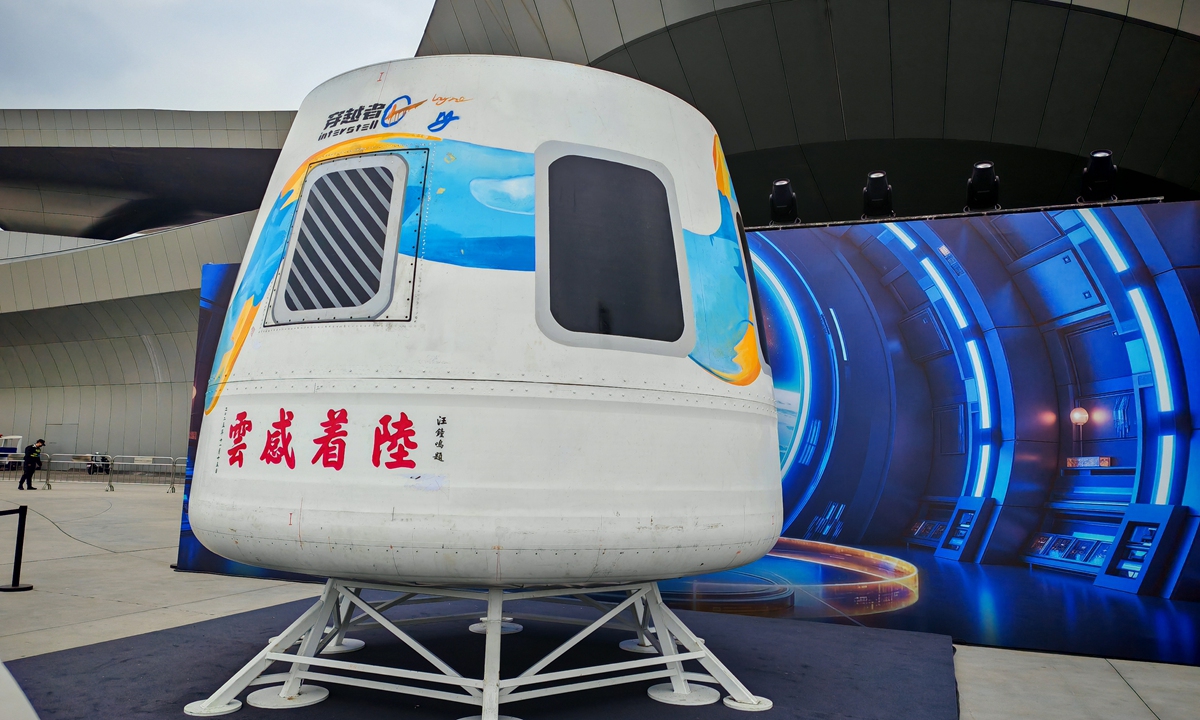
A model of Suborbital Spacecraft Crosser 1 (CYZ1), China's first full-scale commercial crewed spacecraft test capsule Photo: Liang Rui/GT
InterstellOr, the only private company in China approved to undertake a national-level commercial crewed spaceflight project, on Thursday unveiled China's first full-scale commercial crewed spacecraft test capsule, Suborbital Spacecraft Crosser 1 (hereafter CYZ1), at a launch event in Chengdu, Southwest China's Sichuan Province. The CYZ1 technical team revealed that more than three spacecraft have already been booked, involving over 20 space tourists in total. The company expects to conducts its first crewed flight in 2028.
The CYZ1 crewed spacecraft is China's first crewed spacecraft designed with full reusability as a core development goal. Building on the development experience of the Shenzhou spacecraft and the new-generation crewed spacecraft, which have achieved partial reusability of their return capsules, CYZ1 places user experience at its core and draws on international design concepts, according to the company.
The spacecraft aims to achieve a reusability rate of 99 percent by mass, through innovative configuration design and the reusable key systems, the company said.
During the event, the technical team introduced the project's current progress and outlined the key technological challenges they have overcome. The first group of space tourists also appeared at the event, sharing their plans for space travel and the training they have undergone.
According to the InterstellOr, in order to enhance space tourists' ability for suborbital flight and ensure a positive flight experience, participants are required to undergo systematic, professional training before any space mission.
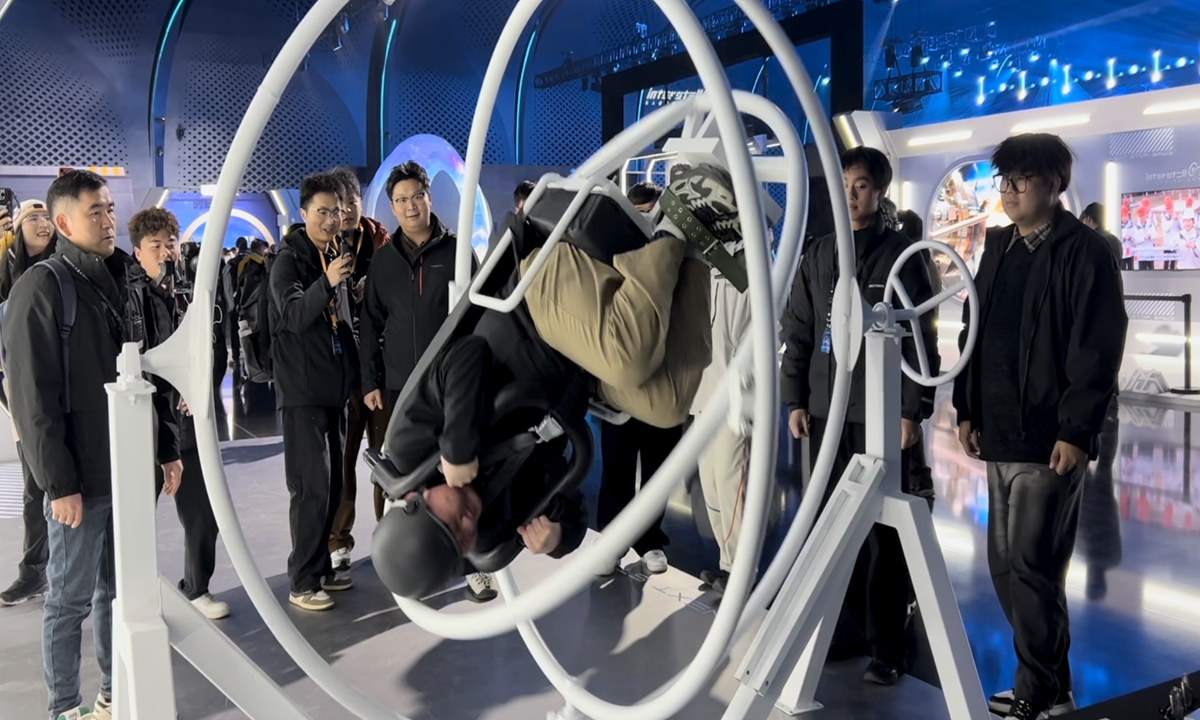
A visitor experiences the hand-cranked space ring at the conference venue in Chengdu, Southwest China's Sichuan Province, on January 22, 2026. Photo: Liang Rui/GT
Wu Jie, a Chinese spaceflight training expert, told the Global Times that for ordinary people who are interested in traveling to space, age may not be the primary factor to consider.
"The requirements for space tourists will not be as strict as those for professional astronauts, but they do need to understand basic knowledge," Wu said. Unlike aviation simulation experiences, space travel requires participants to acquire general aerospace knowledge, specialized technical knowledge, and space medicine fundamentals first. Suborbital flights, in particular, demand targeted training. For example, participants must learn about rockets, spacecraft, landing sites, launch facilities, tracking and communications systems, and become familiar with the various phases and procedures of a flight.
"We must make sufficient preparation on the ground, master the response measures at each stage, and learn how to handle emergencies quickly," he said.
At the venue, visitors lined up to experience the hand-cranked space ring, a program designed to simulate space environment adaptation training.
Considering the perspective of industrial opportunities, Lei Shiqing, founder and CEO of InterstellOr, told the Global Times that she believes the current moment represents a "historic strategic window."
"Today, China has many outstanding companies in related fields, with intense competition across both the rocket and satellite sectors. To catch up more quickly with international advanced levels, China's commercial space industry should work together, complementing one another's strengths and pursuing cooperation for mutual benefit," Lei said.
Meanwhile, launching a new industrial direction in China's commercial crewed spaceflight sector and tapping into the vast growth potential of the global space economy are expected to drive the development of a wide range of related upstream and downstream industries, including commercial launch vehicles, spacecraft manufacturing, space biomedicine, artificial intelligence, and aerospace components, according to the company.