German Chancellor echoes Canadian PM’s warning on ‘great power politics’ in Davos speech; expert says it highlights Merz's deep anxiety about Europe's future
By Published: Jan 23, 2026 01:33 PM

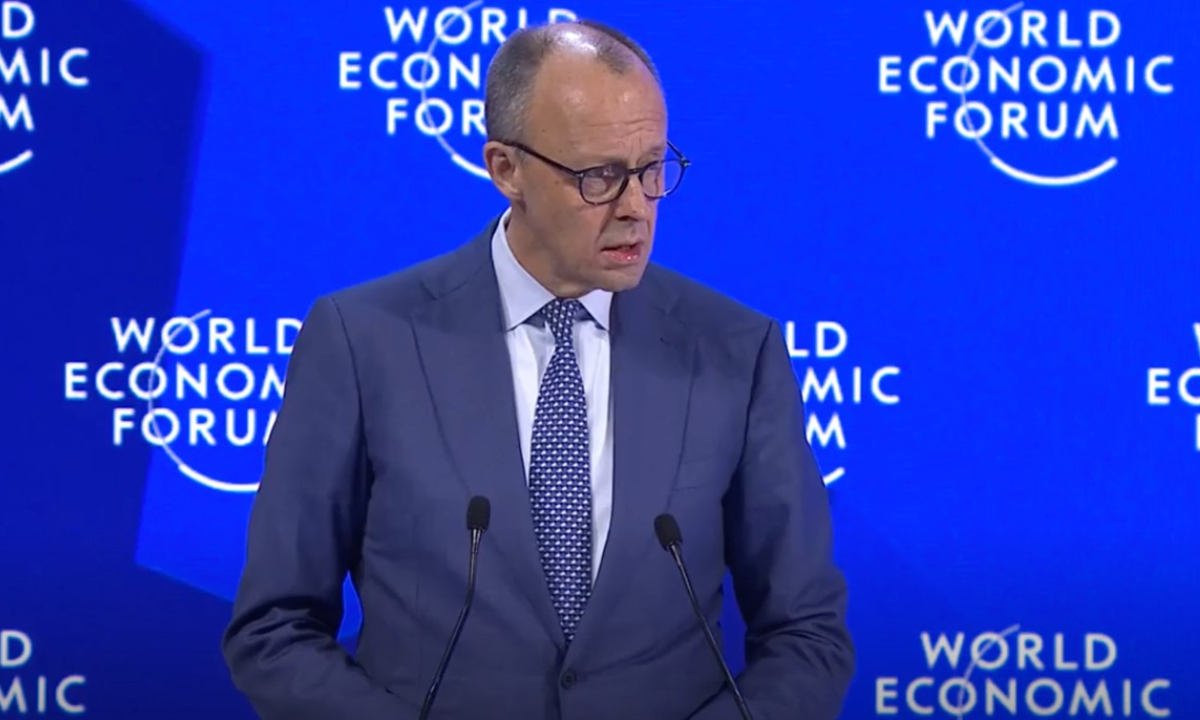
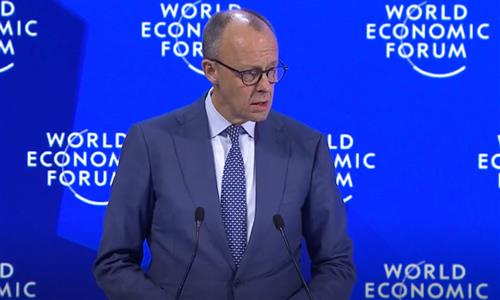
Screenshot of German Chancellor Friedrich Merz delivering speech at the World Economic Forum in Davos Photo: World Economic Forum
During a speech at the World Economic Forum in Davos on Thursday local time, German Chancellor Friedrich Merz outlined how the new German government is assessing what he described as "tectonic shifts" in the global landscape and shaping its response, saying he shared the view expressed by Canadian Prime Minister Mark Carney in Davos. Merz also noted that China, "with strategic foresight," has worked its way into the ranks of the great powers.Merz's remarks reflect, on the one hand, the EU's recognition of China's strategic development, but on the other hand frame China as part of a "problematic" great-power order challenging Europe -revealing a flawed understanding of China, said some Chinese experts. The real obstacle to EU strategic autonomy lies in Europe's lack of unity, experts said, stressing that autonomy cannot be sought from others, but must be built from within.
In his over 20-minute speech, Merz talked about shifts in the global order, the transatlantic security and NATO, plans to increase Germany's defense spending, and trade and global partnerships. He also called for reducing bureaucracy, modernizing the EU budget, enhancing Europe's capital markets, and strengthening Germany's innovation and infrastructure to attract investment, according to a transcript released by the German government website.
While describing the world has entered "a new era marked by great-power politics," Merz claimed the international order of the past decades is unraveling, including Russia's war with Ukraine, China's rise "with strategic foresight," and evolving US foreign policy.
"This new world of great powers is being built on power, on strength and when it comes to it, on force. It is not a cozy place," Merz said while mentioning about Canadian Prime Minister Mark Carney's speech in Davos on that "We must no longer rely only on the power of our values. We must also recognize the value of our power." Merz said that "I share that view. And when I look into this room, into this hall, I want to say: Most of us share it. And that is a good starting point."
Together with Carney's speech, the remarks of Merz reveal a deeper sense of anxiety in Europe and among some middle powers, including Canada, yet a lack effective means to respond to it, Jiang Feng, a senior research fellow at Shanghai International Studies University, told the Global Times on Friday.
Merz's words on China showed that he acknowledges China's rise as a major power based on its strategy and long-term development. However, he then frames China as part of a problematic great-power order that challenges Europe, placing it alongside the US. This leads to a policy logic that seeks strategic autonomy from major powers - military autonomy from the US and economic caution toward China, said Jiang.
While this framework of logic may apply to the US, applying it to China is fundamentally flawed, as it misreads China's cooperative strategic approach and its view of Europe as a partner. This also shows a persistent misjudgment in Europe's understanding of China, which must be corrected for a more rational and constructive approach with China, also for the interest of Europe, said the expert.
Germany and Europe's attention to China reflects a recognition of a shifting global order. China's economic and technological advances, and the narrowing gap with the US, have made it a central factor in great-power competition, Dong Yifan, an associate research fellow from the Beijing Language and Culture University, told the Global Times.
At the same time, this focus also reveals Europe's growing anxiety as its relative influence declines, prompting calls to reassess China from a fundamentally different perspective, said Dong.
In his speech, Merz also warned that "a world where only power counts is a dangerous place - first for small states, then for middle powers, and ultimately for great powers themselves."
He then turned to recent US "vehemently demanded greater influence on Greenland," noting that "We support talks between Denmark, Greenland and the US on the basis… it is good news that we are making steps into that right direction… This is the right way, because any threat to acquire European territory by force would be unacceptable."
European leaders have increasingly invoked "great-power politics" against the backdrop of stepped-up US pressure over Greenland. Jiang noted that this narrative reflects a self-centered logic, as Europe itself has long practiced great-power politics alongside the US, relying both on military means and on so-called value-based diplomacy, including sanctions.
Without breaking from this mindset and engaging in genuine self-reflection, he said, Europe cannot have a serious or meaningful discussion about great-power politics.
While reporting on Merz's speech in Davos, some European media outlets also highlighted the theme of "great power politics." For example, The Guardian quoted Merz as saying that the global order is changing at a "breathtaking pace" and urged leaders in Davos not to accept the new reality as inevitable. Deutsche Welle, in a report titled "Germany's Merz Says Old World Order Is 'Unraveling,'" noted that amid a shifting geopolitical landscape, Merz stressed that Europe must remain united.
Historically, Europe has at times managed to unite at moments of existential peril, and such extreme crisis situations may serve as a catalyst for greater European unity. However, given Europe's current realities, the outlook is not optimistic. The problem lies not only in the absence of a clear strategic direction, but also in the lack of political resolve to unite around shared strategic goals, said Jiang.
The expert said Europe's problem is not a lack of power but a lack of unity and the feasible strategy for that. Despite its huge economic weight, defense spending, and manpower, Europe remains unable to act as one, preventing it from turning existing capacity into real strategic strength. Continued reliance on NATO - and thus on the US - underscores this contradiction, leaving Europe without a clear or coherent vision of genuine strategic autonomy.
Dong said that against current geopolitical changes, Europe is also undergoing a deeper reassessment of its long-standing dependence on NATO and the US. While Europe cannot disengage from the US in the short term, it increasingly recognizes that its long-term security should rest on its own capabilities.
However, Europe's defense industry faces internal contradictions and practical constraints, making it impossible to break free from dependence on the US or NATO overnight. This will inevitably be a prolonged and contested process. At the same time, potential political or foreign-policy shifts in the US could also introduce new uncertainties and disrupt this trajectory, said Dong.
RELATED ARTICLES