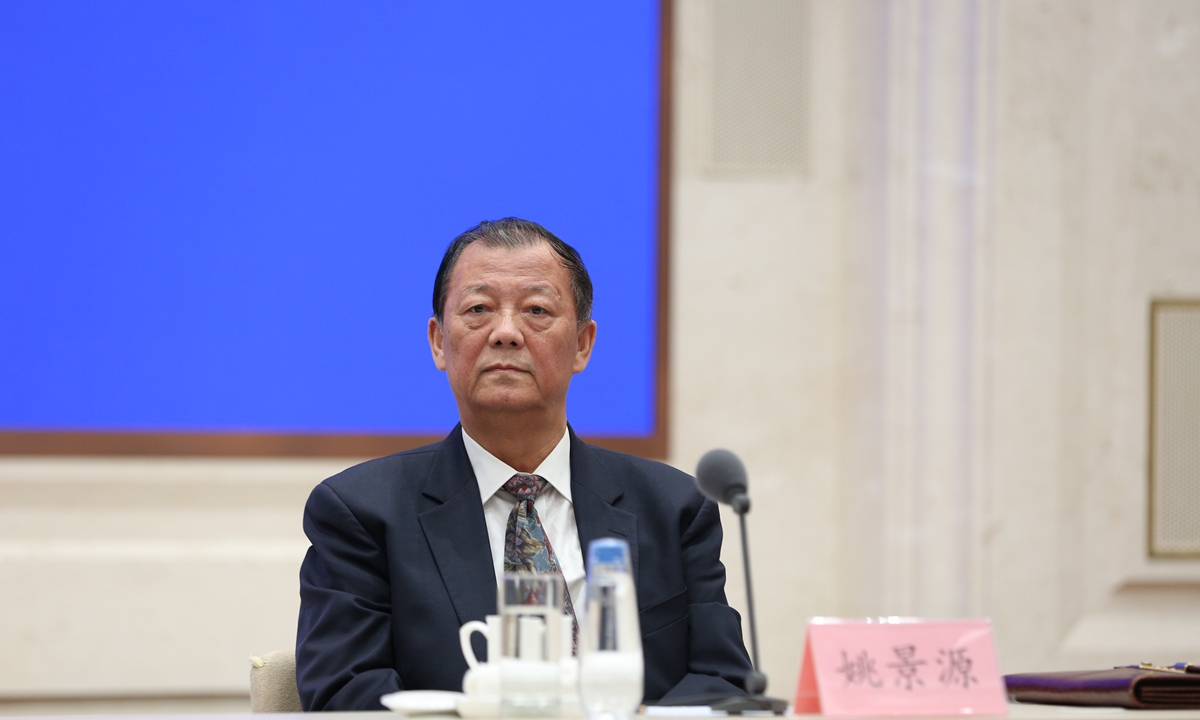
Yao Jingyuan Photo: VCG
China's GDP grew 5 percent year-on-year to 140.19 trillion yuan ($20.13 trillion) in 2025, the National Bureau of Statistics (NBS) said on Monday, meeting the annual growth target of around 5 percent and surpassing the 140-trillion-yuan threshold for the first time.
This 5-percent growth rate undoubtedly places China at the forefront among the world's major economies. According to estimates from IMF, the US economic growth in 2025 was projected to grow at approximately 2 percent, the EU around 1.4 percent, and the global average about 3.3 percent. As such, China's 5-percent GDP growth rate last year clearly stands out as one of the highest among major economies, fully demonstrating the strong resilience and leading position of the Chinese economy.
It should be noted that 2025 was an extraordinarily challenging year for China. The internal and external pressures the Chinese economy faced were unprecedented. Externally, trade protectionism continued to rise, anti-globalization sentiments gained momentum, and in particular, there are renewed attempts to contain and suppress China's development, with the US administration once again wielding the tariff stick.
Internally, China also faced prominent challenges such as insufficient effective demand, an imbalance between supply and demand, as well as some pains associated with structural transformation and upgrading. Under such complex circumstances, achieving 5-percent GDP and crossing the total GDP to a new level of 140 trillion yuan is a truly hard-won and remarkable accomplishment. It not only marks the successful conclusion of China's 14th Five-Year Plan period (2021-25) , but also lays a solid and crucial foundation for the smooth opening of the 15th Five-Year Plan period (2026-30), and also for marching toward the country's second centenary goal.

A sunrise view over Honglingjin Park and the CBD in Beijing on November 20, 2025 Photo: VCG
China's GDP growth last year further demonstrated the enormous potential and exceptional resilience of the Chinese economy. Particularly noteworthy was its resilience against internal and external challenges on multiple fronts, or the ability to withstand risks and shocks.
In addition, the technological transformation of industry and the formation of new quality productive forces accelerated significantly and deepened further throughout last year, becoming another highlight of the economy. China's high-tech sectors, such as artificial intelligence, big data, and the digital economy, have been developing very strongly.
China indeed is facing the arduous task of transforming from old to new growth drivers and upgrading traditional industries. Last year, based on a thorough review of experience, the Central Economic Work Conference and the 15th Five-Year Plan (2026-30) all made arrangements and deployments on this front.
When assessing the soundness of the macro-economy, we should focus on four major indicators. The first is the economic growth rate. China achieved 5 percent GDP growth last year, which ranks at the forefront among major countries.
The second is employment. With a population of 1.4 billion and 12.22 million university graduates last year, China in fact faces the world's largest employment pressure. China has set its urban unemployment rate target at 5.5 percent at the beginning of the year, and the actual figure came in at 5.2 percent. Although there is still a lot of work to be done in this area, it is fair to say we have achieved a hard-won accomplishment.
The third one is the consumer price. Everyone can see that China's consumer prices have remained at stable and low level. Some economists say this price level reflects insufficient demand, but I think the more important point is that when we compare our current prices in China with those in other countries. The last one is the international balance of payments. Overall, it should be said that China's international balance of payments situation has been continuously improving. So from this perspective, I think that the Chinese economy delivered a hard-won transcript last year.
Yao Jingyuan is a special researcher of the Counselor's Office of the State Council and former chief economist with the National Bureau of Statistics. bizopinion@globaltimes.com.cn
RELATED ARTICLES