What do the international divisions surrounding the ‘Board of Peace’ reveal?: Global Times editorial
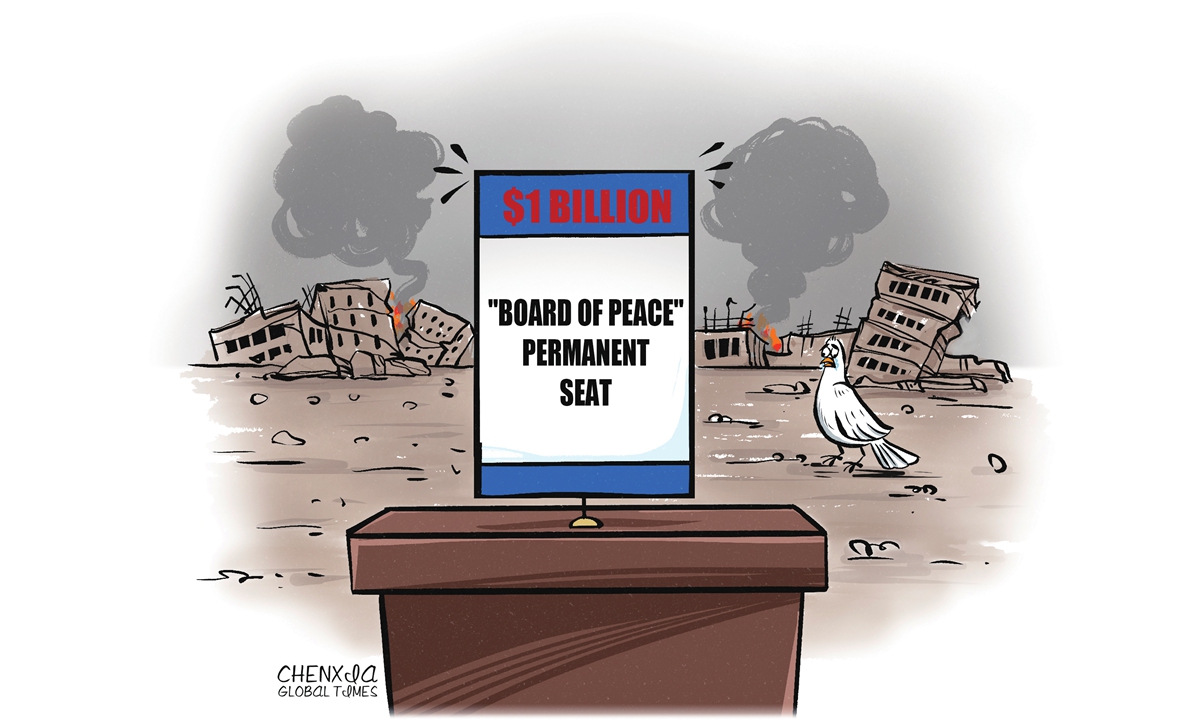
Illustration: Chen Xia/GT
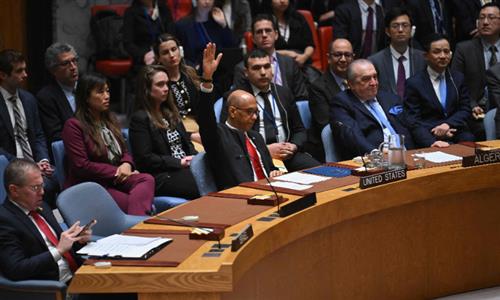
On Thursday, in Davos, Switzerland, more than a dozen countries and regions signed the charter for a "Board of Peace" for the Gaza Strip, an initiative led by the US. The draft charter indicates that it is an international organization dedicated to resolving conflicts and ensuring peace. This may imply an expansion of its functions and scope to address broader issues beyond the Gaza conflict.However, during the signing ceremony, representatives from the two key parties - Israel and Palestine - were absent. Aside from the US, the other four permanent members of the United Nations (UN) Security Council did not join, and the caution and reservations held by many countries toward the "Board of Peace" were evident.
The international community's skepticism centers primarily on one point: Since the mission definition of the "Board of Peace" appears to "overlap" with the UN's purpose of maintaining international peace and security, does it intend to replace or usurp the responsibilities of the UN?
The current international order is undergoing profound transformation and adjustment. Its direction should not deviate from the track of consolidating and safeguarding the fundamental interests of the vast majority of countries, nor should it undermine the prevailing trend of economic globalization that benefits all nations. The UN is the most authoritative international organization built by humanity after enduring the tribulations of war and making immense sacrifices to avoid conflict and ensure peace. It not only entrusts major powers with the significant responsibility of maintaining international peace, but also provides the most inclusive and acceptable multilateral mechanism for human development and addressing major global challenges. Bypassing the UN is equivalent to weakening the authority of international law, which will sow the seeds of hidden dangers for future conflicts.
Achieving lasting peace in Gaza, a land ravaged by war, is the shared and urgent aspiration of all peace-loving people around the world, including the Chinese people. Sustained warfare long ago turned the Gaza Strip into a "living hell," while over a million people continue to struggle on the brink of life and death. At this moment, we welcome all efforts to promote a political settlement of the Israel-Palestine conflict, particularly the UN's continued role in performing its indispensable coordinating function on the Middle East issue. From resolutions passed by the UN General Assembly and cease-fire calls from the Security Council to the on-the-ground assistance provided by the United Nations Relief and Works Agency for Palestine Refugees in the Near East, the UN has consistently remained the core platform for promoting peace.
In recent days, discussions surrounding the "Board of Peace" have surged in the international media. At the Chinese Ministry of Foreign Affairs' regular press conferences from Tuesday to Friday, Chinese and foreign media outlets posed questions regarding China's stance on the "Board of Peace" for four consecutive days. China said that it had received an invitation from the US and emphasized that no matter how the international landscape may evolve, China will stay firmly committed to safeguarding the international system with the UN at its core, the international order based on international law, and the basic norms governing international relations based on the purposes and principles of the UN Charter.
As UN Secretary-General António Guterres has said, "The United Nations is more than an institution. It is a living promise." The international community places high expectations on the UN system. Any mechanism that seeks to bypass or even replace the UN is unlikely to earn broad trust. The notion that contributions exceeding $1 billion could "purchase" seats on the "Board of Peace" or even "permanent membership" effectively puts international power up for sale. This runs counter to the principle of equality that international mechanisms are meant to uphold.
At present, countries including France, Norway, Sweden, Denmark and Slovenia have publicly refused to join the "Board of Peace." Germany's foreign minister has stated plainly, "We have a peace council, and that is the United Nations." The emergence of divisions even among Western countries shows that the "Board of Peace" has failed to foster unity; instead, it has intensified international fragmentation.
Facts have long demonstrated that the Gaza issue cannot be resolved behind closed doors by a handful of countries. It must be addressed within the UN framework, with extensive consultations involving Palestine, Israel, Arab countries and all other relevant stakeholders. The only viable path to lasting peace in Gaza lies in the full implementation of the "two-state solution."
China supports the establishment of an independent State of Palestine and supports Palestine and Israel in achieving a lasting cease-fire through political dialogue. Any solution that excludes Palestine, a key party involved, from the decision-making level is, in essence, an exclusive "clique" mechanism. It represents a unilateral attempt to hijack the concept of multilateralism, calling into question both its fairness and effectiveness. In practice, such a mechanism is more likely to exacerbate confrontation rather than ease it, and it does not serve the long-term peace and interests of the Middle East.
The international divisions surrounding the "Board of Peace" in fact underscore the irreplaceability of the UN. What the world urgently needs is to foster a sense of community with a shared future characterized by solidarity, cooperation and mutual support, as well as sustained efforts to build and consolidate a system and mechanisms with the UN at their core. Attempts to establish an organization parallel to international law and the UN system clearly run counter to the mainstream aspirations of the international community. Peace is not a slogan. It must be carefully nurtured and, above all, realized through sincere and concrete actions by all parties.
RELATED ARTICLES