CCCEU warns European Commission’s FSR probe into Chinese firm threatens market openness, urges fair procedures
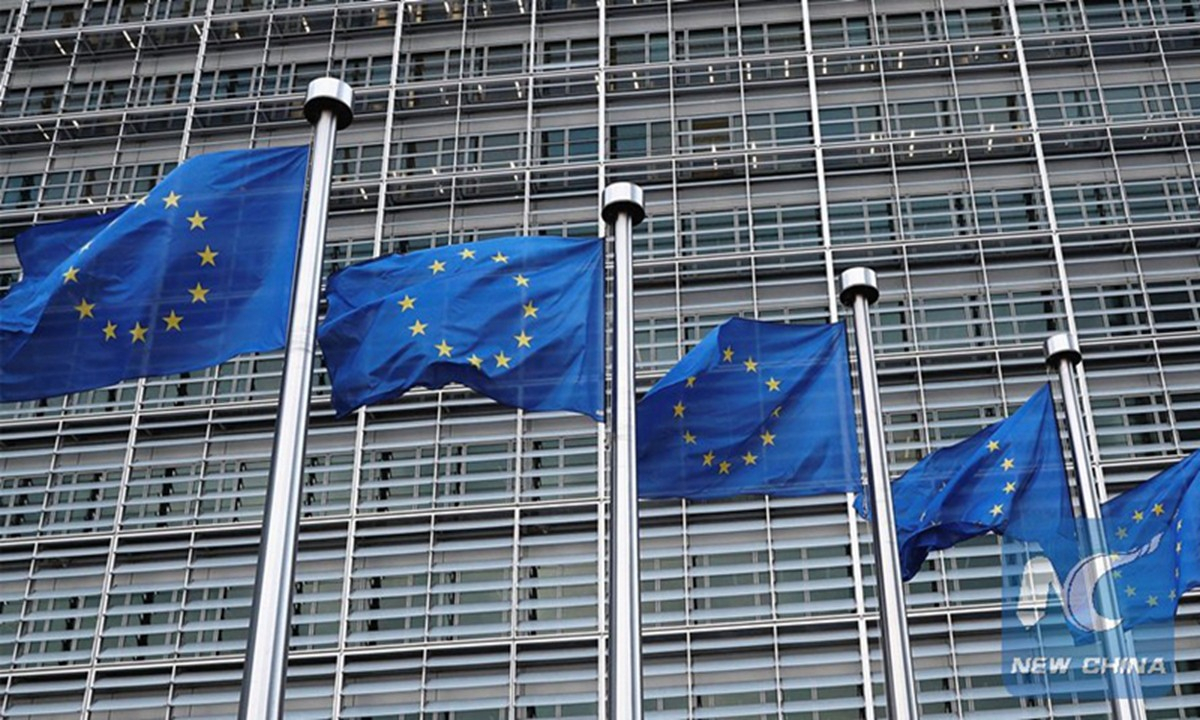
The European Union flags in front of EU headquarters in Brussels, Belgium. Photo: Xinhua
The China Chamber of Commerce to the European Union (CCCEU) expressed concern about developments in a European Commission (EC) investigation under the Foreign Subsidies Regulation (FSR) into a Chinese company, and reiterated that the process must ensure procedural fairness and adequate information disclosure so that companies can effectively exercise their right to a hearing and to defend themselves, the chamber said in a statement posted on its official WeChat account on Saturday.
The remarks followed the EC's release on Friday (EU time) of a summary notice regarding an in-depth FSR investigation into Chinese security firm Nuctech.
The CCCEU believes that against the backdrop of heightened uncertainty in the global economic and trade environment and a significant increase in compliance costs for cross-border business operations, the enforcement approach of the FSR not only affects the fairness of individual case handling, but will also directly impact the openness of the EU market, the predictability of its rules, and the credibility of its institutions, according to the statement.
The CCCEU warned that the preliminary "determinations" set out in the notice — including the proposed treatment of "categories of subsidies," inferences about "transferability of resources / cross-subsidization," the assessment of competitive impact in public procurement tenders, and the enforcement risks under the FSR — could negatively affect the openness, predictability and credibility of the EU market and its institutions.
"Requiring enterprises to prove that their competitive advantage in a tender is 'completely unrelated' to any potential subsidy would impose an unreasonable burden and could stifle competition," the chamber said, adding that it expects the European side to adhere to an empirical approach in procurement-related analyses, ensuring that enterprises have sufficient procedural rights and reasonable opportunities for explanation and defense.
The CCCEU said it will continue to closely monitor the progress of the case. "We are willing to maintain communication with European institutions and all stakeholders, promoting dialogue based on facts and rules, fostering a fair, transparent, and non-discriminatory market environment, and contributing to the long-term stability and healthy development of China-EU economic and trade relations."
The chamber has previously expressed strong dissatisfaction and firm opposition to the EC's continued, targeted, and excessive use of FSR investigative tools against Chinese enterprises. While the Commission may initiate investigations at will, it should not abuse its powers or the FSR framework to unreasonably disrupt or interfere with the normal business activities of EU-based enterprises established by foreign investors, the chamber said in a statement released in December 2025.
A Chinese expert warned that the EC's current enforcement approach under the FSR may have consequences well beyond the individual case. How the FSR is applied in practice will affect the openness of the EU market, the predictability of its rules, and the credibility of its institutions.
Jian Junbo, director of the Center for China-Europe Relations at Fudan University's Institute of International Studies, told the Global Times on Saturday that the FSR has become an important tool affecting trade with China and is widely regarded as a significant component of Europe's protectionist measures toward China.
Jian said, it remains disputed whether the FSR — a regulatory framework unilaterally adopted by the EU — fully complies with World Trade Organization (WTO) norms and principles.
In January 2025, China's Ministry of Commerce determined that the EC's FSR enforcement had created de facto barriers to investment and trade, with cumulative direct and indirect losses to Chinese enterprises amounting to about 2.1 billion euros ($2.46 billion).
Jian said that frequent unilateral investigations and restrictive measures would weaken mutual investment confidence and harm the long-term stability of bilateral economic and trade cooperation. Against a global backdrop of rising protectionism, maintaining dialogue and promoting regulatory transparency and non-discrimination between China and the EU are better ways to avoid further tensions and to achieve mutually beneficial outcomes.
RELATED ARTICLES