Two cold air waves to hit China in following week, bringing temperature plunges, ice rain and more snowfall; expert warns potential impact of freezing rain on agriculture, grids
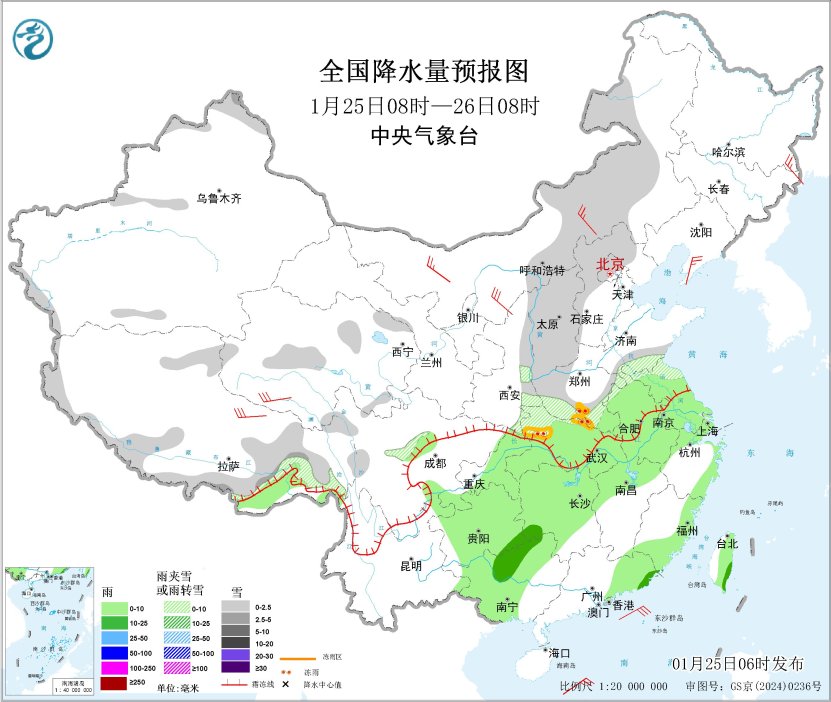
National precipitation forecast map from January 25 to 26 Photo: Courtesy of National Meteorological Center
Two successive cold air masses are set to affect China in the following week from Sunday, triggering frequent temperature fluctuations across many parts of the country especially in the central and eastern regions. Rain and snow are also expected to become more widespread, with snowfall forecast for parts of North China and the Huanghuai region on Sunday, and another potentially stronger round of snow possible in the latter half of next week, according to CCTV News.
According to the National Meteorological Center (NMC), a weak cold air mass will influence central and eastern China from Sunday to next Tuesday, bringing temperature drops of 3 to 6 C, and over 8 C in some localities.
On Sunday, the cooling is expected to quickly spread from much of Northwest China to North China, the Huanghuai region and the Jianghan region. Over the following two days, the focus of the temperature drop will shift southward. Overall, the cold air will have a greater impact on northern China, where temperatures in most areas will temporarily fall below seasonal averages, CCTV reported.
After this cold air passes, another cold air mass is forecast to arrive from next Thursday to Saturday, bringing temperature drops of 4 to 8 C across Northwest and central and eastern China, with some areas seeing declines of around 10 C. The back-to-back cold air events will lead to frequent temperature swings. In major cities, Taiyuan saw a high of 7.7 C on Friday, which is expected to fall to 0 C on Sunday, rebound on Monday, and then drop back to around freezing point again in the latter half of next week.
Meanwhile, rain and snow are expected to increase nationwide from Sunday through next week. From January 25 to 27, light snow or sleet will move from west to east across central and eastern Inner Mongolia, western and northern North China, central Northeast China, and western and southern parts of the Huanghuai region. Light rain is forecast for the Jianghan, Jianghuai, Jiangnan and South China regions, as well as Guizhou, with moderate rain in some areas, according to the NMC.
According to information released by the Xinjiang Uygur Autonomous Region Meteorological Bureau on Sunday, cloudy and snowy conditions have already reduced visibility on some roads, posing risks to traffic and facility agriculture, and calling for increased precautions in parts of northern Xinjiang.
Meanwhile, netizens in Shanxi and Henan provinces have reported snowfall on Sunday morning. The Shanxi Provincial Meteorological Observatory on Sunday issued a yellow alert for road icing in cities including Datong and Taiyuan, warning that icy roads affecting traffic may occur within the next 24 hours. Drivers are advised to pay close attention to road conditions and drive carefully, while pedestrians are urged to avoid cycling and take precautions against slipping.
Ma Jun, director of the Institute of Public and Environmental Affairs, told the Global Times on Sunday that the current round of snowfall in northern China is mainly caused by backflow snowfall, a phenomenon common at this time of year. It occurs when cold air moving southward is blocked by mountain ranges, enters the Northeast Plain, and then flows into the North China Plain.
Compared with snowfall on January 17, the snow-to-water ratio of this round of snowfall in North China and other regions is within the normal range.
From January 29 to 31, light to moderate snow or sleet is expected in eastern parts of the Qinghai-Tibet Plateau, eastern Northwest China, North China, the Huanghuai and Jianghuai regions, as well as western Hubei and northwestern Hunan. Some areas may experience heavy snow, while parts of western Hubei, eastern Guizhou and northwestern Hunan could see freezing rain. Most of Jiangnan and South China are forecast to have light to moderate rain during the same period.
"Freezing rain, in particular, requires close attention. In agriculture, young crops in some fields need to be covered with plastic sheeting to avoid direct contact with freezing rain or to maintain insulation. The branches of fruit trees should also be treated in a timely manner to prevent ice buildup. At the same time, the maintenance of power lines and electric towers needs to be strengthened to promptly deal with ice accumulation," Ma said.
RELATED ARTICLES