ARTS / CULTURE & LEISURE
Over 1,000 unearthed celadon pieces confirm a millennia-old kiln’s imperial origins
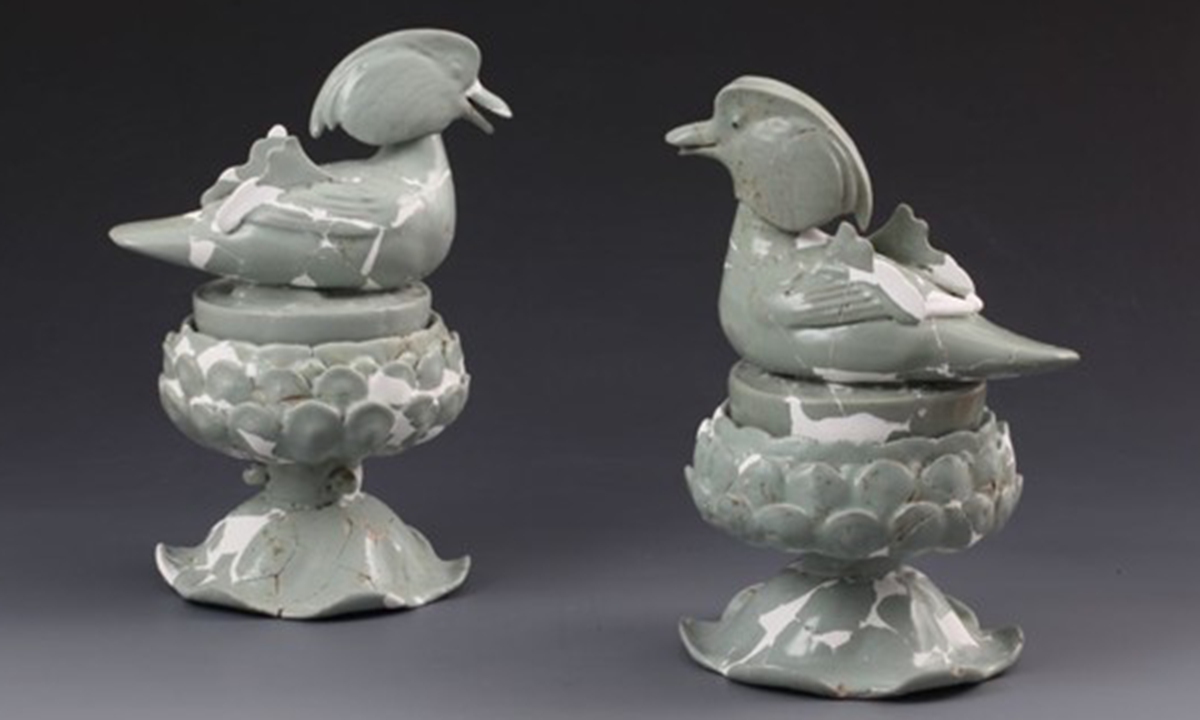
Restored porcelain statuettes unearthed from the Zhanggongxiang kiln site in Ruzhou, Central China's Henan Province Photo: Courtesy of the Zhanggongxiang archaeological team
More than 1,000 pieces of Northern Song Dynasty (960-1127) celadon pottery unearthed at the Zhanggongxiang kiln site in Ruzhou, Central China's Henan Province, confirm the site's imperial status.
Discovered in 2000 during residential redevelopment, the Zhanggongxiang kiln is located about 20 kilometers from the Qingliangsi kiln, another imperial kiln. It has been the focus of multiple excavations, culminating in a large-scale dig beginning in March 2017.
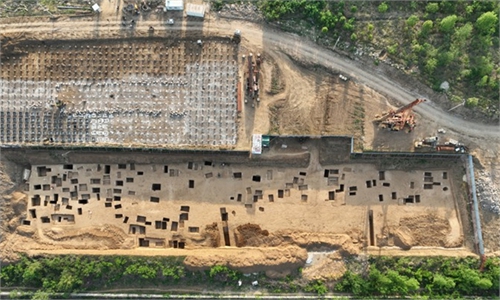
In 2017, the archaeological team from the Henan Provincial Institute of Cultural Heritage and Archaeology, in collaboration with Peking University, Fudan University, the Palace Museum, and local authorities, kicked off the fifth archaeological excavation at the site. The total excavation area exceeded 6,000 square meters.
This marked the first large-scale, proactive excavation at the site. Excavations of pits H813 and H833 have yielded numerous ceramic fragments, Zhao Wenjun, lead archaeologist at the Zhanggongxiang kiln, told the Global Times on Sunday.
After careful laboratory reconstruction, more than 1,000 items, including bowls, plates, bottles, censers and vases across 30 types, have been restored, representing 95 percent of the kiln's known forms and providing a nearly complete picture of its production system, Zhao noted.
The collection from the site was reconstructed from 94 newly excavated bags of fragments, some of which had never been discovered at the site before. Research and restoration work on the collection is still ongoing.
Analyses show that some Zhanggongxiang wares closely resemble products from the Qingliangsi imperial kiln. In addition, the two kilns share many similarities in firing techniques and kiln equipment, suggesting not only extensive technical exchange and interaction but also a likely continuity or inheritance, which indicates that the two kilns were closely related in both function and period of production.
"These findings strongly indicate the Zhanggongxiang kiln made porcelain solely for the imperial court," Zhao noted.
Some Zhanggongxiang kiln products show strong Daoist influences, while elements of Buddhism or other religions are largely absent. Coupled with the kiln's likely role in producing wares for the imperial court, this religious focus may reflect the period's official religious policies, a broader historical context, or the personal preferences of the ruling elite. This characteristic aligns with the social climate of the late Northern Song Dynasty and could provide an important clue for dating the site, said Zhao.
According to Zhao, the practice of systematically burying defective wares at the Zhanggongxiang kiln reflects a typical Song Dynasty official kiln management strategy, aimed at strictly controlling resources and techniques, ensuring products were made exclusively for the imperial court, and preventing flawed pieces or technical knowledge from reaching the general market.
Since its discovery, the Zhanggongxiang kiln has attracted widespread attention at home and abroad for its exquisite, high-quality products. Yet scholars have long debated the site's status, dating, and whether it corresponds to a "Northern Song imperial kiln" recorded in historical texts.
Worldwide, only two complete Zhanggongxiang pieces have been identified, which, for years, has limited research due to the scarcity of surviving material. "This collection is invaluable for clarifying the kiln's place within the system of ancient Chinese imperial kilns," said Zhao.
The collection of restored wares represents a major breakthrough in the archaeology of the Zhanggongxiang kiln site. For the first time, it provides a systematic, tangible view of the kiln's production system, craftsmanship and aesthetic preferences, laying a solid foundation for determining its nature and dating, and for constructing a complete chronology of Song and Jin dynasty official kilns and celadon development, Zhao told the Global Times.
RELATED ARTICLES