Finnish PM arrives in China for 4-day visit; ties set model for Europe when 'law of the jungle' on the rise, says expert
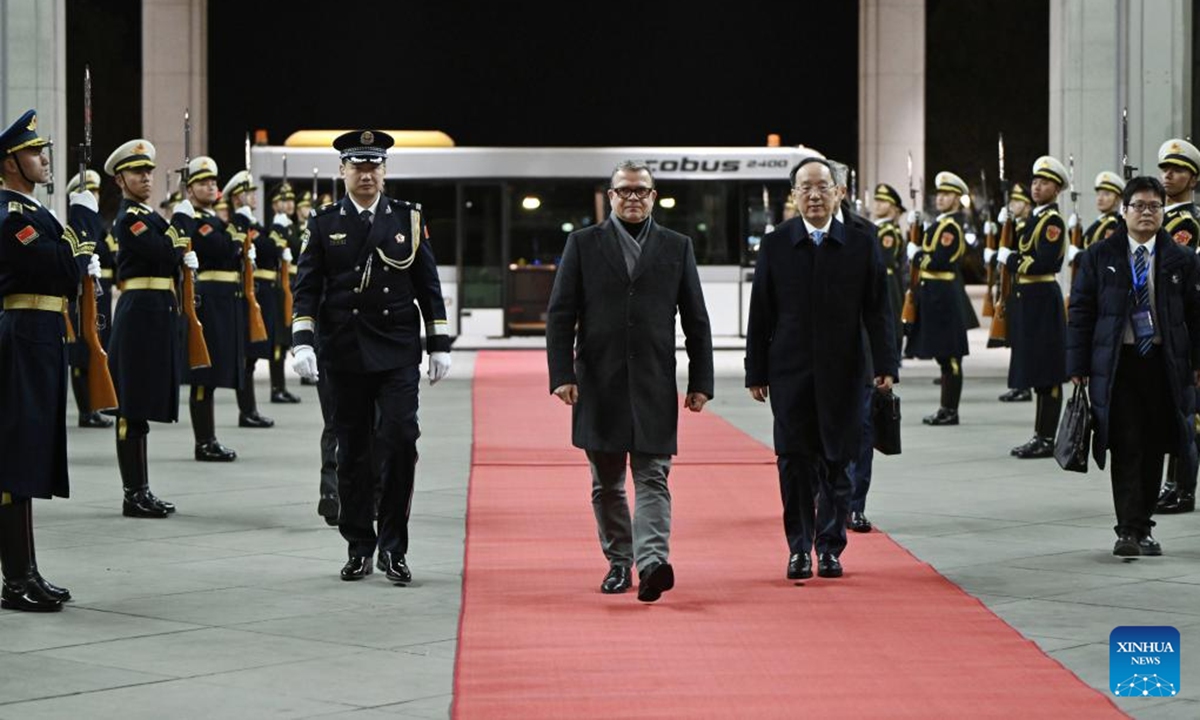
Finnish Prime Minister Petteri Orpo arrives in Beijing, capital of China, Jan. 25, 2026. Orpo arrived here on Sunday for an official visit to China through Wednesday. (Xinhua/Dai Tianfang)
Finnish Prime Minister Petteri Orpo arrived in Beijing on Sunday for a four-day official visit to China, along with executives from more than 20 Finnish companies, spanning Finland's strengths in machinery, forestry, innovation, clean energy and food. Chinese experts said China-Finland relations demonstrate a strong role model for China-Europe ties amid a changing international landscape where "the law of the jungle" is increasingly prominent.
As British Prime Minister Keir Starmer and German Chancellor Friedrich Merz are reported to also visit China in the future, the recent intensive China visits by European leaders, also reflect an adjustment in Europe's foreign policy from traditional ideology or values-based diplomacy to a pragmatic and multilateral foreign orientation. However, such an adjustment needs more than simply "showing gestures," experts noted.
According to the Chinese Foreign Ministry, Chinese President Xi Jinping will meet with the Finnish prime minister during the visit, while Chinese Premier Li Qiang and Chairman of China's National People's Congress Standing Committee Zhao Leji will hold talks and meet with Orpo, respectively, to conduct in-depth exchanges of views on bilateral relations and issues of common concern.
Finland has set multiple "firsts" in China's foreign exchange history. Politically, Finland was one of the first Western countries to recognize and establish diplomatic relations with the People's Republic of China, and was the first Western country to sign an intergovernmental trade agreement with China.
Economically, China has been Finland's largest trading partner in Asia for many consecutive years, and Finland is China's third-largest trading partner in Northern Europe. In people-to-people and cultural exchanges, Finnair launched the first direct flight from the capital of a Western country to the capital of China in 1988, and the number of Chinese students studying in Finland exceeded that of Russian students in 2015, making Chinese students the largest group of international students in Finland, Chinanews.com reported on Sunday.
Under the strategic guidance of the two heads of state in recent years, a future-oriented new-type cooperative partnership between the two countries has deepened and cooperation in various fields has steadily advanced, China Central Television (CCTV) reported on Sunday upon Orpo's arrival.
Notably, during the Finnish prime minister's visit, the two sides are expected to sign a Memorandum of Understanding on strengthening the work of the China-Finland Committee for Innovative Business Cooperation, and companies from China and Finland will also sign several business cooperation agreements, the Chinese Ministry of Commerce (MOFCOM) announced.
"All of this fully demonstrates that China and Finland have the will, confidence and ability to promote the continued positive development of bilateral economic and trade cooperation," a spokesperson from the ministry said.
Offsetting challenges
In an exclusive interview with the Global Times, Juha Tuominen, chairman of FinnCham China Beijing, said China remains an important market for Finnish businesses, giving examples of the high complementarity between businesses of the two countries in wide sectors such as green energy, innovation, healthcare and sports.
Prior to his trip, Orpo said it is important to continue dialogue with China on bilateral cooperation and topical international issues, such as challenges in the rules-based system and trade. "China is an important export market for Finnish companies and the EU's second-largest trading partner," he said, per a Finnish government release on January 22.
On Monday, Orpo and representatives from Finnish companies will meet with Chinese Minister of Commerce Wang Wentao, according to the statement.
The Committee for Innovative Business Cooperation between Finland and China will also organize a meeting, where Orpo will deliver an address.
Orpo's visit comes after Finnish President Alexander Stubb made a state visit to China in October 2024 and Speaker of Parliament Jussi Halla-aho's visit in April 2025.
Cui Hongjian, a professor at the Academy of Regional and Global Governance at Beijing Foreign Studies University, told the Global Times on Sunday that development of China-Finland relations has remained steady over the years with complementary cooperation centered on free trade and innovation.
Facing restrictive EU measures and US unilateral tariffs, Finland, as an export-oriented economy, is looking to strengthen economic and trade cooperation with China to offset losses, reducing dependence on the US as well as the risk of tariff weaponization, Cui said.
Another consideration for Orpo's visit is that given the drastic changes in its diplomatic and security environment, Finland is seeking a new balance in major-power relations through cooperation with China, Cui noted.
Re-examining China ties
One of the particularities in China-Finland ties lies in its balancing role in China-EU relations, Jiang Feng, a senior research fellow at Shanghai International Studies University, told the Global Times on Sunday, as Finland's pragmatic and balanced China policy has promoted rationality in EU's China-related policies at a time when Europe still holds a biased position on China.
The relationship provides a demonstration effect amid an international environment where "the law of the jungle" is increasingly prominent, Jiang noted.
In recent months, Western leaders have been visiting China with notable frequency. After French President Emmanuel Macron's trip late in 2025, Irish Taoiseach Micheal Martin and Canadian Prime Minister Mark Carney already made visits in January 2026. British Prime Minister Keir Starmer and German Chancellor Friedrich Merz are said to visit China in the near future, according to media reports.
Per a Reuters report, Britain is aiming to revive a "golden era" business dialogue with China when Starmer visits Beijing, according to three sources familiar with the initiative, noting that top company executives from both sides are invited to participate. The country's finance and trade chiefs are also set to join Starmer's China trip, according to Politico.
At the just-concluded World Economic Forum in Davos, Switzerland, Canadian Prime Minister Mark Carney warned the world is "in the midst of a rupture" of the international order, urging middle powers to be both principled and pragmatic, while citing newly concluded strategic partnerships with China and Qatar as part of Canada's efforts to diversify its external relations.
German Chancellor Friedrich Merz said he shared the view expressed by Carney, meanwhile outlining how the new German government is assessing what he described as "tectonic shifts" in the global landscape. Merz noted that China, "with strategic foresight," has worked its way into the ranks of the great powers.
Reuters reported on Saturday that China's low-key approach in Davos this year could not have been more different to that of the US. China is seen "controlling the dynamic through stillness", a senior global business leader told Reuters.
Cui noted that the development path of China-EU relations has been changing. "Venezuela and Greenland have dealt a significant impact on these middle-power countries, making them realize the need to seek a rebalance in major-power relations," the expert said.
While currently high-level interactions between China and Europe are frequent, the relationship is mostly in a phase of "showing gestures" with policy adjustments, said Chinese experts.
Jiang noted that Europe is in a period of profound adjustment of its foreign policy, and the intensive visits to China reflect an important part of this adjustment. The core direction is to gradually shift from traditional ideology or values-based diplomacy to a pragmatic and multilateral foreign orientation.
Nevertheless, influenced by the "de-risking" strategy, the perception of China among some European politicians has not undergone a fundamental change. Jiang said it is crucial for them to break out of the traditional discourse and truly recognize that China has always regarded Europe as a strategic partner and never as an adversary.
RELATED ARTICLES