US Treasury Secretary reiterates 100% tariff threat on Canadian goods; Chinese expert slams move as coercive and untenable
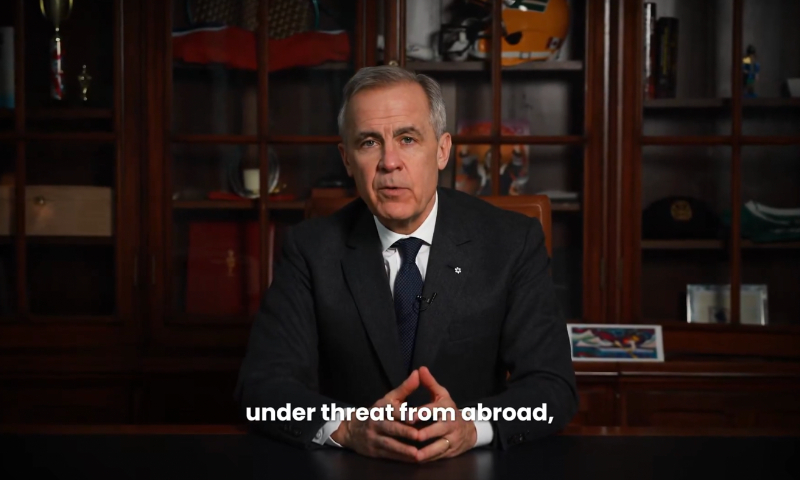
A screenshot of a video posted on the personal social media account of Canadian Prime Minister Mark Carney
US Treasury Secretary Scott Bessent on Sunday lashed out at Canada’s trade engagement with China, warning that Ottawa could face 100 percent tariffs, while claiming that Beijing could also be hit with additional penalties. A Chinese expert said the remarks once again lay bare Washington’s tendency to politicize trade and exert hegemonic pressure through coercive means.
According to The Guardian, Carney said on Sunday that his recent agreement with China merely cut tariffs on a few sectors that were recently hit with them. He noted that Canada has no intention of pursuing a free trade agreement with China, stressing, “What we have done with China is to rectify some issues that developed in the last couple of years.”
Bessent, in an interview with ABC on the same day, accused Carney of making an “about-face” by striking a deal with China to lower some trade barriers, while echoing US President Donald Trump’s latest tariff threat against Canada, Bloomberg reported.
Bessent claimed that Canada could face 100 percent tariffs if it enters into a free-trade agreement with China and allows itself to become a conduit for artificially cheap goods into the US supply chain, particularly in automobile manufacturing.
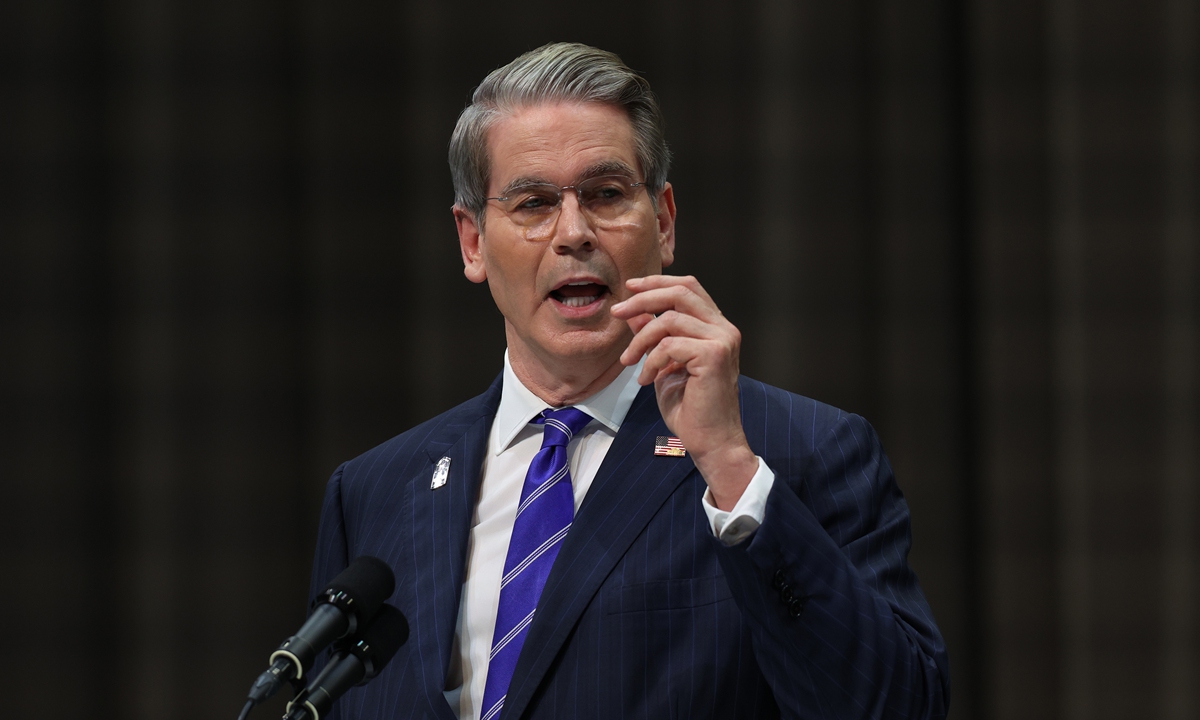
US treasury secretary Scott Bessent, Photo: VCG
Whether to launch trade negotiations or sign related agreements is entirely a sovereign decision made by countries based on their own national interests, and no third party has the right to interfere, Zhou Mi, a senior researcher at the Chinese Academy of International Trade and Economic Cooperation, told the Global Times on Monday.
Zhou said the US’ practice of politicizing trade and weaponizing tariffs once again underscores its lack of justification, noting that unilateral tariffs and pressure tactics undermine multilateral rules and the normal international economic order.
The expert added that free trade agreements require long-term preparations, complex negotiations and strict adherence to WTO rules, making them impossible to conclude during a single visit. “Washington’s anxious accusations are fundamentally untenable,” he said.
Carney paid a state visit to China from January 14 to 17, during which the two sides reached specific arrangements to address trade issues and signed an economic and trade cooperation roadmap, described as a major achievement under the framework of the China-Canada new strategic partnership.
As part of the arrangements, Canada this month agreed, according to China’s Ministry of Commerce (MOFCOM), to allow an annual quota of 49,000 Chinese electric vehicles into its market at the most-favored-nation tariff rate of 6.1 percent, exempting them from the 100-percent surtax imposed in 2024.
Bloomberg also quoted Bessent as claiming on Sunday, “We have a highly integrated market with Canada,” while claiming that goods may cross the border multiple times during production and that Washington would not allow Canada to become a channel for Chinese products entering the US.
The US official further claimed that China could face additional penalties, including tariffs, if the agreement goes beyond what has already been announced.
When the US itself is unable to provide Canada with competitive products or sufficient market access, it nevertheless resorts to tariffs as a blunt instrument to interfere with other countries’ normal economic and trade relations, Zhou said, adding that such behavior has repeatedly been proven to be a dead end that only intensifies confrontation. Differences, he stressed, should be addressed through equal dialogue.
Regarding tariff threats against China, Zhou warned that China will never accept such blatant bullying. Any attempt to push through such measures will ultimately further backfire on the US economy itself, he said.
According to CBC News, Carney said on X on Saturday that Canada would focus on “buying Canadian” and “building Canadian,” after Trump threatened to impose 100 percent tariffs on Canadian goods if the country “makes a deal with China.”
Earlier, Carney delivered a closely watched speech at the World Economic Forum in Davos, Switzerland, warning that the world is “in the midst of a rupture” of the international order. He urged middle powers to remain both principled and pragmatic, while citing newly concluded strategic partnerships with China and Qatar as part of Canada’s efforts to diversify its external relations.
MOFCOM previously described the China-Canada trade arrangements as “a positive step in the right direction,” saying they are expected to boost bilateral industrial cooperation and benefit people in both countries.
The ministry said both sides would accelerate the finalization of details, clarify timelines, develop action plans, expedite domestic procedures and promote early implementation of the outcomes.
Canada’s engagement with China reflects a highly pragmatic and rational choice, Zhou said. By strengthening cooperation with partners such as China and reducing excessive reliance on a single country, Canada is pursuing what is not only a necessity for economic development, but also a key consideration for safeguarding its economic and national security.
Against the backdrop of lingering Cold War mentalities and hegemonic thinking from certain countries, more nations are making rational choices, a trend that also contributes to a more multipolar world, the expert added.
