ARTS / CULTURE & LEISURE
Beijing art exhibition marks 90th anniversary of Long March victory
By Published: Jan 26, 2026 10:58 PM
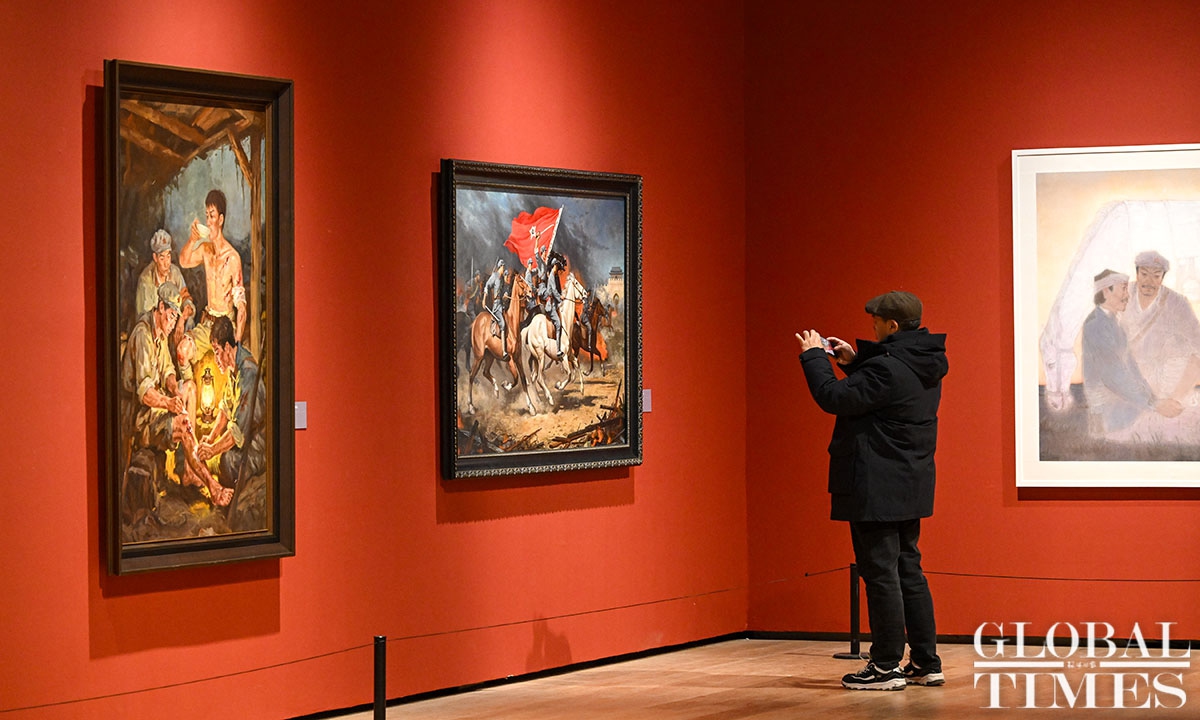
Photo: Chen Tao/GT
The Great Journey, an art exhibition commemorating the 90th anniversary of the victory of the Long March and themed on the Long March National Cultural Park, opened at the Beijing Working People's Cultural Palace on Monday.
Hosted by the Chinese National Academy of Arts (CNAA), the exhibition features nearly 120 new pieces. It constructs an artistic narrative of the "Long March spirit," aiming to carry forward the revolutionary legacy and inspire its enduring power in the modern era.
Zhou Qingfu, president of the CNAA, stated at the opening ceremony that parks dedicated to the Long March, the Grand Canal, and the Yellow River represent not just geographical spaces but vessels for the country's national spirit and cultural continuity.
"As part of the national expert committee, we have a responsibility to produce refined, high-quality works that decode and communicate the profound spiritual heritage contained within these parks," Zhou said, noting that the collaborative effort has created a significant public platform for engaging with revolutionary history and has yielded valuable experience for future thematic artistic creation.
From October 1934 to October 1936, the Red Army, the forerunner of the People's Liberation Army (PLA), carried out a daring military maneuver that laid the foundation for the eventual victory of the Communist Party of China.
The Red Army marched through raging rivers, snowy mountains and arid grasslands to break the Kuomintang regime's grip on the country and continue their fight against Japanese invaders. Some of them marched as far as 12,500 kilometers, enduring hunger, thirst and cold.
"While the Long March as a monumental historical event has concluded, it persists as a symbol of faith and a spiritual tradition," Niu Kecheng, head of the Chinese Painting Institute at the CNAA, told the Global Times.
He stated that the exhibition serves as a vessel for contemporary artists to collectively reflect on this legacy and reinterpret the Long March spirit for today, injecting profound spiritual strength into the advancement of Chinese modernization.
Discussing his own work centered on Liupan Mountain, hailed as the "Mountain of Victory," Niu explained his artistic choices to enhance the slopes, creating a strong upward visual thrust to evoke a monumental and sublime feeling.
"The piece symbolizes not just victory, but also the immense hardships and sacrifices endured, expressing the spirit's core of unwavering faith and perseverance," he said.
The exhibition is structured into three sections. According to Niu, the first section stems from CNAA artists retracing the Long March routes, seeking spiritual resonance and creative inspiration from the very lands where Red Army soldiers fought and marched. This transforms landscapes into embodiments of revolutionary will.
The second section employs traditional mediums like ink painting and seal engraving, infusing them with modern revolutionary substance to crystallize the revolutionary spirit into tangible imagery.
And the third section utilizes diverse media like installations and digital art to create a dialogue between historical memory and modern artistic expression.
Niu pointed out that for the art world, this translates into concrete tasks: constructing a distinct subjectivity for Chinese art within complex globalized and digital contexts, and developing new artistic forms rooted in history yet responsive to contemporary concerns.
Another participating artist, Liu Shaoning, focused on a classic tale of solidarity between soldiers and civilians. His ink work depicts a well-known story from the Long March, during which three female Red Army soldiers shared half of their only quilt with a local villager.
Liu told the Global Times that a recent organized trip to retrace the Long March path finally allowed him to translate this deeply moving story into art.
"The core of the work is to depict the profound bond shared by the Party, the army, and the people," he noted.
RELATED ARTICLES