Allies' trade diversification driven by uncertainty and aggressiveness of US policy, Chinese experts say after Bessent claims tariff threat on Canada over China trade
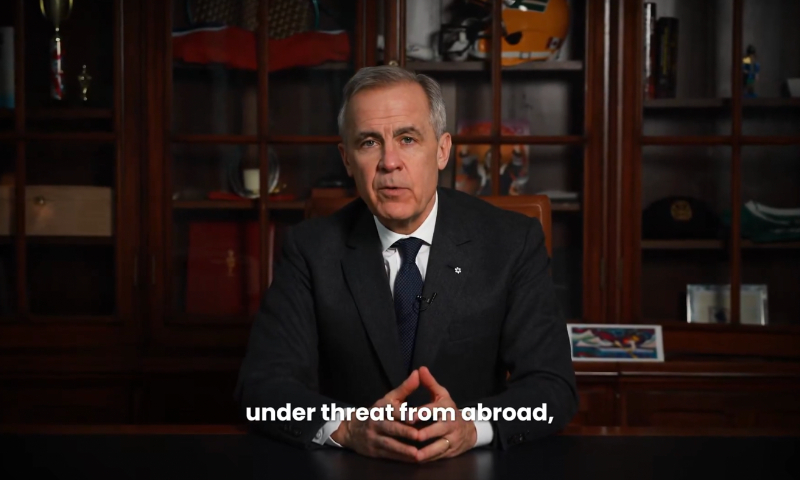
A screenshot of a video posted on the personal social media account of Canadian Prime Minister Mark Carney
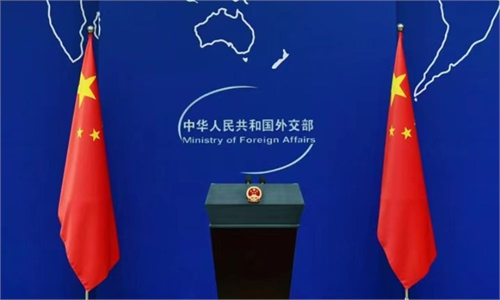
China believes countries need to approach state-to-state relations in the spirit of win-win rather than the mentality of zero-sum, and through cooperation rather than confrontation, a spokesperson for the Chinese Foreign Ministry said on Monday.
Spokesperson Guo Jiakun made the remarks at a press conference when asked to comment on claims by the US Treasury secretary Scott Bessent that Washington would impose 100 percent tariffs on Canadian imports if Canada finalizes a free-trade agreement with China, following a similar warning from President Donald Trump.
Guo said China and Canada have established a new type of strategic partnership, and made some specific arrangements on properly handling the economic and trade issues between the two countries. This reflects the spirit of equality, openness and inclusiveness, peaceful cooperation, and shared benefit. It does not target any third party, serves the common interests of the people of both countries, and is conducive to world peace, stability, development and prosperity, the spokesperson added.
Chinese experts said the US official's threats once again expose Washington's habitual practice of politicizing trade and wielding tariffs as a tool of hegemonic pressure, arguing that the growing push by US allies to diversify their trade ties is not accidental but driven by mounting uncertainty and an increasingly aggressive policy posture from Washington itself.
Repeated threat and coercion
In an interview with ABC on Sunday (local time), Bessent said Canadian Prime Minister Mark Carney did an "about-face" by striking a deal with China to lower some trade barriers, reinforcing Trump's latest tariff threat against Canada, Bloomberg reported.
The US official claimed Canada could face 100 percent tariffs if it enters into a free-trade agreement with China and "allows itself to become a place where artificially cheap goods can enter the US supply chain, particularly in automobile manufacturing."
Bessent's threat followed an earlier warning from Trump, who on Saturday claimed in a Truth Social post that Canada would face sweeping tariffs if it moved to turn itself into what he described as a "drop-off port" for Chinese goods entering the US market, according to Bloomberg.
Also on Sunday, Canadian Prime Minister Mark Carney stated that Ottawa's recent agreement with China merely cut tariffs on a few sectors that were recently hit with them. According to Associated Press, Carney noted that Canada has no intention of pursuing a free trade agreement (FTA) with China, stressing, "What we have done with China is to rectify some issues that developed in the last couple of years."
Whether to launch trade negotiations or sign related agreements is entirely a sovereign decision made by countries based on their own national interests, and no third party has the right to interfere, Zhou Mi, a senior researcher at the Chinese Academy of International Trade and Economic Cooperation, told the Global Times.
Zhou said Washington's threat to politicize trade and weaponize tariffs is unjustified, warning that unilateral pressure undermines multilateral rules and the normal international economic order.
It is not accidental that US allies are increasingly seeking trade diversification, said Liu Dan, a research fellow at the Center for Regional and Country Studies at Guangdong University of Foreign Studies. "As pressure and threats from the US intensify, these nations are coming to realize that American policy commitments are no longer a reliable, making diversification a pragmatic, interest-driven choice to reduce dependence on any single market,'' Liu added.
The latest tariff threat is not without precedent. In August 2025, the US administration raised tariffs on certain Canadian goods to 35 percent from 25 percent.
While most Canadian exports are exempt from US tariffs under the Canada-US-Mexico Agreement, some products - including steel, copper and certain automobiles and auto parts - remain subject to US duties, according to CNBC.
When the US is unable to offer Canada competitive products or sufficient market access, it instead turns to tariffs as a blunt tool to interfere in other countries' normal economic and trade relations, Zhou said, noting that such behavior has repeatedly proven to be a dead end that only fuels confrontation. Differences, he stressed, should be resolved through dialogue.
Seeking certainty
According to CBC News, Carney said on X on Saturday that Canada would focus on "buying Canadian" and "building Canadian," to combat economic threats from other countries, without naming the US, after the US president's steep tariff threat on Saturday.
Earlier last week, the Canadian prime minister delivered a closely watched speech at the World Economic Forum in Davos, Switzerland, warning that the international order is "in the midst of a rupture." He urged middle powers to remain both principled and pragmatic, citing new strategic partnerships with China and Qatar as part of Canada's efforts to diversify its external relations.
Moshe Lander, a professor of economics at Concordia University, citing the growing unpredictability of the US administration. Quoted by CBC News, Lander said he was "not surprised" by Washington's response to the prospect of Canada pivoting toward China, adding that securing alternative options would give Ottawa more leverage in pushing back during the upcoming review of the North American free trade agreement with US officials.
Carney paid a state visit to China from January 14 to 17 - the first by a Canadian prime minister in eight years - during which the two sides reached specific arrangements to address trade issues and signed an economic and trade cooperation roadmap, described as a major achievement under the framework of the China-Canada new strategic partnership.
As part of the arrangements, Canada this month agreed, according to China's Ministry of Commerce (MOFCOM), to allow an annual quota of 49,000 Chinese electric vehicles into its market at the most-favored-nation tariff rate of 6.1 percent, exempting them from the 100-percent surtax imposed in 2024.
Cooperation with China could help Canada ease pressing economic pressures, including on agricultural exports, while expanded trade in areas such as energy would support domestic growth, serving Canada's interests and contributing to the long-term stability of China-Canada relations, Liu said.
Amid hegemonic pressure from certain countries, more nations are opting for greater autonomy and diversification, a shift driven by economic realities and steadily reshaping the global order toward multipolarity, Zhou noted.
RELATED ARTICLES