Chinese FM slams Takaichi’s latest claim concerning Taiwan, urging Japan to stop manipulating on Taiwan question; Chinese expert says Japanese PM builds her risky argument on unfounded assumption
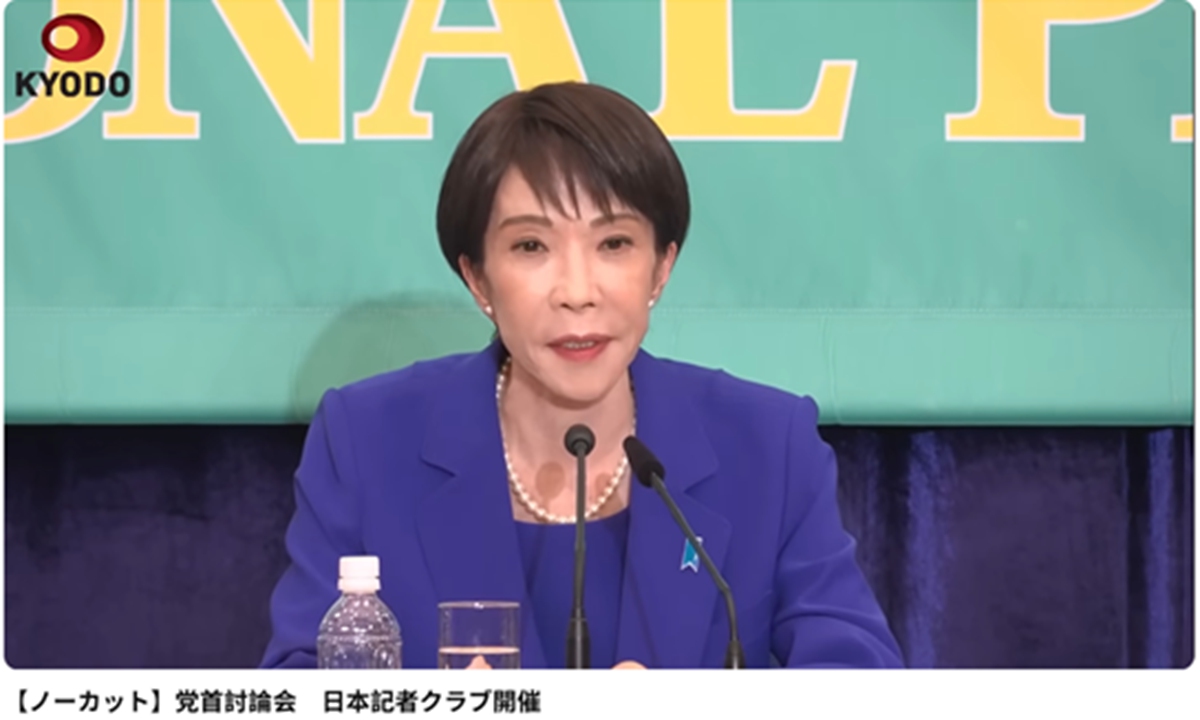
Japanese Prime Minister Sanae Takaichi attends the public debate TV Asahi program on January 26, 2026. Photo: Screenshot from Kyodo News
"We once again urge the Japanese side to abide by the spirit of the four political documents between China and Japan and Japan's own political commitments made to China, do soul-searching, correct its wrongdoings, and stop their manipulation and reckless moves on the Taiwan question," said Chinese Foreign Ministry spokesperson Guo Jiakun, in response to Japanese Prime Minister Sanae Takaichi's latest remarks relating to Taiwan question on Tuesday.
Chinese expert said that Takaichi has attempted to bind the US more tightly to Japan's strategic posture, leveraging the alliance to pressure Washington, while also misleading the public and distorting opinion - an approach that will fool no one.
According to Japan's Nikkei Asia, Takaichi, who also serves as president of the Liberal Democratic Party, asserted Japan's response to a potential "Taiwan contingency" during a TV program on Monday night.
Takaichi has sparked renewed criticism by claiming "when something serious happens, we must go to rescue Japanese and American citizens in Taiwan," again referring to evacuation operations. She claimed Japan would "respond while comprehensively assessing the situation within the scope of current laws," and that the US-Japan security alliance would "collapse" if Japan did not respond to any attack on US forces during a Taiwan Straits crisis.
Referring to a scenario in which Japan and the US conduct evacuation operations for Japanese nationals and others in Taiwan region, she claimed that "if US forces were attacked and Japan did nothing and simply fled, the Japan-US alliance would collapse at that moment."
She also claimed that "when something serious happens, we must go to rescue Japanese and American citizens in Taiwan," again referring to evacuation operations. She claimed Japan would "respond while comprehensively assessing the situation within the scope of current laws," per Nikkei Asia.
Her latest claim which also invoked the need to "rescue Japanese and US citizens" in an emergency, follows previous erroneous remarks on a "Taiwan contingency" that have already strained China-Japan relations, according to the Japan Times.
Chinese Foreign Ministry spokesperson Guo said that the remarks by the Japanese side once again reveal the Japanese right-wing forces' ambitions to provoke antagonism, make trouble, and take the opportunity to keep remilitarizing Japan and to challenge the post-war international order.
"This has severely threatened regional peace and stability and the political foundation of China-Japan relations. The international community must stay on high alert and firmly reject that," Guo said.
The core logic behind Takaichi's latest claim is an attempt to "leverage the US to counter China." By claiming that the alliance would collapse if US forces come under attack while Japan fails to respond, she attempts to further bind Japan and the US together while exerting pressure on Washington to adopt positions on the Taiwan question that more closely align with Tokyo's stance, Lü Chao, president and associate professor at the Institute of American and East Asian Studies at Liaoning University, told the Global Times on Tuesday.
Lü noted that Takaichi builds her argument on the unfounded assumption that US forces would inevitably be involved in Taiwan region, and from that premise concludes that Japan "must follow suit." This, Lü said, amounts to inventing a premise to justify a predetermined conclusion - a logical sleight of hand that confuses the public and misleads opinion.
The Wall Street Journal reported in November, 2025 that after a China-US leaders' phone call initiated by Washington, US President Trump soon called Takaichi and advised her not to provoke China on Taiwan question.
Takaichi's remarks on Monday also drew criticism from Japanese politicians and netizens. Japanese Communist Party lawmaker Taku Yamazoe wrote on X on Tuesday that Takaichi has repeatedly fueled fears of a so-called "Taiwan contingency." Yamazoe said Takaichi has once again publicly signaled the possibility of the Self-Defense Forces entering combat in a so-called "survival-threatening situation" - effectively a scenario involving the defense of US forces - while showing no awareness of, or reflection on, how her own remarks have contributed to the deterioration of relations.
Hitoshi Tanaka, former Deputy Minister for Foreign Affairs of Japan, wrote on X on Tuesday that "Canada and Europe are rushing to hedge against risks from Trump. They aim to reduce dependence on the United States and resist Trump. Strengthening self-defense capabilities, expanding options, especially restoring relations with China…Takaichi of the LDP refuses to reconsider relationship with the United States and insists on locking horns with China - this can only be called a state of mental paralysis."
A Japanese netizen "kimuratomo" commented that conflating "the rescue of nationals" with "the use of force" was "an extremely dangerous statement." The comment said such ad-hoc, off-the-cuff remarks are not merely about provoking China, but would also "undermine the US' strategy of ambiguity" and create serious problems for Washington. "The more this person appears in debates, the deeper a hole they seem to dig for themselves," the netizen wrote.
Another netizen "kemuchiman" commented that after "stirring up Japan-China relations so badly, she is once again blabbering on without a shred of reflection." The commenter said the remarks amounted to "another foolish move that hands China unnecessary cards," adding that this "diplomatically tone-deaf figure - who alone has worsened Japan-China relations and continues to fan the flames - is the real risk to the country."
Takaichi's remarks on Monday also came against the backdrop of mounting domestic criticism. In addition to backlash over her latest comments on the Taiwan question, she has faced criticism for dissolving the lower house for a snap general election.
Takaichi and the LDP have also come under scrutiny over their ties to the former Unification Church. According to a report from the Asahi Shimbun, in late 2025, reports emerged in South Korea about internal documents showing a close relationship between the LDP and the former Unification Church.
Takaichi's smile vanished instantly from her face during the Asahi TV show on Monday when she was asked about the exposed internal document showing a close relationship between the LDP and the former Unification Church, which mentioned her name for 32 times.
Lü said that Takaichi's Monday narrative also carried another dangerous intention: to stir up a narrative of "trilateral confrontation among China, the US and Japan," provoke potential strategic friction between China and the US, for Japan to "fish in troubled waters" in major-power rivalry to create political space for its own right-wing agenda.
RELATED ARTICLES