Rise of the 'weaver girl' mirrors vigor and diversity of China's consumption potential
Trend of emotional purchasing among youngsters mirrors the vitality and diversity of the country’s consumption potential
By and Zhang Yiyi Published: Jan 27, 2026 09:41 PM
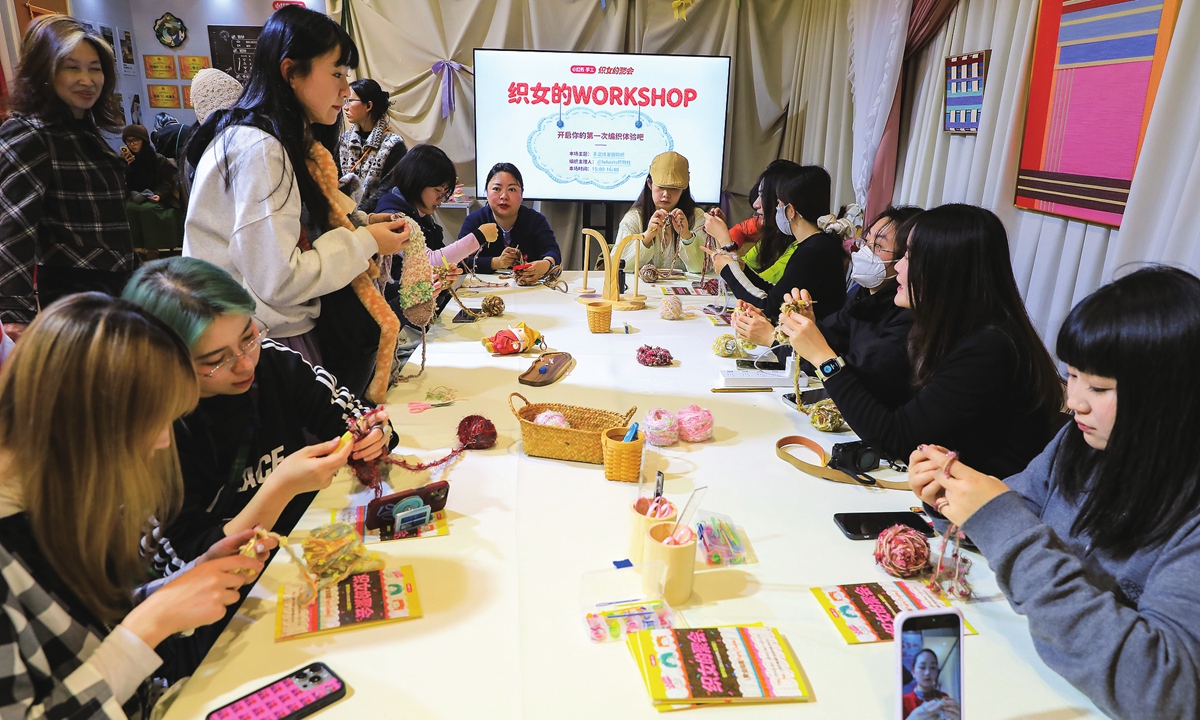
"Weaver girls" crochet handcrafts at the "Party of Weaver Girls" held in Shanghai on January 16, 2026. Photo: VCG
Li Hongyu, the 25-year-old Beijing white-collar worker, kicked off her Monday night routine with a cozy crochet session. Her nimble fingers moved swiftly between the hook and yarn, weaving one stitch at a time. In just a short while, an adorable little plushie sprang to life right in her hands.
"Watching a ball of yarn slowly transform into a little something right in my hands feels truly magical—it really delivers so much emotional value," Li told the Global Times on Monday. She said that amid mounting work pressure and widespread addiction to mobile phones and short-video platforms, crocheting has enabled her to escape from daily life.
"The moment I pick up my hook and yarn, I sink completely into it—my mind quiets down in the best way. Crocheting demands patience. You can't hurry through it, and that slowness is exactly what balances out the frantic pace short videos have wired into me. Hands busy, mind at ease—it's honestly my favorite kind of rest," Li said.
Li identifies herself as part of the growing number of "weaver girls," which traditionally refers to a celestial fairy in Chinese mythology who weaves cloth among the clouds, but now also extends to the urban young people who are interested in crocheting and regard it as a means of personal expression and emotional healing.
From the scarves made by moms, the sweaters knitted by grandmothers, to the hats crocheted by nannies, crocheting is something every Chinese is familiar with from their childhood. Now, the "nostalgic resurgence" comes as Chinese young consumers, especially Generation Z, are increasingly making purchases for emotional value, and such consumption patterns are not only emerging as a formidable new trend but also mirrors the vitality and diversity of China's consumption potential, analysts said.
The scale of China's emotional consumption market is expected to reach 2.72 trillion yuan in 2026 and is projected to exceed 4.5 trillion yuan by 2029, data from iiMedia Research showed, according to CNR News.
A growing business
"In November last year, I opened an online store selling a variety of knitted products such as crochet bags, crochet tutorials and crochet DIY kits. Now the best-selling product is the crochet DIY kit, which includes all the materials needed, along with detailed video tutorials and step-by-step illustrated guides. The product generates sales revenue of about 7,000 yuan a month," the owner of an online vendor at Xiaohongshu nicknamed Xiaozhang told the Global Times on Monday.
Unlike the perfectly uniform, machine-made goods churned out on industrial production lines, each knitted piece is one of a kind - whether the differences lie in the stitches, the color choice or the emotional expression. This "non-standardized" quality precisely taps into young people's pursuit of "uniqueness," allowing them to find objects in a homogenized consumer market that truly represent their individuality and carry personal meaning, analysts pointed out.
According to Xiaozhang, she initially began crocheting to make customized scarves and hats for her son. After some success, she began designing bags, hats and other items as gifts for friends and family.
"My online store also accepts customized knit product orders. I remember that ahead of last year's Christmas, a young mom came over and wanted to customize a pair of baby shoes for her baby to match the outfit she planned to wear for the holidays. I used a beautiful gradient-dyed yarn to crochet a pair of baby shoes, and added a rainbow-colored button as the finishing touch. The customer loved them so much and she sent me photos of her baby wearing the shoes," Xiaozhang said, noting that the handmade work is unique because "it's about conveying heartfelt intentions and warmth."
According to a report by Chinese social networking platform Xiaohongshu, crocheting has emerged as one of the breakout interests among young people on the platform in 2025, news portal jiemian.com reported. On the platform, topics related to the "weaver girls" have racked up over 900 million views to date.
Meanwhile, crocheting has also emerged as "a fresh form of social currency among the young generation," a weaver girl surnamed Li, based in Shanghai, told the Global Times on Tuesday, as she has just made a lot of "weaving friends" through participating in an offline crocheting activity - the Party of Weaver Girls. The event was held from January 16 to 18 in Shanghai, drawing nearly 20,000 enthusiastic "weaver girls" and crocheting fans.
"It's a very exciting moment when all the weaver girls gather, sit at a long table, and exchange topics such as 'your yarn color is gorgeous' and 'what stitch are you using?' It is very easy and natural to make friends as we then move from sharing tips to sharing lives," Li said.
The rising popularity of knit culture among Chinese consumers is also on vivid display across multiple e-commerce platforms.
On Taobao, crochet Spring Festival-themed knitted hair clips are among the hot-selling items in searches for knitting products. On Pinduoduo, a new crochet hook tool set has accumulated over 5 million combined orders.
Diverse consumption patterns
Chinese observers pointed out that the rise of crochet culture mirrors how the Chinese young generation is increasingly willing to pay for emotional offerings.
From crocheting, buying a blind box to decorating a room in the virtual world, the group now happily foots the bill for anything that brings joy, comfort, validation, relaxation, or a sense of ceremony—prioritizing emotional fulfillment over pure functionality in an era of stress and uncertainty.
Tian Yun, an economist based in Beijing, told the Global Times on Tuesday that the emotional consumption streak is set to tap significant potential and inject new impetus into China's domestic consumption market, while also giving rise to a range of new industries such as stress-relief toys, trendy blind boxes, virtual companions, and immersive performances.
According to the 2025 Gen Z Double 11 Consumption Behavior Report released by the Shanghai Youth Research Center, 56.3 percent of respondents chose "happy consumption and paying for emotional value or personal interests," marking an increase of 16.2 percentage points compared to 2024.
From young people's prioritization of emotional consumption, to middle-aged groups favoring stress-relief experiences, and to seniors' passion for "enjoying old age" consumption, the diverse choices across different age groups paint a vivid picture of a vigorous Chinese consumption market, analysts added.
RELATED ARTICLES