ARTS / BOOKS
Creating good books, building bridges: Publishing house editors try to foster deeper book-reader bond
Creating good books, building bridges

Editor's Note:
Reading is an important avenue for humans to acquire knowledge, expand wisdom and cultivate virtues. It enlightens us and helps us aim high and stand upright.
As China's first national regulations to promote public reading are set to take effect on February 1, the country is entering a new phase for its national reading initiative. The regulations explicitly call for improving reading services for different groups and advancing reading equity through institutional guarantees.
The Global Times is launching a special series to show how reading is changing people's lives. This installment looks inside the publishing house, where editors build bridges between authors and readers.
This is a key challenge faced by many editors in publishing houses. As China prepares to implement its first national regulations to foster public reading on February 1, delivering quality content and guiding readers into deeper engagement with books has become the direction and goal that editors like Xi constantly pursue.
"Ultimately, readers want to be moved by content. What we can do is to help them see and discover a book by capturing their attention with the cover and positioning so they're willing to open it," Xi told the Global Times.
Bao Jian, head of The Writers Publishing House, shared similar thoughts. He emphasized both readability and innovative expression. "We should not overlook the core requirement of being engaging and compelling. The primary goal of publishing is to make readers willing to read and enjoy reading," he noted.
These understandings and reflections are already woven into the daily work of China's publishers. As the era of "national reading" approaches, Xi has set herself a new goal: to move beyond the old "shelf mentality" of merely putting books on shelves and waiting for buyers. Now, it is necessary to distill and convey the core value of books through video, writing, and other forms, telling the story of the book with the right language. "It's not just about editing and processing manuscripts, but letting more people understand the value of books and reading," she said.
Finding connections
Xi Cheng works at Yilin Press. Over the years, she has concluded that one secret to engaging readers is to tap into a book's "emotional value." This is especially true for classics - works by Friedrich Nietzsche, Lu Xun, and others - whose famous quotes have become "mouthpieces" for young people. With this in mind, Yilin Press has focused on bridging the gap between classics and younger readers in their new editions, helping them find comfort and nourishment in books.
For example, when Yilin's editors worked on the collected works of Xiao Hong (1911-42), a celebrated writer from China's 1930s literary scene who reflected a progressive thinking not frequently seen at the time.
They knew there were already many versions on the market so they brought in a young designer, Tang Xu, to create an eye-catching cover and packaging, and themed the collection "Her and Her Golden Era," highlighting Xiao Hong's spirit of resistance as a female writer of her time. The collection received positive feedback after launch and attracted a cohort of readers eager to engage with the classics. Xi noted that when editing Lu Xun's works later on, they adopted a similar youthful approach, presenting the books in ways that appeal to young people, lowering the barriers to reading and increasing accessibility.
"In the age of new media, finding readers is something we are constantly exploring," Xi said. Before and during a new book's release, editors use new media platforms to conduct surveys and listen to feedback such as holding cover design votes and incorporating reader opinions into their work. When a new book launches, they collaborate with influential book bloggers, who share notes and videos tailored to their followers' interests, to promote the new titles.
At the same time, building bridges for direct communication between authors and readers is a major focus for publishers. Editors organize events such as book launches and face-to-face meetings, giving readers the chance to interact with authors in person.
Through these efforts, Xi has witnessed striking stories of reading changing lives.
"In 2023, when the writer Liu Liangcheng came to Nanjing, East China's Jiangsu Province, for a book sharing event at the Librairie Avant-garde Bookstore, there was one young woman who had traveled by bus for several hours just to attend. She had read Liu's books for years and brought her own reading notes to share with him. Liu was deeply moved. When we held another event in Shanghai in 2025, the same young woman, now working, came again. The deep connection between writer and reader is especially important for young people; it can influence their career paths and life pursuits," Xi shared.
New era for quality reading
"Enhancing the provision of high-quality reading content for all" is a key focus of the new regulations. What defines "quality" in reading? Bao told the Global Times that the core of a quality reading product lies in being "widely loved by readers and containing wholesome content." On this foundation, through precise topic selection, careful editing, and in-depth communication with authors to enhance a work's depth and artistry, the resulting refined product can be called a "reading masterpiece."
In an era of information overload, achieving in-depth reading rather than fragmented consumption is a real challenge. Bao used a vivid metaphor: "In the past, it was like several people sharing a single television; now, diverse content is everywhere. Readers have more choices, but it becomes harder for a work to be chosen."
He suggested three key steps: refined cover designs aligned with modern aesthetics, openings that strike at the core to capture readers' attention with one sentence and make the entry to reading smoother, and concise narratives free of redundant details to suit contemporary fragmented reading habits, enabling readers to patiently finish a work and absorb core values.
As the national reading era arrives, editors are constantly reflecting on what more they can do. Chen Yucheng, deputy editor-in-chief of the Beijing October Arts and Literature Publishing House, told the Global Times that returning to some traditional editorial fundamentals is especially important today. The growth of an editor requires years of refinement, close cooperation with authors, and the careful polishing of books one after another.
"Editors should read extensively across a wide range of books… and above all, never relinquish the ability to engage in lifelong learning," Chen said.
Reading is an important avenue for humans to acquire knowledge, expand wisdom and cultivate virtues. It enlightens us and helps us aim high and stand upright.
As China's first national regulations to promote public reading are set to take effect on February 1, the country is entering a new phase for its national reading initiative. The regulations explicitly call for improving reading services for different groups and advancing reading equity through institutional guarantees.
The Global Times is launching a special series to show how reading is changing people's lives. This installment looks inside the publishing house, where editors build bridges between authors and readers.
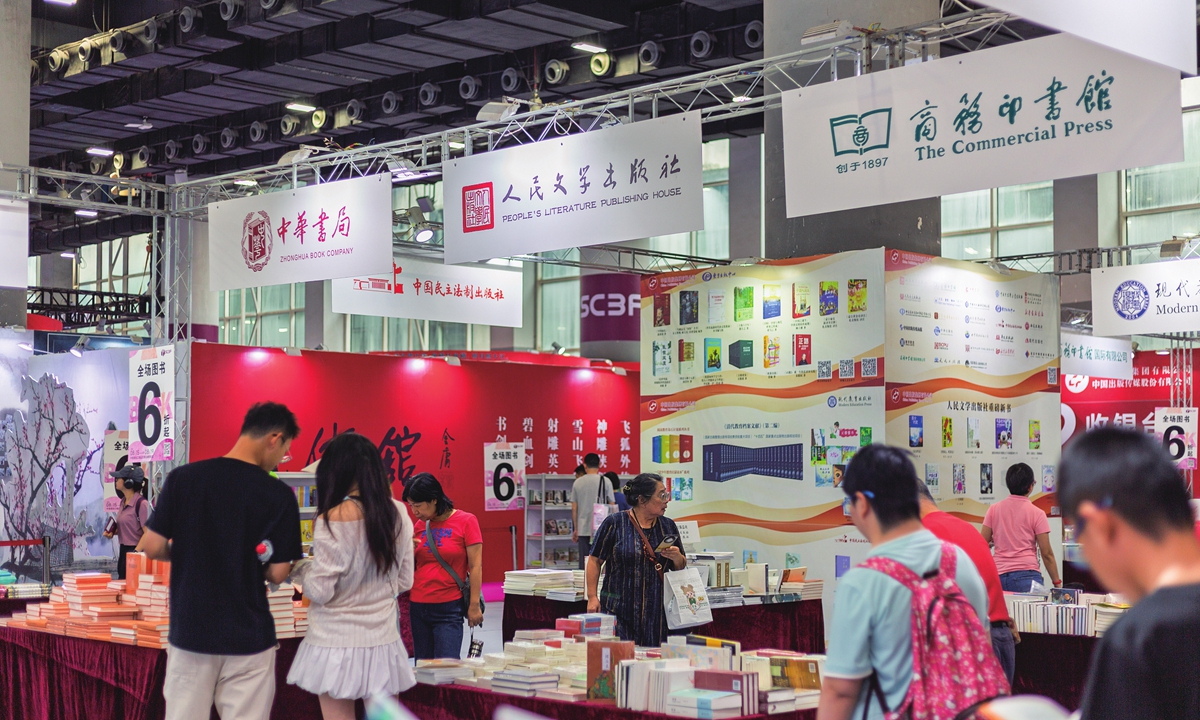
Readers explore the latest books showcased by publishing houses at the 2025 Southern China Book Fair in Guangzhou, South China's Guangdong Province on August 18, 2025. Photo: VCG
When Xi Cheng, a literature editor, receives a new manuscript, she always finds herself pondering the same question: How can these words truly connect with today's readers?This is a key challenge faced by many editors in publishing houses. As China prepares to implement its first national regulations to foster public reading on February 1, delivering quality content and guiding readers into deeper engagement with books has become the direction and goal that editors like Xi constantly pursue.
"Ultimately, readers want to be moved by content. What we can do is to help them see and discover a book by capturing their attention with the cover and positioning so they're willing to open it," Xi told the Global Times.
Bao Jian, head of The Writers Publishing House, shared similar thoughts. He emphasized both readability and innovative expression. "We should not overlook the core requirement of being engaging and compelling. The primary goal of publishing is to make readers willing to read and enjoy reading," he noted.
These understandings and reflections are already woven into the daily work of China's publishers. As the era of "national reading" approaches, Xi has set herself a new goal: to move beyond the old "shelf mentality" of merely putting books on shelves and waiting for buyers. Now, it is necessary to distill and convey the core value of books through video, writing, and other forms, telling the story of the book with the right language. "It's not just about editing and processing manuscripts, but letting more people understand the value of books and reading," she said.
Finding connections
Xi Cheng works at Yilin Press. Over the years, she has concluded that one secret to engaging readers is to tap into a book's "emotional value." This is especially true for classics - works by Friedrich Nietzsche, Lu Xun, and others - whose famous quotes have become "mouthpieces" for young people. With this in mind, Yilin Press has focused on bridging the gap between classics and younger readers in their new editions, helping them find comfort and nourishment in books.
For example, when Yilin's editors worked on the collected works of Xiao Hong (1911-42), a celebrated writer from China's 1930s literary scene who reflected a progressive thinking not frequently seen at the time.
They knew there were already many versions on the market so they brought in a young designer, Tang Xu, to create an eye-catching cover and packaging, and themed the collection "Her and Her Golden Era," highlighting Xiao Hong's spirit of resistance as a female writer of her time. The collection received positive feedback after launch and attracted a cohort of readers eager to engage with the classics. Xi noted that when editing Lu Xun's works later on, they adopted a similar youthful approach, presenting the books in ways that appeal to young people, lowering the barriers to reading and increasing accessibility.
"In the age of new media, finding readers is something we are constantly exploring," Xi said. Before and during a new book's release, editors use new media platforms to conduct surveys and listen to feedback such as holding cover design votes and incorporating reader opinions into their work. When a new book launches, they collaborate with influential book bloggers, who share notes and videos tailored to their followers' interests, to promote the new titles.
At the same time, building bridges for direct communication between authors and readers is a major focus for publishers. Editors organize events such as book launches and face-to-face meetings, giving readers the chance to interact with authors in person.
Through these efforts, Xi has witnessed striking stories of reading changing lives.
"In 2023, when the writer Liu Liangcheng came to Nanjing, East China's Jiangsu Province, for a book sharing event at the Librairie Avant-garde Bookstore, there was one young woman who had traveled by bus for several hours just to attend. She had read Liu's books for years and brought her own reading notes to share with him. Liu was deeply moved. When we held another event in Shanghai in 2025, the same young woman, now working, came again. The deep connection between writer and reader is especially important for young people; it can influence their career paths and life pursuits," Xi shared.
New era for quality reading
"Enhancing the provision of high-quality reading content for all" is a key focus of the new regulations. What defines "quality" in reading? Bao told the Global Times that the core of a quality reading product lies in being "widely loved by readers and containing wholesome content." On this foundation, through precise topic selection, careful editing, and in-depth communication with authors to enhance a work's depth and artistry, the resulting refined product can be called a "reading masterpiece."
In an era of information overload, achieving in-depth reading rather than fragmented consumption is a real challenge. Bao used a vivid metaphor: "In the past, it was like several people sharing a single television; now, diverse content is everywhere. Readers have more choices, but it becomes harder for a work to be chosen."
He suggested three key steps: refined cover designs aligned with modern aesthetics, openings that strike at the core to capture readers' attention with one sentence and make the entry to reading smoother, and concise narratives free of redundant details to suit contemporary fragmented reading habits, enabling readers to patiently finish a work and absorb core values.
As the national reading era arrives, editors are constantly reflecting on what more they can do. Chen Yucheng, deputy editor-in-chief of the Beijing October Arts and Literature Publishing House, told the Global Times that returning to some traditional editorial fundamentals is especially important today. The growth of an editor requires years of refinement, close cooperation with authors, and the careful polishing of books one after another.
"Editors should read extensively across a wide range of books… and above all, never relinquish the ability to engage in lifelong learning," Chen said.
RELATED ARTICLES