IN-DEPTH / IN-DEPTH
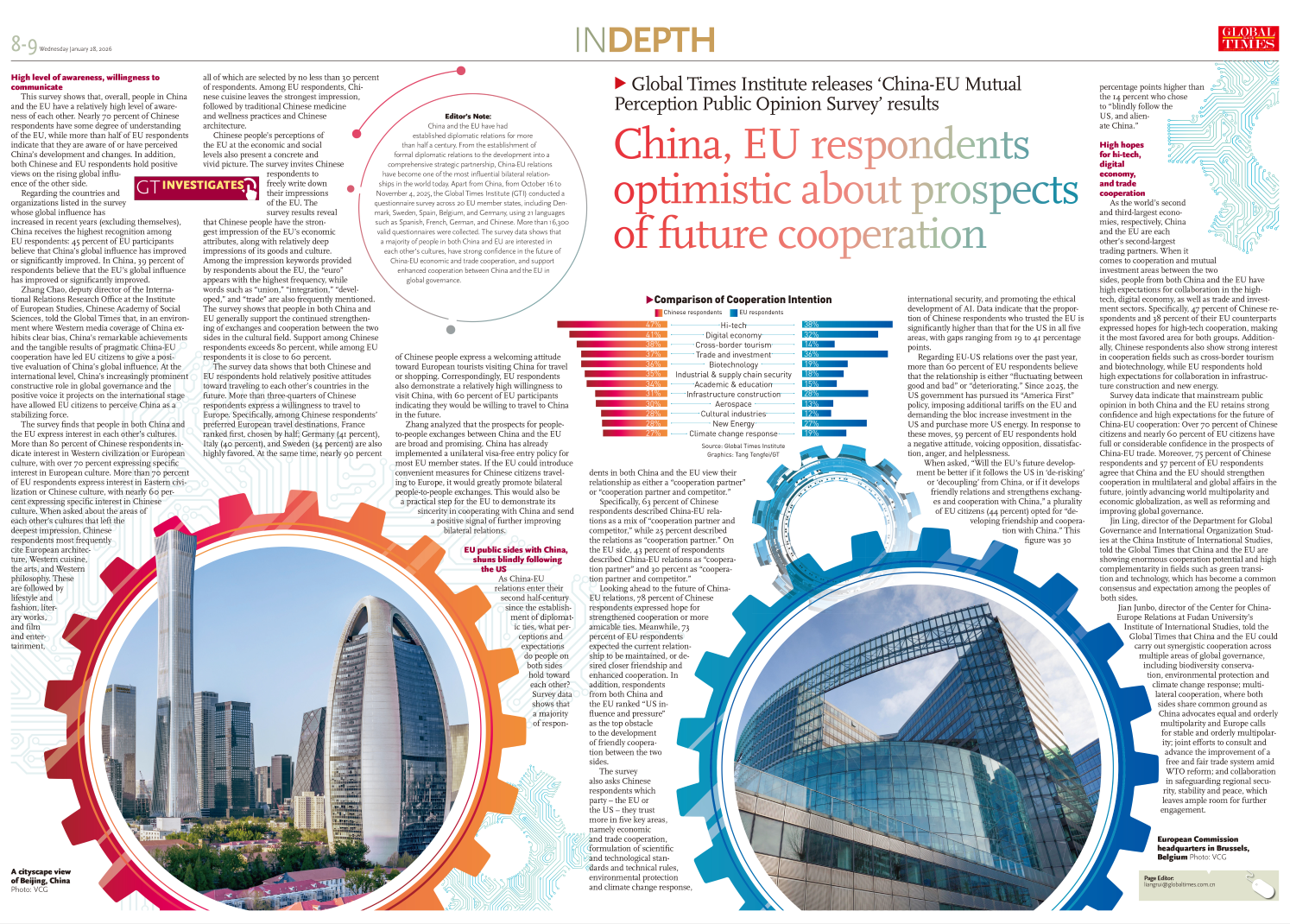
China, EU respondents optimistic about prospects of future cooperation: GT survey

European Commission headquarters in Brussels, Belgium Photo: VCG
Editor's Note:
China and the EU have had established diplomatic relations for more than half a century. From the establishment of formal diplomatic relations to the development into a comprehensive strategic partnership, China-EU relations have become one of the most influential bilateral relationships in the world today. Apart from China, from October 16 to November 4, 2025, the Global Times Institute (GTI) conducted a questionnaire survey across 20 EU member states, including Denmark, Sweden, Spain, Belgium, and Germany, using 21 languages such as Spanish, French, German, and Chinese. More than 16,300 valid questionnaires were collected. The survey data shows that a majority of people in both China and EU are interested in each other's cultures, have strong confidence in the future of China-EU economic and trade cooperation, and support enhanced cooperation between China and the EU in global governance.
High level of awareness, willingness to communicate
This survey shows that, overall, people in China and the EU have a relatively high level of awareness of each other. Nearly 70 percent of Chinese respondents have some degree of understanding of the EU, while more than half of EU respondents indicate that they are aware of or have perceived China's development and changes. In addition, both Chinese and EU respondents hold positive views on the rising global influence of the other side.
Regarding the countries and organizations listed in the survey whose global influence has increased in recent years (excluding themselves), China receives the highest recognition among EU respondents: 45 percent of EU participants believe that China's global influence has improved or significantly improved. In China, 39 percent of respondents believe that the EU's global influence has improved or significantly improved.
Zhang Chao, deputy director of the International Relations Research Office at the Institute of European Studies, Chinese Academy of Social Sciences, told the Global Times that, in an environment where Western media coverage of China exhibits clear bias, China's remarkable achievements and the tangible results of pragmatic China-EU cooperation have led EU citizens to give a positive evaluation of China's global influence. At the international level, China's increasingly prominent constructive role in global governance and the positive voice it projects on the international stage have allowed EU citizens to perceive China as a stabilizing force.
The survey finds that people in both China and the EU express interest in each other's cultures. More than 80 percent of Chinese respondents indicate interest in Western civilization or European culture, with over 70 percent expressing specific interest in European culture. More than 70 percent of EU respondents express interest in Eastern civilization or Chinese culture, with nearly 60 percent expressing specific interest in Chinese culture. When asked about the areas of each other's cultures that left the deepest impression, Chinese respondents most frequently cite European architecture, Western cuisine, the arts, and Western philosophy. These are followed by lifestyle and fashion, literary works, and film and entertainment, all of which are selected by no less than 30 percent of respondents. Among EU respondents, Chinese cuisine leaves the strongest impression, followed by traditional Chinese medicine and wellness practices and Chinese architecture.
Chinese people's perceptions of the EU at the economic and social levels also present a concrete and vivid picture. The survey invites Chinese respondents to freely write down their impressions of the EU. The survey results reveal that Chinese people have the strongest impression of the EU's economic attributes, along with relatively deep impressions of its goods and culture. Among the impression keywords provided by respondents about the EU, the "euro" appears with the highest frequency, while words such as "union," "integration," "developed," and "trade" are also frequently mentioned. The survey shows that people in both China and EU generally support the continued strengthening of exchanges and cooperation between the two sides in the cultural field. Support among Chinese respondents exceeds 80 percent, while among EU respondents it is close to 60 percent.
The survey data shows that both Chinese and EU respondents hold relatively positive attitudes toward traveling to each other's countries in the future. More than three-quarters of Chinese respondents express a willingness to travel to Europe. Specifically, among Chinese respondents' preferred European travel destinations, France ranked first, chosen by half; Germany (41 percent), Italy (40 percent), and Sweden (34 percent) are also highly favored. At the same time, nearly 90 percent of Chinese people express a welcoming attitude toward European tourists visiting China for travel or shopping. Correspondingly, EU respondents also demonstrate a relatively high willingness to visit China, with 60 percent of EU participants indicating they would be willing to travel to China in the future.
Zhang analyzed that the prospects for people-to-people exchanges between China and the EU are broad and promising. China has already implemented a unilateral visa-free entry policy for most EU member states. If the EU could introduce convenient measures for Chinese citizens traveling to Europe, it would greatly promote bilateral people-to-people exchanges. This would also be a practical step for the EU to demonstrate its sincerity in cooperating with China and send a positive signal of further improving bilateral relations.

A cityscape view of Beijing, China Photo: VCG
EU public side with China, shuns US blind following
As China-EU relations enter their second half-century since the establishment of diplomatic ties, what perceptions and expectations do people on both sides hold toward each other? Survey data shows that a majority of respondents in both China and the EU view their relationship as either a "cooperation partner" or "cooperation partner and competitor."
Specifically, 63 percent of Chinese respondents described China-EU relations as a mix of "cooperation partner and competitor," while 25 percent described the relations as "cooperation partner." On the EU side, 43 percent of respondents described China-EU relations as "cooperation partner" and 30 percent as "cooperation partner and competitor."
Looking ahead to the future of China-EU relations, 78 percent of Chinese respondents expressed hope for strengthened cooperation or more amicable ties. Meanwhile, 73 percent of EU respondents expected the current relationship to be maintained, or desired closer friendship and enhanced cooperation. In addition, respondents from both China and the EU ranked "US influence and pressure" as the top obstacle to the development of friendly cooperation between the two sides.
The survey also asks Chinese respondents which party - the EU or the US - they trust more in five key areas, namely economic and trade cooperation, formulation of scientific and technological standards and technical rules, environmental protection and climate change response, international security, and promoting the ethical development of AI. Data indicate that the proportion of Chinese respondents who trusted the EU is significantly higher than that for the US in all five areas, with gaps ranging from 19 to 41 percentage points.
Regarding EU-US relations over the past year, more than 60 percent of EU respondents believe that the relationship is either "fluctuating between good and bad" or "deteriorating." Since 2025, the US government has pursued its "America First" policy, imposing additional tariffs on the EU and demanding the bloc increase investment in the US and purchase more US energy. In response to these moves, 59 percent of EU respondents hold a negative attitude, voicing opposition, dissatisfaction, anger, and helplessness.
When asked, "Will the EU's future development be better if it follows the US in 'de-risking' or 'decoupling' from China, or if it develops friendly relations and strengthens exchanges and cooperation with China," a plurality of EU citizens (44 percent) opted for "developing friendship and cooperation with China." This figure was 30 percentage points higher than the 14 percent who chose to "blindly follow the US, and alienate China."
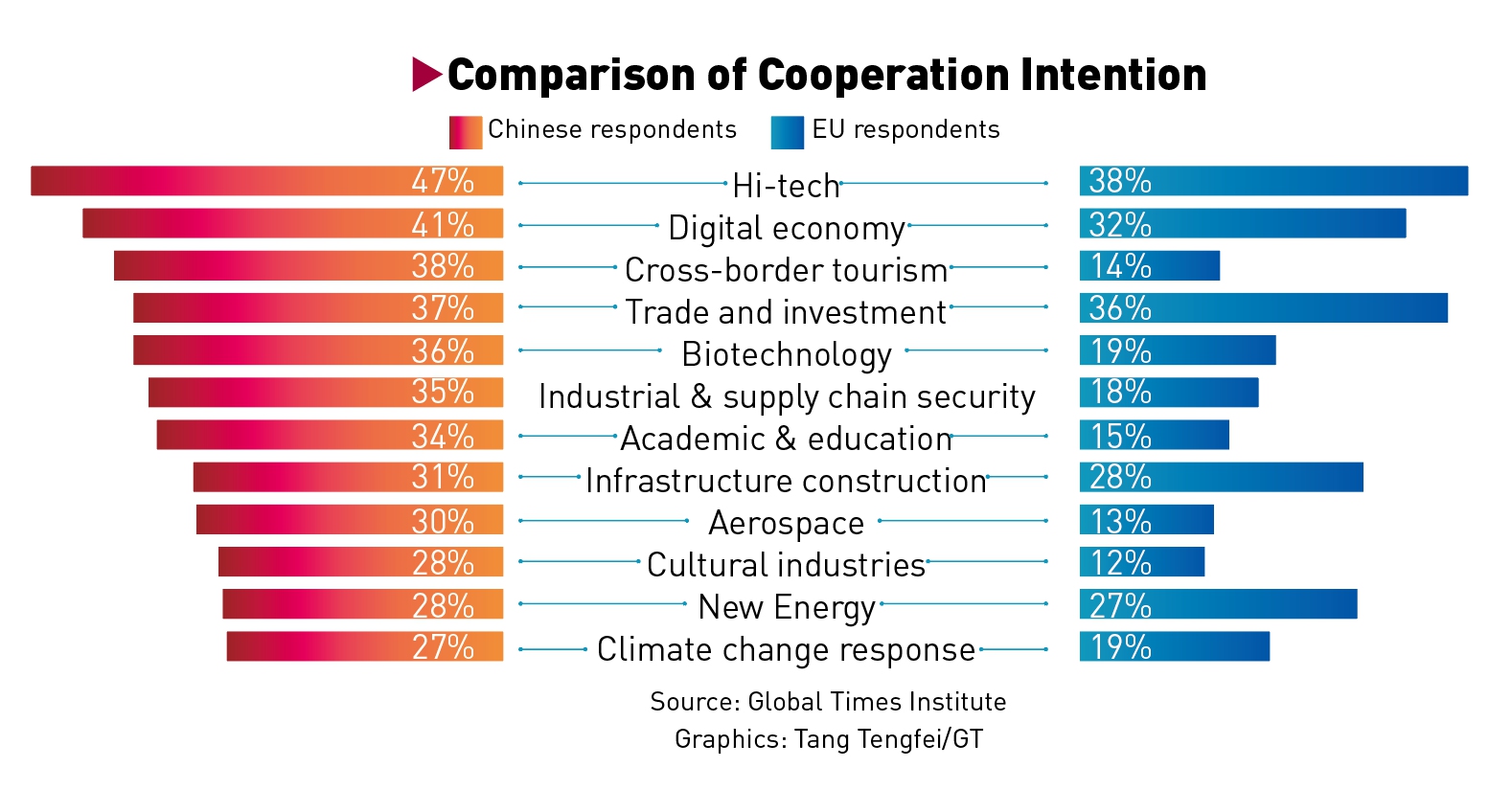
Comparison of Cooperation Intention
High hopes for hi-tech, digital economy, and trade cooperation
As the world's second and third-largest economies, respectively, China and the EU are each other's second-largest trading partners. When it comes to cooperation and mutual investment areas between the two sides, people from both China and the EU have high expectations for collaboration in the high-tech, digital economy, as well as trade and investment sectors. Specifically, 47 percent of Chinese respondents and 38 percent of their EU counterparts expressed hopes for high-tech cooperation, making it the most favored area for both groups. Additionally, Chinese respondents also show strong interest in cooperation fields such as cross-border tourism and biotechnology, while EU respondents hold high expectations for collaboration in infrastructure construction and new energy.
Survey data indicate that mainstream public opinion in both China and the EU retains strong confidence and high expectations for the future of China-EU cooperation: Over 70 percent of Chinese citizens and nearly 60 percent of EU citizens have full or considerable confidence in the prospects of China-EU trade. Moreover, 75 percent of Chinese respondents and 57 percent of EU respondents agree that China and the EU should strengthen cooperation in multilateral and global affairs in the future, jointly advancing world multipolarity and economic globalization, as well as reforming and improving global governance.
Jin Ling, director of the Department for Global Governance and International Organization Studies at the China Institute of International Studies, told the Global Times that China and the EU are showing enormous cooperation potential and high complementarity in fields such as green transition and technology, which has become a common consensus and expectation among the peoples of both sides.
Jian Junbo, director of the Center for China-Europe Relations at Fudan University's Institute of International Studies, told the Global Times that China and the EU could carry out synergistic cooperation across multiple areas of global governance, including biodiversity conservation, environmental protection and climate change response; multilateral cooperation, where both sides share common ground as China advocates equal and orderly multipolarity and Europe calls for stable and orderly multipolarity; joint efforts to consult and advance the improvement of a free and fair trade system amid WTO reform; and collaboration in safeguarding regional security, stability and peace, which leaves ample room for further engagement.
China, EU respondents optimistic about prospects of future cooperation
RELATED ARTICLES