New discovery in C.China’s Henan reveals major technological shifts over hafted stone tools in East Asia’s Paleolithic
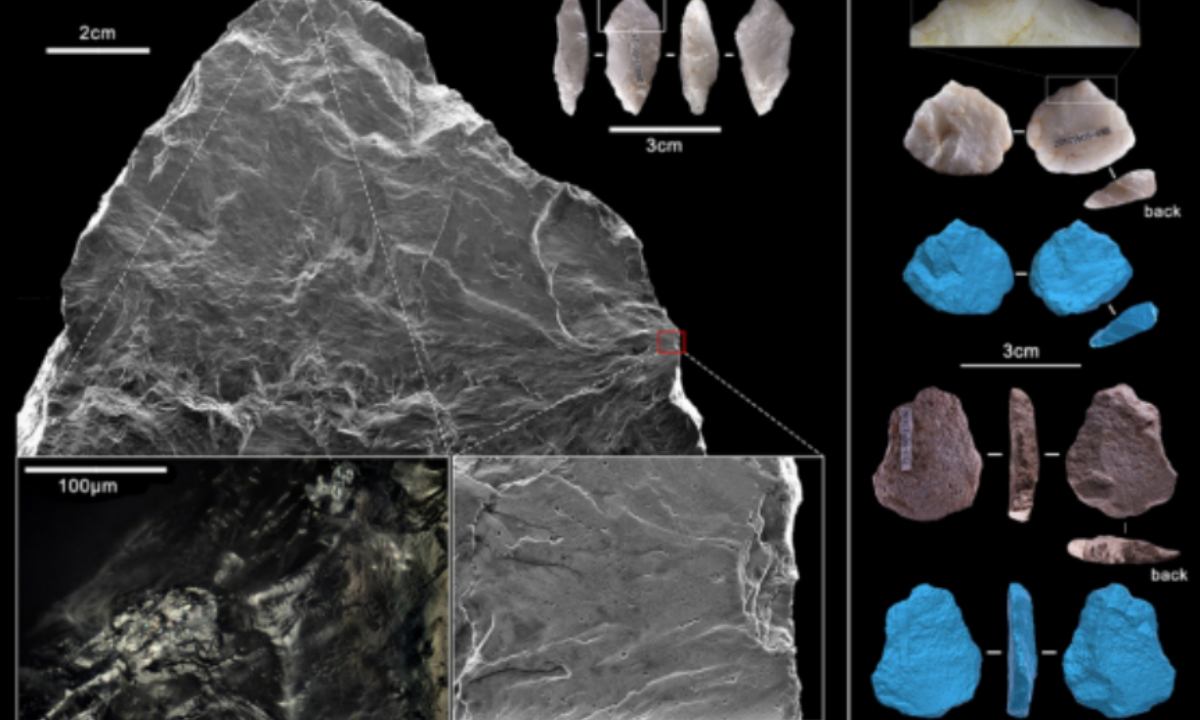
The hafted stone tools discovered from Xigou site in Xichuan county, Central China's Henan Province Photo: Courtesy of the Institute of Vertebrate Paleontology and Paleoanthropology of CAS
Chinese scientists' recent research suggests that early humans in Central China may have begun using hafted stone tools and other significant technological innovations between about 160,000 and 70,000 years ago, challenging the long-held archaeological view that Paleolithic cultures in East Asia were technologically conservative and slow to innovate, according to a press release sent to the Global Times on Wednesday by the Institute of Vertebrate Paleontology and Paleoanthropology of the Chinese Academy of Science(CAS).
The late Middle Pleistocene to early Late Pleistocene period (roughly 300,000 to 50,000 years ago) is a critical stage in human evolution. For decades, cultural development in East Asia during this time was widely regarded as relatively continuous and conservative, largely because stone tool assemblages were considered simple and major technological changes were thought to have occurred only after around 40,000 years ago.
However, researchers analyzed 2,601 stone artifacts unearthed at the Xigou site, and the findings show that these tools dated to approximately 160,000-70,000 years ago, already exhibit systematic small-flake production strategies and the earliest known evidence of tool hafting in East Asia. The discovery provides key evidence of technological innovation among early humans in the region during the late Middle to early Late Pleistocene.
The Xigou site is located in Xichuan county, Nanyang city, Central China's Henan Province, on the southern slopes of the Qinling Mountains near the Danjiangkou Reservoir. It lies at the intersection of China's north-south climatic boundary and the biogeographical transition zone between the Palearctic and Oriental realms.
Most of the stone tools from the site were made of quartz and quartzite, with the majority measuring less than 50 millimeters in length, according to Xinhua News Agency. Despite the coarse raw materials, the assemblage shows a high degree of specialization and diversity, including scrapers, borers, notched tools, denticulates, points and engravers. This challenges the traditional assumption that quartz is unsuitable for producing finely made tools, and highlights early humans' efficient management and skilled use of local raw materials.
The study indicates that prehistoric groups at Xigou employed core-on-flake techniques—producing small flakes from larger flakes—as well as discoid core technology, allowing the targeted production of small flakes. These flakes were then used as blanks to manufacture a range of tools, such as scrapers, borers and engravers. More significantly, some tools show features such as tangs and backed edges, suggesting they were hafted. Subsequent use-wear analysis provides further support for this interpretation.
The Xigou findings are not an isolated case. In recent years, multiple Paleolithic sites dating to the late Middle to early Late Pleistocene across China have yielded evidence of increasingly complex behaviors, which indicate that between about 300,000 and 50,000 years ago, early humans in East Asia had already developed sophisticated cultural practices, including prepared-core technologies, hafting, bone tool production and the use of pigments, comparable to those seen in Africa and western Eurasia during the same period.
The research also notes that East Asia experienced strong climatic fluctuations at the time, and that early humans adapted to these environmental changes by developing flexible and diverse stone-tool technologies.
It represents the earliest known evidence in East Asia for composite tools supported jointly by technological typology and use-wear analysis, pushing back the emergence of hafting technology in the region by a significant margin, according to Xinhua.
The finding is set to rewrite the conventional narrative of early human behavioral development and environmental adaptation in East Asia, once again underscoring the region's pivotal role in global research on human evolution, according to CAS.
Global Times
RELATED ARTICLES