China's School of Space Exploration aims to address urgent talent needs amid critical window, says school dean
By Fan Wei and Published: Jan 28, 2026 03:42 PM

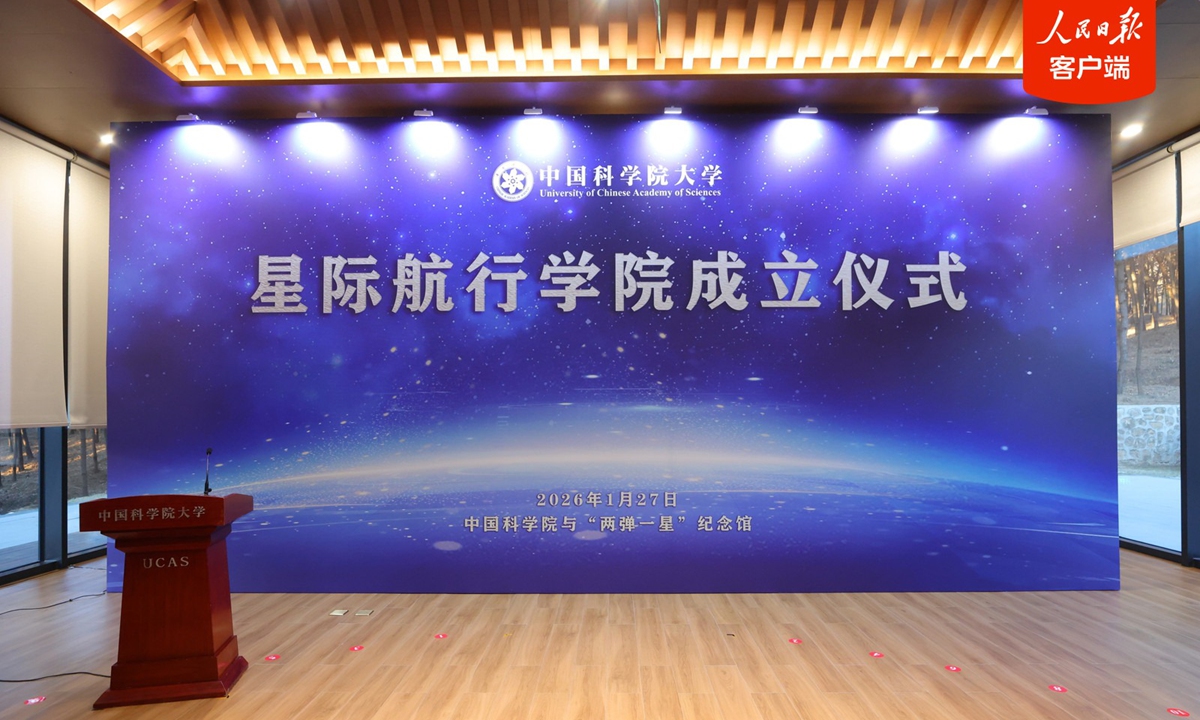
A ceremony on the establishment of School of Space Exploration was held at The University of Chinese Academy of Sciences in Beijing on January 27, 2025. Photo: People's Daily
Zhu Junqiang, an academician of the Chinese Academy of Sciences (CAS) and dean of the newly established School of Space Exploration, told the Global Times on Wednesday that the launch of the school aims to address the urgent need for talent cultivation and the facility will train a new type of interdisciplinary talent who possesses scientific thinking, engineering awareness, and the ability to integrate disciplines such as engineering thermophysics, astronomy, and more."We hope that by cultivating these composite talents, they will be able to meet the demands arising from changes in the global situation in the future. They should not only understand engineering - capable of designing excellent launch vehicles and space stations to deliver what is needed into space - but also possess strong scientific literacy, enabling them to conduct research on space science problems and explore unknowns such as the origin of life, habitable environments beyond the solar system, and other mysterious phenomena and questions," Zhu stated.
Global Times spoke with Zhu, the school's dean, following China on Tuesday unveiled its first School of Space Exploration to cultivate more leading talents in the aerospace field.
Established by the University of Chinese Academy of Sciences (UCAS), the school will focus on cutting-edge fields such as interstellar propulsion, deep-space communication and navigation, and space science, aiming to cultivate urgently-needed interdisciplinary professionals.
In terms of tutoring, the school will rely on three existing platforms focused on frontier science, key technologies, and strategic applications in Beijing's Huairou Science City. Additionally, it will establish six specialized platforms, including an unmanned aerial vehicle intelligent patrol simulation platform, a full-process teaching practice platform for space science satellites, and a space-ground collaborative experimental teaching and innovation platform, so as to provide students with an immersive training environment, Global Times has previously reported.
Conducting research on interstellar navigation holds unique practical significance. In an interview with Global Times, Wu Fuyuan, another CAS academician and a researcher at the Institute of Geology and Geophysics, CAS, explained that human exploration of celestial bodies is becoming increasingly important, and that related technologies are developing rapidly. Especially in recent years, with advancement in space technology, interstellar travel is becoming more attainable.
"What patterns does the evolution of celestial bodies in the solar system follow? If such patterns exist, what controls them? These are all important questions for us to understand nature," Wu said.
Conducting space exploration through new technologies can better help humanity understand the formation of Earth. "After all, we live on Earth, and deepening our understanding of it solely through our own planet is insufficient. For example, due to Earth's active geological movements, early traces cannot be preserved. However, on other celestial bodies, traces from the early stages of the solar system's formation may be preserved. By studying them, we can gain a better understanding of Earth."
Global Times has learned that the next 10 to 20 years represent a critical window period for China's leapfrog development in the field of interstellar navigation. Breakthroughs in original, innovative basic research and key technologies will reshape the landscape of deep-space exploration and profoundly impact national competitiveness.
The establishment of the school is a key initiative by UCAS to seize the commanding heights of science and technology and strategically develop talent cultivation in the field of interstellar navigation. It will provide talent support for major national strategic needs, such as deep-space exploration and space science research, Global Times learned from the UCAS.
"The core positioning of the school is to serve as an innovation source and talent cultivation base for the long-term development of national interstellar navigation," Zhu noted.
He explained that the school will collaborate synergistically with other institutes of the CAS to build a complete chain encompassing "basic research, technological breakthrough, research results transfer, and talent cultivation."
Zhu believes that interstellar navigation is essentially a complex and systematic engineering endeavor, and that breakthroughs in a single discipline cannot support the advancement of the overall undertaking.
The establishment of the school is driven by the significant national demand for "interstellar navigation." It breaks through traditional disciplinary barriers and promotes deep integration across multiple disciplines, including aerospace engineering, physics, chemistry, biology, artificial intelligence, materials science, and more, according to Zhu.
This enables scientists and engineers from different fields to collaborate and tackle challenges around the same goal, Zhu said.
Looking into the future, Zhu disclosed that China will launch the Tanyuan, or Exploring Origins, series of space science satellites.
The successive launches of these scientific satellites will help all of humanity better explore fundamental questions such as the origin of the universe, the origin of space weather, and the origin of life.
"I believe that, in explaining certain space science problems, Chinese scientists will take the lead in the world," Zhu said
Wu Weiren, the chief designer of China's lunar exploration program, previously stated in an interview with the media that China's planetary exploration program will conduct solar exploration in the future, as well as exploration at the edges of the solar system. He expressed hope that China could launch its own probe to reach the edges of the solar system and observe what the region looks like where the solar wind intersects with the interstellar wind (or cosmic wind).
RELATED ARTICLES