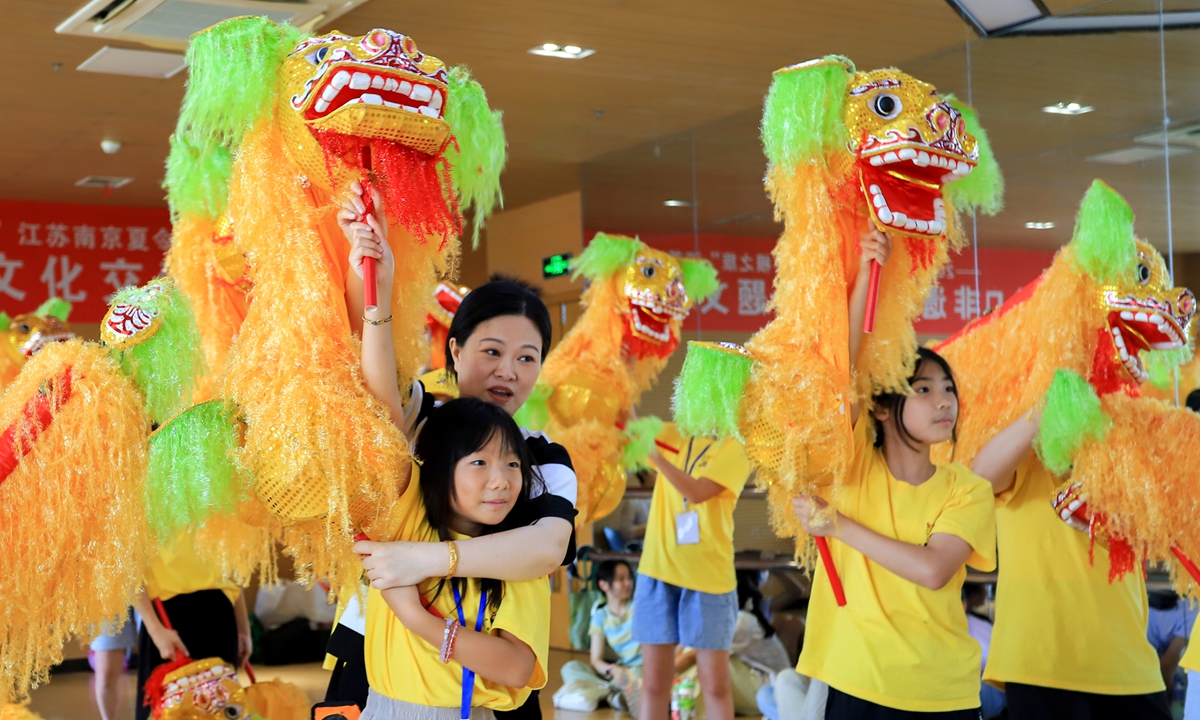
Descendants of overseas Chinese visiting China for a root-seeking journey try their hand at the Hand Lion Dance at an intangible cultural heritage exchange activity in Nanjing, Jiangsu Province, on July 20, 2025. Photo: IC
When 47-year-old financial analyst Katherine Wong decided to move to China, her colleagues in New York were perplexed. In October 2025, the US-born Chinese American gave up her life in Manhattan along with a $300,000 annual salary, and moved back to her hometown in Shantou, Guangdong Province, with her 16-year-old son and retired parents. There, she joined the investment division of a leading Chinese securities firm.For Wong, the most striking contrast etched in her mind over the past couple of months consists of two scenes. One is a photo from the 1960s, showing her parents boarding a ship at a Shantou harbor, bound for the US, their backs turned to the old port city with its distinct rows of arcaded buildings. The other is the scene at the end of 2025, when she stepped out of Guangzhou Baiyun International Airport holding her elderly parents' hands and guiding her teenage son through the bustling traffic of a modern metropolis. As a native New Yorker who spent over two decades building a solid middle-class life, Wong chose to uproot her family in midlife and return to the homeland her parents once left behind.
Wong's choice is far from an isolated case. As China's development gains momentum, a growing number of overseas Chinese are now seeing China with fresh eyes - they see boundless opportunities in emerging sectors, the real progress in people's livelihoods, and the vibrant continuity of cultural roots. Bringing diverse international perspectives, they are "returning" to their ancestral land, seeking to align their personal aspirations with the opportunities unfolding in their country of origin.
A new tide of 'return'
"Emigrating, working hard abroad, and eventually settling down with permanent residency, that was the path many of the older generation in Shantou once took. But now, the story has changed," Wong told the Global Times.
Sixty years ago, Wong's parents huddled in the lower deck of a cargo ship bound for the US. Their only possessions were a few dozen US dollars and a slip of paper with the address of their hometown in Shantou. Like countless overseas Chinese pioneers before them, they washed dishes in restaurants and worked in garment factories. Back then, the phrase "going abroad" carried the heavy weight of a family's hope for a better life.
Their only daughter did not let their sacrifices go to waste. After graduating from university, Wong spent more than a decade working at a mid-sized investment firm. She moved into a high-rise apartment in Manhattan, becoming the epitome of a successful immigrant in her parents' eyes.
But changes crept in quietly. In recent years, this "comfortable life" gradually lost its shine. The invisible glass ceiling in the workplace became increasingly palpable. Nearly a quarter of the analysts at her mid-sized investment firm were of Chinese descent, yet very few managed to break into the management ranks.
In daily life, high tax burdens took a big bite out of her actual income. Mortgage payments alone accounted for 30 percent of the family's earnings. When her mother suffered a sudden gallbladder inflammation in early 2025, they faced endless waits just to get a doctor's appointment.
"Between the career roadblocks, financial pressures, and healthcare frustrations, life already felt fraught with uncertainty," Wong recalled. "Every time we got together with friends, news of layoffs at major companies like Amazon would come up - and that only added to my anxiety."
The turning point came during her trip back to China for the 2024 Christmas holiday. The high-speed train ride from Guangzhou to Shantou took less than two hours. As she looked out the window, she saw a brand-new sci-tech park standing next to the arcaded buildings she remembered from her childhood photos. She also realized how convenient life in China is when she used her phone to scan QR codes for doctors' appointments and food delivery.
What really caught her attention, though, was a conversation with local government officials. The green finance support policies they mentioned aligned perfectly with the field she had been researching in New York for years, a field where she had struggled to find feasible projects to implement.
Countless moments like these turned the distant thought of moving back to China into a firm decision.
If many middle-aged people's life experiences offer a chance for a new beginning, a growing number of young descendants of overseas Chinese are also choosing to look to China when imagining their future.

Kira Sun (second left), Yeva Sun (second right), and their family members skate and enjoy their time on the ice at the Summer Palace in Beijing in January 2026. Photo: Courtesy of Yeva Sun
Eighteen-year-old twin sisters Yeva Sun and Kira Sun moved to Beijing about a month and a half ago. Born in Kyiv to a Chinese father and a Ukrainian mother, they spent most of their childhood in Ukraine and lived in Germany in recent years."We always knew that we have Chinese heritage, and it is part of who we are," Yeva recalled. Growing up in an international environment, they were accustomed to cultural diversity, with classmates from various backgrounds.
A real shift came as they grew older. Over the past few years, the sisters visited China several times to see family. As children, their impressions of China were mostly about food, travel, and sightseeing. With age, however, they began paying closer attention to how cities function, how people study and work, and how China's rapid development is reflected in everyday life.
In December 2025, Yeva and Kira arrived in Beijing to begin what they described as a trial period of living in China. They are living with their grandmother while completing Ukrainian high school courses online and studying Chinese.
Their daily life has quickly settled into a routine, from online classes and food delivery to spending time with family and making new friends. "We adapted pretty fast," Kira told the Global Times. "China is very convenient to live in."
Reflecting on their decision, Yeva said that coming to China has allowed them to experience living in the country, spend time with family, and see more opportunities for the future. "When we came to China, we saw how different it is. I just liked it so much here that it really inspired me."
Who do you think you are
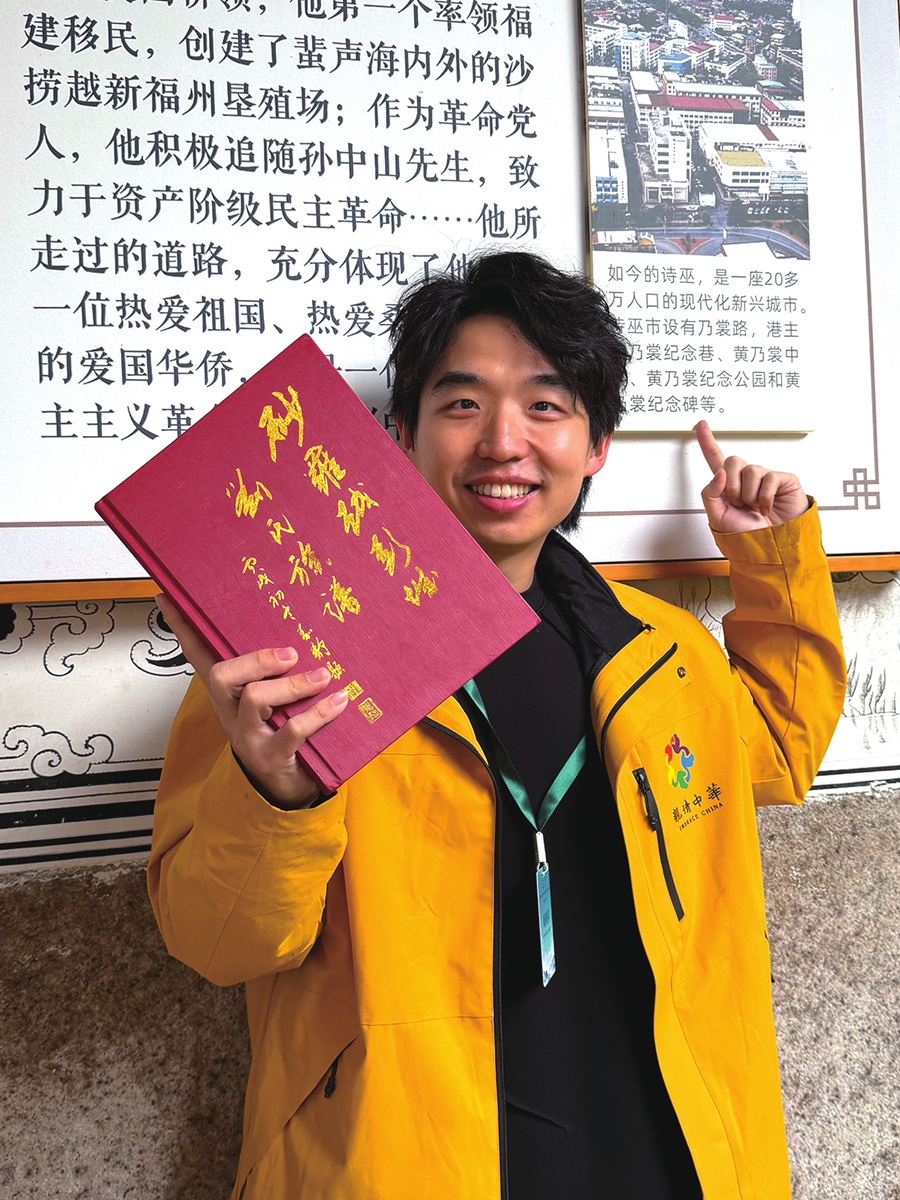
Malaysian youth Richard Lau Lee Siong takes photos holding his family tree at a museum with an overseas Chinese theme in Fuzhou, Fujian Province, on December 23, 2025. Photo: Courtesy of Lau
In recent years, the tide of overseas Chinese returning to their ancestral homes to seek their roots has also created several new trends, reflecting contemporary global shifts, China's rapid development, and evolving international relations.For instance, this "root-seeking" journey is undergoing a profound transformation from the traditional nostalgia of older generations to a conscious awakening of identity among young Chinese people. Many of them have shared their stories on lifestyle sharing apps Rednote and TikTok, inspiring more to explore their roots back in China.
For 35-year-old Richard Lau Lee Siong from Sibu, Malaysia, December 2025 was not just another month - it marked the culmination of a long-held dream: Stepping onto the soil of his ancestral home in Fuzhou, East China's Fujian Province. As a fourth-generation overseas Chinese, Lau had grown up hearing fragmented stories about his roots and China's rapid development, and his journey - documented in a viral video series - struck a chord with a global audience.
Lau told the Global Times that a particularly moving moment happened in Fuzhou when he visited the former residence of Wong Nai Siong, the revolutionary leader and educator who helped establish Sibu's "New Fuzhou" community over a century ago by leading more than 1,000 Chinese migrants to Malaysia. There, Lau learned that many early Chinese migrants like Wong Nai Siong ventured abroad not merely for survival, but also with a broader vision for their homeland's prosperity. "I felt immense pride," Lau said. "The love for our ancestral country is the greatest common denominator uniting us with our Chinese compatriots."
After posting his journey online, Lau was surprised by the overwhelming response. "So many people left comments under my videos," he said. Many expressed a desire to follow in his footsteps.
Beyond young people like Lau, who maintain a deep connection to Chinese culture and follow in the footsteps of their parents and grandparents by returning to their ancestral hometowns, in recent years an increasing number of mixed-race or third- and fourth-generation overseas Chinese descendants from other parts of the world have begun crossing cultural and geographical barriers to embark on root-seeking journeys.
Their appearances have become foreign, they speak English or other languages, and the only remaining link to their heritage is often a single Chinese surname. Yet, relying on family genealogy records, old photographs, or digital tools, they return from the other parts of the world to China to trace their ancestral stories and reclaim their bloodline roots.
According to a 2024 report by the Jiangmen Daily, the family of Doug Lougoon from Melbourne, Australia, traveled more than 7,000 kilometers back to Hele village in Jiangmen, Guangdong Province, to search for their roots. Although they did not find an exact name match, through phonetic similarities and matching neighbor records, they basically confirmed their ancestral line within the Lei clan. This was the first time they felt so close to their forebears, Doug Lougoon said with tears in his eyes.
From July 7 to 8, 2025, Nauruan President David Adeang visited Jiangmen on a journey with his family to trace his ancestral roots in China, News Guangdong reported. At Zhongxinli village, the president reunited with his maternal great-aunt, with a family member noting simply, "We're cousins." The president's daughter, Magna Adeang, shared, "It's really fun. It's really pretty, too," specifically praising cultural elements like the lion dance, stating, "I feel like I'm from here; I feel like I'm part of here," per News Guangdong.
Building the future
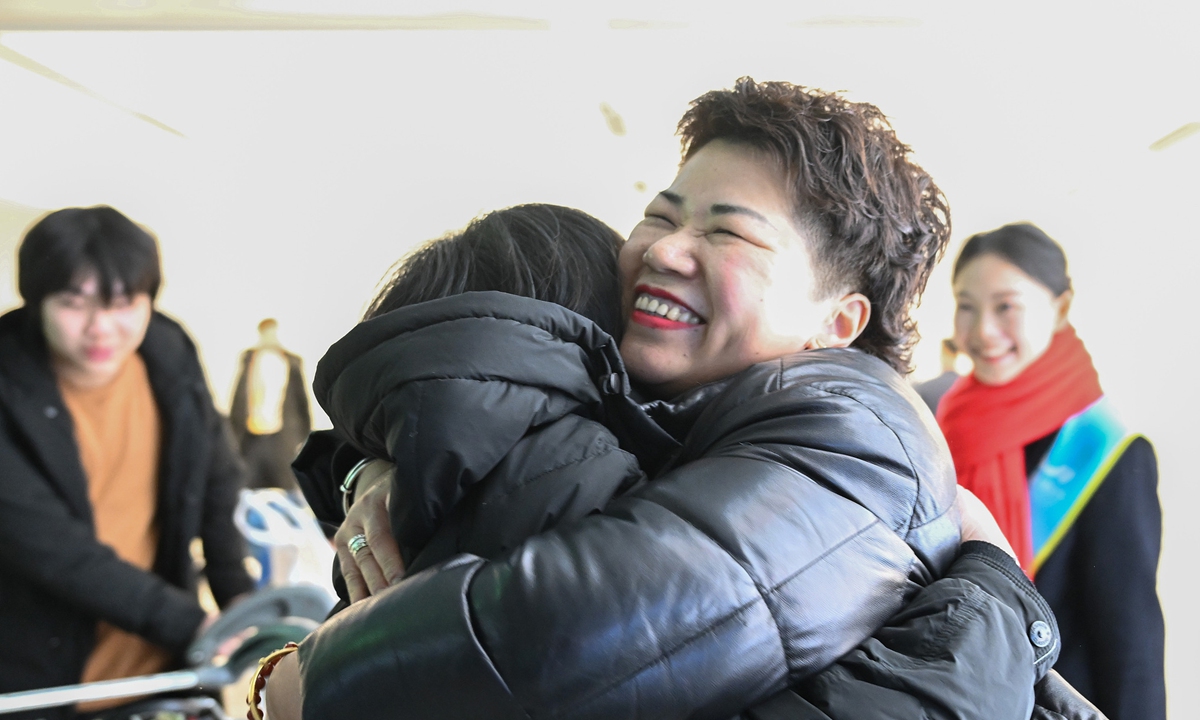
An overseas Chinese runs into a fellow townsman and shares a warm hug at an airport in Hangzhou, Zhejiang Province, when returning to her ancestral homeland, on January 27, 2026. Photo: VCG
According to the Overseas Chinese Affairs Office of the State Council, there are over 60 million overseas Chinese living in nearly 200 countries and regions worldwide. They serve as "China's global ambassadors," and today, through strengthened ties with their ancestral homeland, they have become a key pillar for China to bridge global innovation and expand development horizons, the Xinhua News Agency reported in December 2025."After moving back to China, I noticed my parents' longing to spend their retirement here," Katherine Wong said. "While my son, who's still in school, is already thinking about his career in China, he wants to be a scientist and research AI in the future."
Katherine Wong noted that unlike earlier generations who returned out of nostalgia, many of today's overseas Chinese who closely follow China are motivated by the chance to apply their international experience in a land of opportunities.
This trend was visible at events like the Third Overseas Chinese Talent Conference for Development held in Fuzhou in December 2025, which attracted over 1,000 experts and professionals from 39 countries and regions. According to Xinhua, more than half of the participants were younger-generation overseas Chinese, and over 86 percent were high-level talents. As one attendee put it, "Today's China offers institutional stability, a complete industrial system, and a thriving cultural environment - all of which create a sense of security and upward momentum."
Currently, across China, local authorities are competing to roll out new pro-overseas Chinese policies to attract elite talents to return and start businesses. For example, in August 2025, the Southeast Overseas Innovation Center in Quanzhou, Fujian, officially opened. Targeting returnee entrepreneurs, the center offers turnkey physical spaces, along with perks like free shared workspaces and rent subsidies, Xinhua reported. Similar initiatives have been launched in economic development zones, high-tech parks, and innovation hubs nationwide.
"Looking back, my parents crossed the ocean for survival; today, I returned because I see a future here," Katherine Wong said. "It's no longer about 'making it abroad,' but about growing where our roots run deepest."