ARTS / CULTURE & LEISURE
Pre-application plans revealed for Liulihe’s World Heritage bid
Site verifies Beijing’s 3,000 years of urban devt
By Li Yuche and Published: Jan 28, 2026 11:13 PM

The Liulihe site in Beijing's Fangshan district Photo: VCG
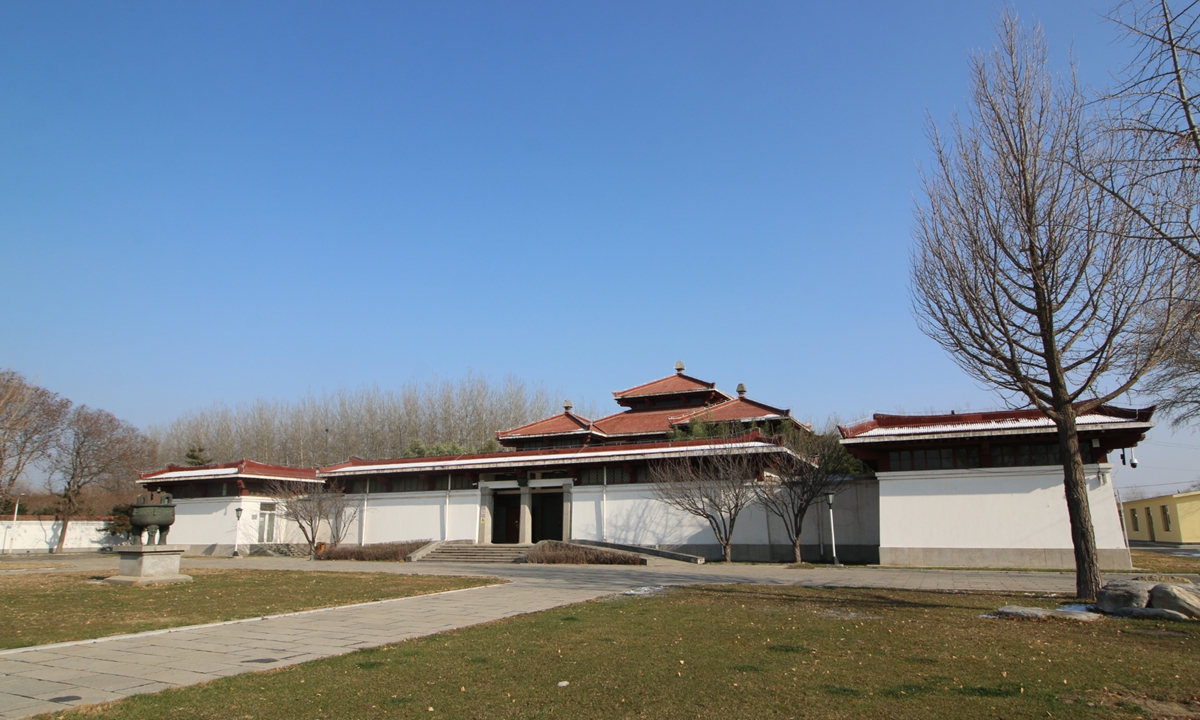
Beijing's archaeological site Liulihe moved closer to attaining World Heritage status after several representatives at the "two sessions" of Beijing detailed pre-application plans related to the site. The fourth session of the 16th Beijing Municipal People's Congress and the fourth session of the 14th Beijing Municipal Committee of the Chinese People's Political Consultative Conference will conclude on Thursday.Located in Beijing's Fangshan district, the Liulihe site is considered the earliest source of urban civilization in Beijing. Its existence verifies that the city has a continued urban development spanning over 3,000 years.
As Beijing's top-tier archaeological priority entering the 15th Five-Year Plan period (2026-2030), the Liulihe site has a new plan to carry out new rounds of "large-scale investigation and excavation," said Zhang Lixin, the director of the Beijing Municipal Cultural Heritage Bureau.
The site has "in fact already undergone multiple major archaeological excavations" since its initial discovery in 1945, Wang Jing, the lead archaeologist of the project, told the Global Times.
Early excavations at the site took place in 1962 and 1973. These initial efforts uncovered a large quantity of Western Zhou Dynasty (1046BC-771BC) pottery fragments alongside a cluster of 69 tombs. A diverse range of relics, such as bronzes, lacquerware and jade items were also found. Among them, the ox-head patterned bronze cauldron known as the "Boju Li" stands as a peerless treasure that has been subject to a permanent export ban for exhibitions abroad even until now.
Such finds were pivotal in proving that the Liulihe site was the first capital of the Yan state, Wang told the Global Times. The location of the ancient Yan state that existed during the Zhou Dynasty is commonly believed to have been located around what is today Beijing.
In 1995, archaeologists further unearthed remains such as palace grounds and more, with the findings directly bolstering the archaeological evidence of Beijing's 3,000 years of urban development.
The historical narrative of the Liulihe site is clear, yet its physical urban layout remains elusive. Hence, "mapping the complete layout" constitutes a priority in the pre-application phase for the UNESCO listing, Zhang said at the two sessions.
The pre-application plans for the site also include formulating a long-term conservation management plan and also building the core infrastructure for the site's related archaeological park.
Back in March 2025, a public call for planning and design proposals of the core area of the Liulihe Archaeological Site Park kicked off. Three shortlisted concepts were selected, each with a distinct vision.
One employs six thematic landscapes to narrate the cultural lineage of the Yan state, another creates 22 immersive experience points to bring ancient culture to life, while a third interprets the dynamic history of the Yan state's founding through architectural forms guided by a "unity in diversity" philosophy.
"A heritage park is essential for any World Heritage bid because it enables holistic protection, makes the site's value tangible, and truly brings history to life through public involvement," cultural heritage expert Yu Bo told the Global Times.
Acknowledging the value of an archaeological park as a tool, Bai Jingfeng, a member representing the cultural and art sector, opined for a "joint World Heritage application" that would bring the Liulihe site and the Fenghao site in Shaanxi Province together to better render their historical consistency.
As both sites are major capital ruins from the Western Zhou Dynasty, a joint nomination has a higher chance of success. Formulating a "joint nomination plan" and "conducting coordinated archaeological research" could facilitate more systematic protection for both heritage sites, Bai noted.
"These sites mark milestones in the 3,000-year continuum of Chinese civilization. A joint World Heritage nomination could deliver a more compelling narrative of Chinese civilization for global audiences," said Bai.
Beyond cross-province efforts, the pre-application for the Liulihe site's World Heritage title also includes threading it with other cultural sites such as the Zhoukoudian site and the Yunju Temple in Beijing. Such a means aims to create a connected historical narrative that can boost local tourism.
The development of tourism can run "parallel" with the application process, Yang Huili, the director of the Intangible Cultural Heritage Research and Development Center at Beijing Normal University, told the Global Times. She has said that moving forward, the Liulihe site should "develop IPs that resonate with modern culture and design diverse tourism products, such as "creating a digital exhibition of Yan culture" and "establishing a global archaeological study base."
So far, the Liulihe site has been successfully included on China's Tentative List for World Cultural Heritage. It was also listed as one of China's top 10 archaeological discoveries of 2024.
RELATED ARTICLES