US Treasury Secretary Bessent calls EU-India trade deal ‘very disappointing’; remarks expose US hegemonic mindset: Chinese expert
By Published: Jan 29, 2026 12:23 PM

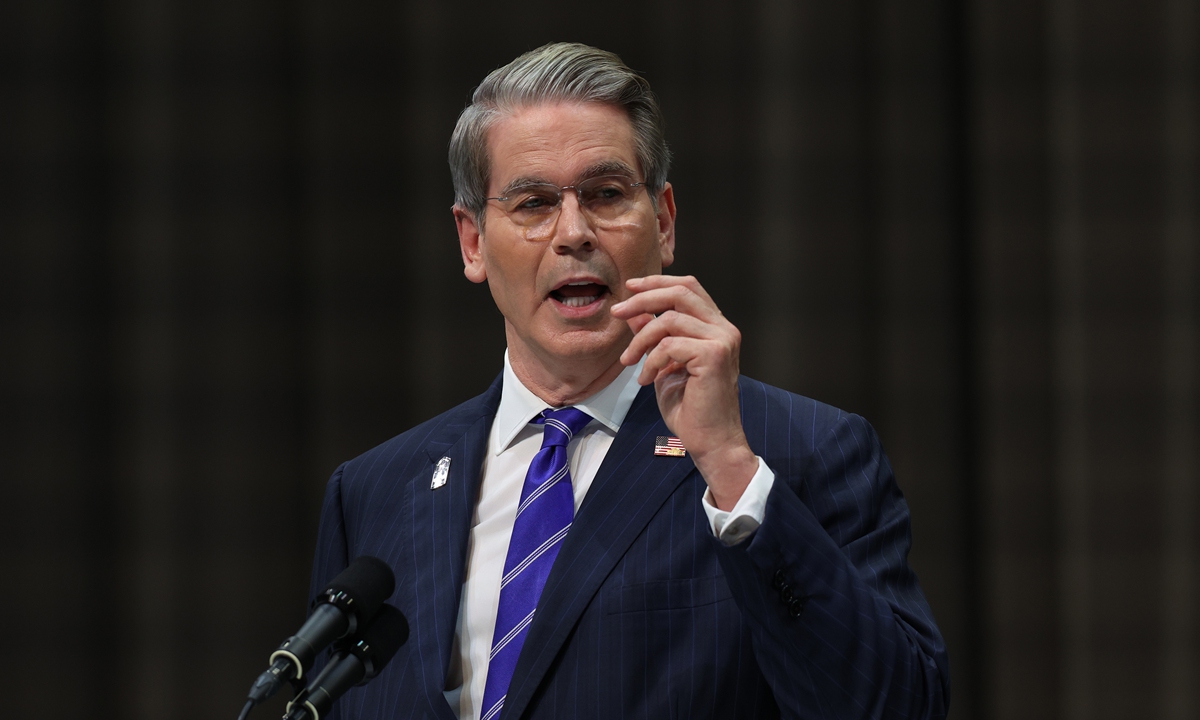
US treasury secretary Scott Bessent, Photo: VCG
US officials have commented on the recently signed trade deal between EU and India, dubbed the "Mother of all deals," with US Treasury Secretary Scott Bessent expressing his disappointment with the Europeans, and US Trade Representative Jamieson Greer saying that India has come out on top of it.
The EU on Tuesday finalized a long‑delayed trade deal with India that aims to boost two-way trade and reduce the bloc's reliance on the US amid growing global trade tensions, according to Reuters.
The deal is expected to double EU exports to India by 2032 by eliminating or reducing tariffs on 96.6 percent of traded goods by value, and will lead to savings of 4 billion euros ($4.8 billion) in duties for European companies, the EU said.
Commenting on the free trade agreement between the EU and India, the first having faced tariffs threats from the US over its opposition of US plans to take over Greenland, and the latter facing a 50-percent tariff from the US for its purchase of Russian oil, Bessent said "they should do what's best for themselves, but I will tell you, I found, I find the Europeans very disappointing."
Bessent said the deal made it clear why Brussels had balked at joining Washington's decision to impose 25 percent tariffs on India last year. "So every time you hear a European talk about the importance of the Ukrainian people, remember that they put trade ahead of the Ukrainian people," Bessent said.
In last August, the US imposed a 25-percent tariffs on Indian imports on the ground that the country imported Russian oil. The tariff rate was later increased to 50 percent.
Greer, in an interview with Fox Business on Tuesday (US time), said "I think India comes out on top on this. Frankly, they have more market access into Europe. It sounds like they have some additional immigration rights."
The US trade representative said that "India is going to have a heyday with this. They have low-cost labor. And it looks like the EU is doubling down on globalization when we're trying to fix some of the problems with globalization here in the US."
Chinese analysts said the act by these trading partners, some US allies included, to diversify and seek to reduce reliance on trade and investment with the US by cuddling together is a natural reaction for self-protection.
Zhou Mi, a senior researcher at the Chinese Academy of International Trade and Economic Cooperation, told the Global Times on Thursday the comments by US trade officials have highlighted the US' adhering to its "America First" ideology, regardless of the harm such unilateral action bring to other countries and economies.
The US has assumed that the world must operate according to its logic, and other trading partners must sacrifice their own interests, Zhou said. "Such thinking is fundamentally at odds with the basic norms of economic globalization, and will continue to erode the US' credibility in the global trade system."
More and more US trading partners are finding that doing business with the US is not just a matter of losing money, but sometimes it can be fatal to their national economy. It is inevitable that a growing number of America's economic partners will want to find possible ways to hedge against these risks with trade diversification, Zhou said.
Zhang Jian, a vice president of the China Institutes of Contemporary International Relations, told the Global Times on Thursday that the comments by US officials are a frank display of the US' hegemonic logic in trade.
"The EU-India agreement is seen by the US as undermining the US' policy of pressuring India and Europe, making them more capable of confronting the US economic pressure, so naturally the US will oppose it," Zhang said.
More countries in the world, including some of US allies, are seeking trade diversification in a practical manner to collectively address uncertainties amid the unpredictability of the US.
Canadian Prime Minister Mark Carney recently led a delegation to visit China, signing a number of productive deals including agreements over the trade of electric vehicles and canola. Carney's visit was followed by UK Prime Minister Keir Starmer, who is visiting China this week accompanied by over 50 UK business executives.
Former World Trade Organization Director-General Pascal Lamy warned on Monday the US' shift toward protectionist measures that violate its WTO commitments, calling on the international community to uphold and further strengthen the multilateral trading system, according to CCTV News.
"I think we should all look at this with a cool head, not indulge in whatever protectionist fever that is in the US... We can improve the disciplines of world trade without the US," he said.
RELATED ARTICLES