Survey analysis reveals China as the 'most valued bilateral partner' for small island states; Chinese expert says appeal lies in reliability against global uncertainties
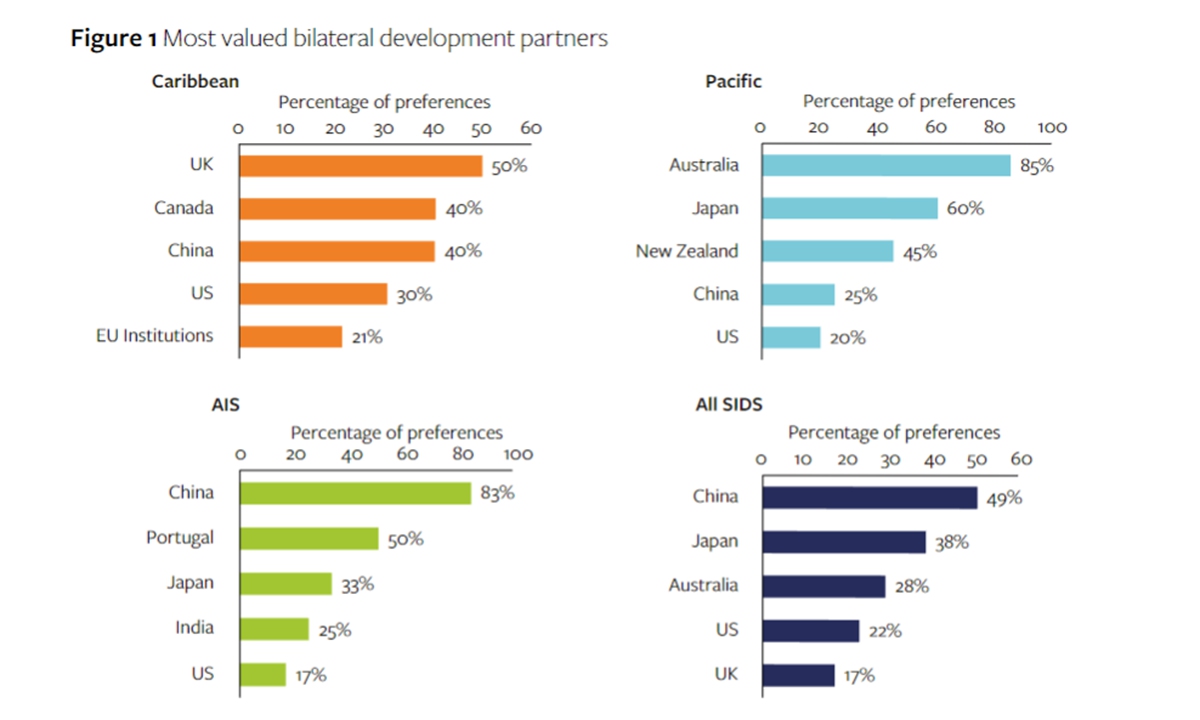
ODI Global, a UK-based independent think tank, publishes a survey on January 28, 2026 where it suggests China features in the top five most valued bilateral partners across regions, and as the top choice on aggregate for all small island developing states. Photo: screenshot of ODI Global survey
Small island developing nations such as Mauritius and the Maldives showed China rated as the top bilateral development assistance partner amid US aid cuts and Washington's pivot away from climate change, a survey by ODI Global published on Wednesday found, Reuters reported.
A Chinese expert said the survey highlights how small island developing states (SIDS) assess development partners as the global development landscape evolves. As the international environment grows increasingly unpredictable, stability has become a scarce resource - and China's appeal lies in its reputation as a partner that is unlikely to withdraw abruptly and is able to follow through on its commitments.
As climate impacts accelerate, SIDS face existential challenges which demand more innovative financing models and better, fairer governance rooted in strong and effective partnerships, per an ODI Global report unveiling the survey findings.
"This analysis reveals China as the most valued bilateral partner [for SIDS], signaling shifting geopolitical dynamics and offering critical insights for development partners seeking to deliver more effective, long-term impact in small islands," the report said.
"China features in the top five most valued bilateral partners across regions, and as the top choice on aggregate for all SIDS. This illustrates the deepening influence of emerging and regional development partners," the survey read, adding that "When compared with other bilateral providers, China remains the top bilateral development finance provider for the Caribbean SIDS ($2.1 billion), while it holds second position in Pacific and AIS SIDS after Australia and Japan, respectively."
The survey added that with emerging donors, SIDS are not only expanding their partnership portfolios but are also responding to providers that combine financial resources with diplomatic, technical and South-South cooperation modalities that are increasingly relevant to their development strategies.
ODI's analysis of finance flows capturing data between 2020 and 2023 shows Beijing provided $6 billion in developmental aid to small island states in the period, outstripping official development finance from Australia, at $4.78 billion, the US at $3.17 billion and Japan at $2 billion.
According to Reuters, data from the ODI survey is collected among officials from 29 small island developing states. The survey, conducted between July and November 2025, includes countries spanning from the Caribbean to the South China Sea, including the Solomon Islands, Papua New Guinea, Barbados, Cabo Verde, Mauritius and the Maldives.
The Overseas Development Institute (ODI), established in 1960 in the UK, is a leading global, independent think tank on international development and humanitarian issues, according to introduction published on the United Nations website.
Chen Hong, director of the Asia Pacific Studies Center at East China Normal University, told the Global Times on Thursday that development cooperation for SIDS is more of a question of survival, not a matter of values: whether ports can be built, power supplies stabilized, and whether infrastructure is resilient enough in the face of climate change.
In this context, China's assistance and cooperation stand out for their visibility, manageable timelines, broad sectoral coverage, and close alignment with national development plans. By contrast, Western engagement often comes with political conditions, Chen noted.
Lead author Emily Wilkinson was quoted in the Reuters report as saying that the SIDS are important to different donors "for geopolitical reasons," Wilkinson said.
"No country's foreign assistance operates outside a strategic environment, and China is no exception," said Chen, "but the key issue is not whether geopolitical considerations exist, but how they are manifested."
When certain countries use aid as a tool of bloc politics, China never asks island states to choose sides. Instead, it binds its own development trajectory with that of its partners. "This is not perceived by island countries as pressure, but rather as a form of risk hedging," Chen noted.
As the US cut its aid and scaling back funds related to climate change issues, China's sustained engagement provides tangible public goods for global development governance, easing the immediate anxieties of island states and contributing to institutional stability in the Global South, the expert said.
China announced a list of initiatives for promoting its cooperation with Pacific Island countries in fields including climate change response, disaster prevention and mitigation, maritime trade and other priority areas at the Third China-Pacific Island Countries Foreign Ministers' Meeting held last May, the first time the meeting was held in person in China.
At the meeting, Chinese Foreign Minister Wang Yi said that over the next three years, China will implement 100 "small yet impactful" projects aimed at addressing climate change in PICs.
The two sides have continued to expand exchanges and cooperation in more than 20 areas. According to Chinese statistics, the total trade volume between China and Pacific Island countries that have diplomatic relations with China has expanded more than thirtyfold from 1992 to 2021.
RELATED ARTICLES