China's National Health Commission expert outlines solutions to further meet public health needs in the 15th Five-Year Plan
By Published: Jan 29, 2026 07:17 PM

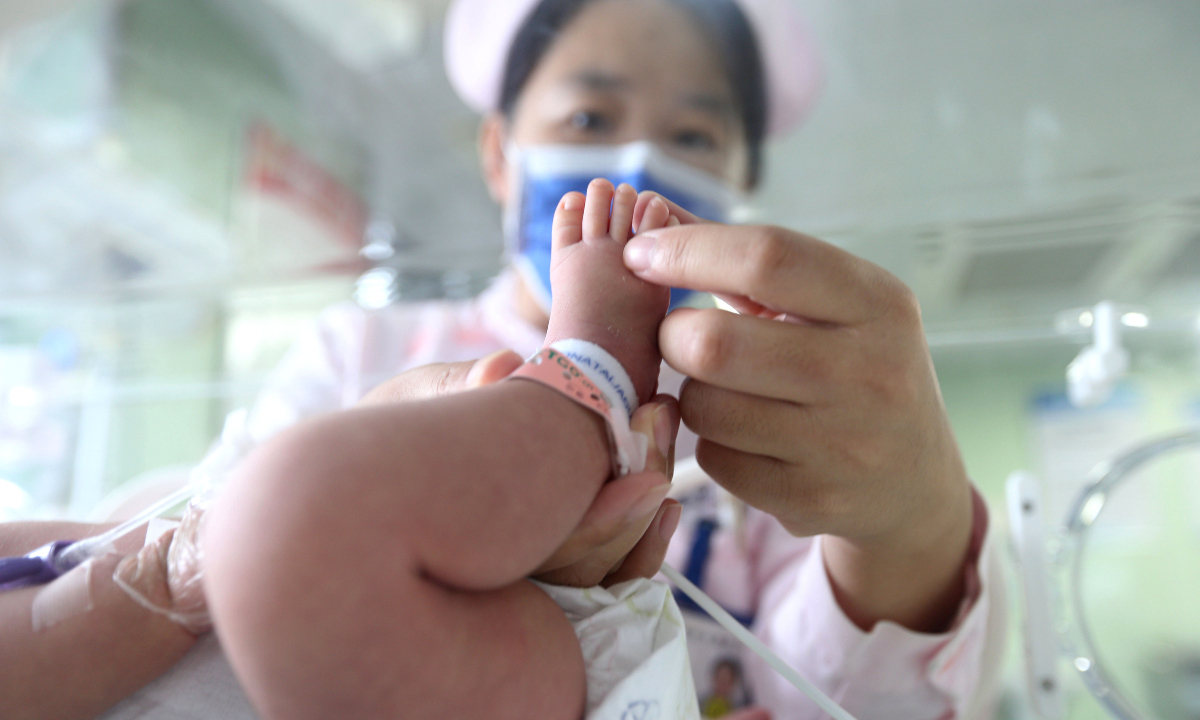
A medical staff member cares for a newborn at the neonatal care unit of a hospital in Lianyungang, East China's Jiangsu Province on October 6, 2025. Photo: IC
During China's 14th Five-Year Plan (2021-25), the country has made notable progress in building its healthcare system. Both the overall scale and service capacity of hospitals, as well as the level of primary healthcare services, have seen significant improvement, Zhu Hongming, Director General, China National Health Development Research Center, told the Global Times during an exclusive interview.
During the 15th Five-Year Plan period, there will be clearer and more direction-oriented measures in policy design and institutional arrangements focusing on key social concerns such as care for the elderly and children, said Zhu.
Breakthrough achieved
Zhu noted that during the 14th Five-Year Plan period, China made major progress in building its disease control and prevention system and medical insurance system, and has established the world's largest healthcare service system and medical security system. Although there remains room for improvement in quality and efficiency, the scale and degree of systematization are among the most advanced globally.
Take the "15-minute medical service circle" at the grassroots level as an example, coverage nationwide has now exceeded 90 percent. In the vast majority of regions, residents can reach a medical institution within a 15-minute walk.
Moreover, childcare services in China achieved a breakthrough from near nonexistence to initial establishment, with gradual expansion on what had previously been an almost blank slate. In many localities, childcare services have been developed by relying on primary medical institutions and community health service centers.
According to data, China's average life expectancy reached 79 years in 2024, while infant mortality and maternal mortality rates have entered the ranks of those in developed countries. In the United Nations Sustainable Development Goals (SDGs), China's health-related indicators rank relatively high overall, demonstrating that through systematic development, China's healthcare sector has achieved outcomes that exceed the country's current level of economic development.
In addition, during the 14th Five-Year Plan period, China withstood the severe impact of the once-in-a-century pandemic and successfully responded to COVID-19. Zhu said that during this period, China became a rare global case of a country with such a large population that was able to emerge from the pandemic rapidly.
Moreover, achievements in advancing the rule of law in the health sector were also notable. A number of important laws and regulations were introduced during this period, including regulations related to major public health emergencies, the revised Law on the Prevention and Control of Infectious Diseases, law on protecting the lawful rights and interests of physicians, and the law to promote basic medical and health care.
Overall, despite the public's higher expectations for medical services, China's overall performance has been relatively strong when measured against objective indicators and compared with international peers. Coupled with the continued advancement of institutional and legal frameworks, the development of the health sector during the 14th Five-Year Plan period has been positive on the whole, said Zhu.
Improving medical service system
Zhu said that while China's health sector continues to make steady progress, it is also facing multiple, very real challenges. One prominent issue is that although the supply of medical services keeps expanding, it still objectively falls short of keeping pace with the upgrading of public demand.
At the same time, rapid population mobility is posing a severe test to the current health system, which is characterized by the model of "one level of government running one level of public services." Zhu further explained that many rural and township areas are experiencing continuous population decline, leaving behind mainly vulnerable groups such as the elderly and children.
Medical needs in these areas have not diminished but have instead become more concentrated. Doctors are being sent down to the grassroots on a sustained basis to shoulder the responsibility of ensuring basic public health services, and village doctor posts still need to be retained in sparsely populated and poorly connected villages.
As a result, primary healthcare is operating under growing pressure, caught between strong public-interest demands and insufficient effective social demand—a strain that is expected to continue to intensify.
As population aging accelerates, chronic diseases and multimorbidity are becoming increasingly common. While the existing healthcare system has achieved notable results in disease treatment, people-centered integrated services that span diagnosis, rehabilitation and long-term care remain insufficient. The demand for rehabilitation nursing and long-term care is real, yet limited ability to pay means that neither families nor society as a whole can fully bear the associated costs.
"In response to these issues, relevant departments have already identified the building of a 'high-quality and efficient integrated service system' as a key direction in the preliminary research for the 15th Five-Year Plan (2026-30)," Zhu said.
Going forward, cities or counties will serve as the basic units, with county-level medical communities, tightly integrated urban medical groups, specialty- and disease-specific alliances, and telemedicine collaboration mechanisms used to break down institutional barriers and form a coordinated service network.
At the same time, reforms to medical insurance payment methods will be advanced in parallel, including exploration of bundled payment mechanisms based on medical communities as a whole, providing institutional support for resource integration and internal coordination. This reform path is expected to help achieve a better balance between meeting public demand, improving system efficiency, and preventing systemic risks.
Care for elderly and children
As demographic structures continue to evolve, issues concerning "the elderly and children" have become a focal point of public attention. During the 15th Five-Year Plan period, it is understood that China has already outlined a number of relatively clear and direction-oriented measures in terms of policy design and institutional arrangements centered on fertility support and elderly care services.
"During the 15th Five-Year Plan period, policy arrangements surrounding fertility support and elderly care services are in fact already quite specific, covering multiple key stages of both childbirth and eldercare," Zhu said.
Regarding fertility support, policies are being advanced from the very front end by focusing on the protection of reproductive capacity. Early-pregnancy care clinics have already been established, and going forward, secondary-level and above hospitals will gradually put relevant mechanisms in place to provide early-pregnancy care and counseling on fertility protection before induced abortions.
At the same time, assisted reproductive technologies will be progressively included in the basic medical insurance system, allowing related costs to be reimbursed. Building on existing institutional and practical foundations, childcare services will also continue to be strengthened in the future.
"From protecting reproductive capacity and providing maternal and prenatal services, to assisted reproduction and childcare support, and further to birth incentives and subsidy policies, each link in the chain has corresponding and clearly defined policy designs. Going forward, subsidies related to fertility support may take various forms, including one-off payments as well as monthly or annual allowances. This reflects a policy shift from 'investing in things' toward 'investing in people,' with the aim of stabilizing and boosting fertility intentions by enhancing the level of care and support extended to childbearing groups across society," Zhu said.
Regarding elderly care services arising from ongoing changes in population structure, Zhu said that as the elderly population continues to grow, the focus will be placed on expanding rehabilitation and nursing care resources and improving the healthcare system for older adults. This includes steadily advancing long-term care insurance and exploring the further expansion of other forms of insurance, with the dual aim of providing services while also addressing financing challenges.
"Care for older adults is inherently costly and challenging, especially when it comes to caring for those with disabilities or cognitive impairments. Not only do costs rise over time, but the low level of cooperation from care recipients also makes service delivery more difficult, while those engaged in such work often experience limited professional fulfillment and relatively modest financial returns. If these responsibilities were to fall entirely on families, the arrangement would be neither sustainable nor equitable. How to develop more viable solutions that better align service provision with financing mechanisms remains an issue that requires further exploration," Zhu said.
Zhu also said that introducing artificial intelligence into the medical field is an inevitable trend, but the key question is not whether to use it, but how to use it and where it should be applied. At present, most hospitals are already using clinical decision support systems (CDSS). However, such systems are not based on "large-model AI" in the general sense; rather, they are small-model systems built on expert guidelines, using expert-guided rules and algorithms to assist clinical decision-making.
He further explained that, in practical application, the medical field is better suited to expert-led, small-model artificial intelligence systems and neural network-based analytical frameworks to support clinical workflows and standardize operations. For example, in building an integrated service system and advancing full-process management for specific diseases, a unified set of expert consensus guidelines and tiered diagnosis and treatment protocols can be adopted, allowing the same standards and systems to be used from top-tier tertiary hospitals down to grassroots village doctors.
In medical settings, all critical decisions should still be led by experts, with artificial intelligence playing more of a role in "technological empowerment" and "data governance." AI can help grassroots doctors transform fragmented and non-standardized information into structured, usable data modules, rather than directly replacing physicians in prescribing medications or making diagnoses. By comparison, a more realistic and urgent need lies in using information technology and artificial intelligence to compensate for capacity shortfalls in primary healthcare.
"China's approach to artificial intelligence in the health sector has consistently focused on targeting specific segments and addressing concrete problems, rather than creating 'intelligent doctors' to replace human medical practice. Going forward, physicians will remain at the core of the healthcare service system at all times, and this principle will not change," Zhu said.
RELATED ARTICLES