US elites prescribe wrong medicine for political disease
By Published: Jan 29, 2026 10:18 PM

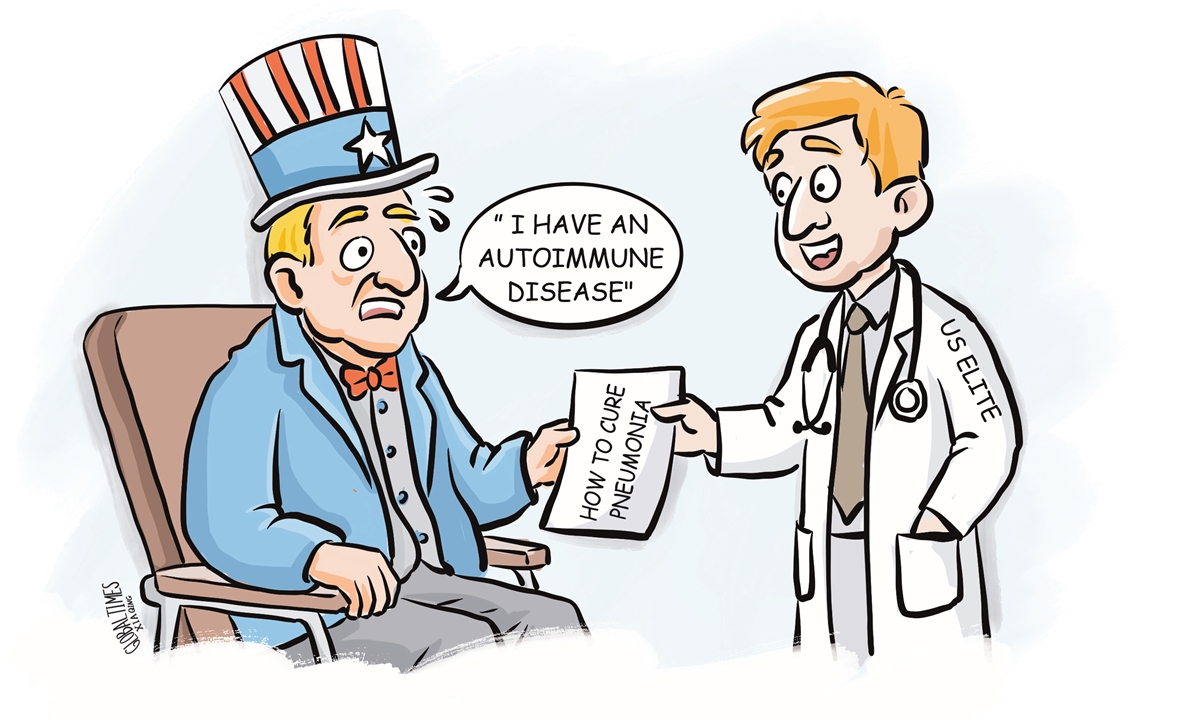
Illustration: Xia Qing/GT
In January 2026, the death of Renée Good, a mother of three in Minneapolis, by an Immigration and Customs Enforcement (ICE) agent, and the subsequent fatal shooting of Alex Pretti, a 37-year-old nurse, by federal agents, sparked outrage and protests within the US.Nobel laureate Daron Acemoglu of Massachusetts Institute of Technology swiftly diagnosed the malady in a Project Syndicate piece. This could be "a turning point," he declared. The killings represented "a key distinguishing feature of authoritarian governments" - the ability to deploy excessive force against opponents. The Trump administration, by granting ICE agents "de facto immunity," was engineering "authoritarian consolidation," following the playbook of "Hungary, Ecuador, Mexico, Nicaragua, Turkey and Venezuela," Acemoglu argued.
His prescription? "The outcome will depend... on the determination of civil society itself, starting in Minnesota."
It sounds compelling. Democracy under siege; the people must rise - it's a narrative America's intellectual elites have perfected - in op-eds, academic journals, think tank reports and congressional testimony.
But here's the problem: This framework cannot explain what's happening in the US. Worse, it cannot cure it.
Buried in Acemoglu's own analysis is a telling admission. Democratic activists during the Joe Biden years "exhausted their legitimacy," he writes. "In the civil service, universities, NGOs, and even in the private sector, Democratic activists had overplayed their hands and lost a lot of support by suppressing legitimate concerns about their desired social changes."
Translation: The other side felt oppressed as well, and millions joined the opposition.
So, which is it? If both camps command massive support bases, if both believe they're defending the US, if both accuse the other of tyranny, is this really "authoritarianism versus democracy"? No. This is two increasingly irreconcilable societies trapped within a single political framework.
Imagine siblings fighting. One shouts, "He's becoming a dictator!" The other retorts, "No, you're the tyrant!" To outsiders, it's a power struggle. To each brother, it's a moral imperative. That's America today. One side sees open borders, DEI (diversity, equity and inclusion) policies and climate action as civilizational progress. The other sees elite oppression of ordinary citizens, with border enforcement as a civic responsibility.
When even "inclusion" and "freedom" mean fundamentally different things, can "democratic institutions" still arbitrate?
Acemoglu's theoretical toolkit contains "inclusive versus extractive institutions," "democracy versus authoritarianism," and "checks and balances versus power concentration." There was a time when these frameworks worked reasonably well for analyzing post-WWII developing nations, Latin American transitions, Eastern European transformations and Middle Eastern upheavals.
But for today's world, including America, it's like diagnosing an autoimmune disease with tools meant for pneumonia - you're looking at the wrong pathology entirely.
More dangerously, when elite scholars deploy the wrong framework, their remedies don't just fail - they worsen the condition.
This is the death spiral of old theory meeting new crisis: Each "defense of democracy" mobilization is perceived as "elite manipulation" by the other side. Each invocation of "institutional norms" sounds like "protecting privilege." Both camps feel existentially threatened. The result? Escalation.
In the "democracy versus authoritarianism" framework, only victory or defeat matters - not compromise. Can you compromise with "authoritarianism"? Of course not; that's capitulation. So Acemoglu can only call for resistance. But when nearly half the country stands on the other side, "resistance to the end" means national rupture.
The bitter irony? This failed framework isn't just misleading the US; it's misleading the world.
For decades, American academia and think tanks have exported this "democratic transition" theory globally. Political turbulence anywhere triggers the "authoritarian resurgence" template. Any strengthening of state capacity gets labeled as "dictatorship." From color revolutions to the Arab Spring, from analyzing Russia to judging China, it's the same logic.
Yet, looking back, how many countries diagnosed with "insufficient democratization" could actually solve their problems following Western templates?
Every nation is struggling to maintain basic order and identity amid the impact of globalization, social fragmentation and technological disruption. Nobody has the master answer.
For the US itself, this reexamination is existential. If it could shed the arrogance of being "democracy's beacon" and actually study how other countries manage ethnic tensions, balance elite and mass interests, maintain stability while preserving dynamism, it might find useful insights.
The gunshots in Minnesota still echo. Acemoglu and his peers continue applying decades-old theories to tell outdated stories, trying to explain today's crisis. The US' real problem - two mutually delegitimizing societies coexisting in one nation - remains unanswered.
What the US needs most desperately is medicine to heal its fracture. The tragic reality is that within existing political institutions and political science frameworks, no such medicine exists.
The author is a senior editor with the People's Daily and currently a senior fellow with the Chongyang Institute for Financial Studies at Renmin University of China. dinggang@globaltimes.com.cn. Follow him on X @dinggangchina
RELATED ARTICLES