ARTS / CULTURE & LEISURE
National Library, Beijing subway launch traditional colors exhibition
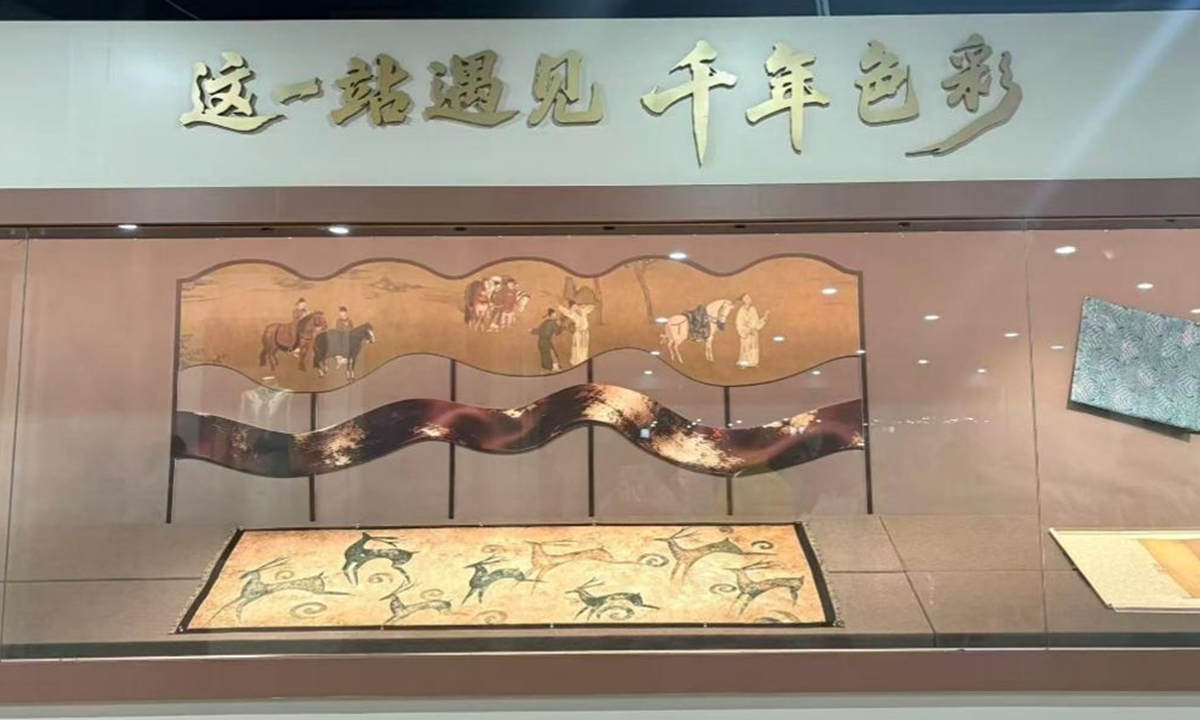
The exhibition held at a subway station in Beijing by the National Library of China and the Beijing MTR Photo: Li Hang/GT
With China's newly released Regulation on the Promotion of Nationwide Reading ready to take effect on February 1, the National Library of China (NLC) and Beijing MTR unveiled a new cultural exhibition inside the city's subway system on Thursday, turning daily commutes into opportunities for public reading and cultural immersion.As part of the 36th edition of the "M Subway • Library" program, the exhibition traces the development of Chinese color culture through history, featuring ceramics, Song Dynasty (960-1279) brocade and other artifacts known for their distinctive use of color.
Interactive color installations, AI-powered audio guides and hands-on activities such as writing the Chinese character for good fortune ahead of the Spring Festival are designed to enhance visitor engagement and immersion. An online themed reading section was also launched simultaneously, allowing commuters to access related digital content through their mobile devices.
The exhibition comes just days before the Regulation on the Promotion of Nationwide Reading is set to take effect on February 1. The initiative is a part of China's drive to cultivate a book-loving society and a socialist cultural powerhouse.
The regulation marks a shift in China's nationwide reading efforts from voluntary advocacy to a more institutionalized approach, providing a legal framework for integrating resources with promoting reading. It explicitly calls on public cultural institutions to cooperate with social organizations and private-sector partners, Huo Ruijuan, deputy director of the NLC, told the Global Times.
The regulation also advances the use of public spaces to encourage reading, particularly in environments suited to fragmented or short-duration engagement.
According to Huo, with average daily ridership exceeding 10 million, Beijing's subway system has become a key venue for short-form, or fragmented reading. The M Subway • Library program is a large-scale public cultural initiative that seeks to "turn commuting time into reading time through themed trains, station displays and an online library platform."
For many commuters, the exhibition offers a refreshing alternative to the monotony of daily travel. "It feels very natural, like traditional culture is being smoothly poured into our minds," a passenger surnamed Cao, an art and architecture student, told the Global Times on Thursday. "This kind of exhibition helps more people understand traditional culture better, and I hope there will be more like this."
Cao added that the visual richness of the display also improves the commuting environment. "If everything was just a white wall, it would cause aesthetic fatigue," he said. "More color and visual expression make public spaces more comfortable and engaging."
In addition, the regulation also calls for expanded digital reading resources, providing policy incentives for the development of technology-based services.
In response, the NLC has accelerated cooperation with technology companies, introducing AI-powered book recommendations and audio guidance systems in subway spaces. Passengers can scan QR codes at the exhibition to access e-books, creating a seamless link between physical displays and online reading.
For example, 10 curated titles related to traditional Chinese colors are available online. Each book is integrated with AI-assisted reading functions, offering smart recommendations, in-depth guides and personalized reading services to improve accessibility and the user experience.
Looking ahead, the NLC plans to expand technological applications and invite more cultural institutions and enterprises to participate in the program, aiming to make reading accessible anytime and anywhere, from private study rooms to shared public spaces, according to Huo.
Over the past decade, the project has hosted 36 themed programs, installed more than 2,700 lightbox posters, launched 16 themed trains and established two permanent station libraries. Online reading content associated with the program has been accessed more than 5.7 million times.
RELATED ARTICLES