ARTS / BOOKS
From late-night reading to community book sharing: Innovative practices of Chinese libraries
Redefining reading
By Published: Jan 28, 2026 11:52 PM

Editor's Note:
Reading is an important avenue for humans to acquire knowledge, expand wisdom and cultivate virtue. It enlightens us and helps us aim high and stand upright.
As China's first national regulations to promote public reading are set to take effect on February 1, the country is entering a new phase for its national reading initiative. The regulations explicitly call for improving reading services for different groups and advancing reading equity through institutional guarantees.
The Global Times has launched a special series to show how reading is changing people's lives. This installment looks inside China's libraries, which build vibrant bridges between readers and books.
These seemingly independent scenes are interwoven in a vivid and systematic cultural landscape. With the enactment and implementation of the Regulations on the Promotion of Public Reading, libraries across China are breaking through traditional service boundaries, blending technology, community engagement and proactive outreach to create inclusive, reader-centered experiences that bridge digital convenience with the depth of physical books.
As of the end of 2024, a total of 3,248 public libraries received 1.34 billion patrons nationwide, according to a report by the Ministry of Culture and Tourism titled "China Cultural Tourism Development Report 2024-25."
Door to in-depth reading
"Every night at 8 pm, a short reading video starts right on time. Guests from various backgrounds share their reading experiences, bidding the city good night in this way," said Xu Yibo, the director of Ningbo Library, in an interview with the Global Times.
The "Tianyi Night Reading" project follows a "one night, one person, one book" daily format, using 2-3 minutes short videos to attract over 28 million online viewers. It further guides readers to return to the in-depth experience of reading physical books.
For readers, they not only watch but also create their own recommendation videos. Inspired by one session, Li, the student, recommended The One and Only Ivan, a Newbery Medal winner based on a real gorilla's story.
Through the gorilla's eyes, the family explored themes of dignity, love, responsibility, tolerance and harmony between humans and animals. "Parent-child reading is an especially precious form of interaction, and bedtime reading serves as a gentle bond," said Li Jia, the mother.
Such efforts upgrade library services from mere access to emphasizing quality and emotional connection, aligning with the new regulations' call for tailored services for different groups.
'Mobile' space for reading
In the city of Foshan, the "Neighborhood Library" (or "N-Library") initiative, launched in 2018 by the Foshan Library, turns private homes into community hubs. Eligible families - with a solid borrowing history and residency - can borrow up to 200 books annually from the library, name their home library, and receive delivery plus training. Residents can borrow from neighbors without leaving their complex, fostering social ties and book circulation.
Huang Baichuan, director of the Foshan Library, told the Global Times that the project bridges limited public resources with unlimited family needs.
Article 27 of the new regulations supports social entities' involvement in reading services and innovative spaces, providing strong backing for such models. Thousands of families have benefited, with N-Libraries sparking community activities like reading clubs and neighborly interactions in typically reserved urban settings.
Similar rural-urban equity shines in Qingdao, East China's Shandong Province, where young entrepreneurs created the Dashi Countryside Library. Amid the scent of coffee, rooster crows, and tractor sounds, it blends modern reading with rustic charm, exemplifying balanced public cultural access.
Delivering books
For readers like Xiaomin (pseudonym) living in Ninghai's Qiangjiaobandao, a trip to the Ningbo Library once meant a nearly two-hour journey. Now, with a few taps on the "Tianyi Book Reservation" mini-program on WeChat, books are delivered to her doorstep - with a shipping fee of just 4 yuan (57 cents) for up to three books.
"Borrowing books is as convenient as ordering takeout," Xiaomin said. Launched in 2018, this service operates on an innovative model that integrates libraries, an online platform and a logistics network. Leveraging a credit system, it enables online borrowing, home delivery, and even drop-offs at nearby smart book lockers.
When the popular TV series Sunshine in Me neared its finale, many viewers were delighted to find multiple copies of the original novel already available at the Ningbo Library. This timely access resulted from proactive efforts by the library's resource curation team, which anticipated demand and planned ahead.
"The role of librarians has evolved beyond passively accepting orders," explained director Xu.
The team monitors social trends in real-time and maintains close communication with publishers and bookstores to ensure hot books are promptly stocked. On the day the Nobel Prize in Literature is announced, librarians even wait alongside bookstore staff to ensure award-winning works are available for borrowing the very next day.
Reader-centered services
As night falls, most areas of the Beijing City Library close, but the 24-hour reading space on the first floor, Luyunzhu, remains brightly lit. Within two large ring-shaped areas of natural wood tone, readers are fully absorbed - some in books, others taking notes or deep in thought - as if time has stood still.
"Ever since I found this late-night library online, I've been coming here to read after work," said Jia, a reader who sometimes stays until the early morning. The establishment of 24-hour reading spaces not only shatters these time restrictions but also reflects a profound shift in public services from a "supply-oriented" to a "demand-oriented" approach.
"A 'one-size-fits-all' approach is not applicable to public services, which should instead deliver personalized services to different user groups," Xu summarized.
Reading is an important avenue for humans to acquire knowledge, expand wisdom and cultivate virtue. It enlightens us and helps us aim high and stand upright.
As China's first national regulations to promote public reading are set to take effect on February 1, the country is entering a new phase for its national reading initiative. The regulations explicitly call for improving reading services for different groups and advancing reading equity through institutional guarantees.
The Global Times has launched a special series to show how reading is changing people's lives. This installment looks inside China's libraries, which build vibrant bridges between readers and books.
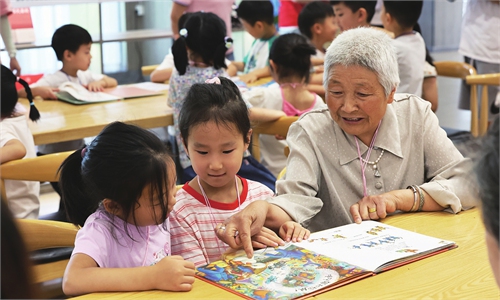
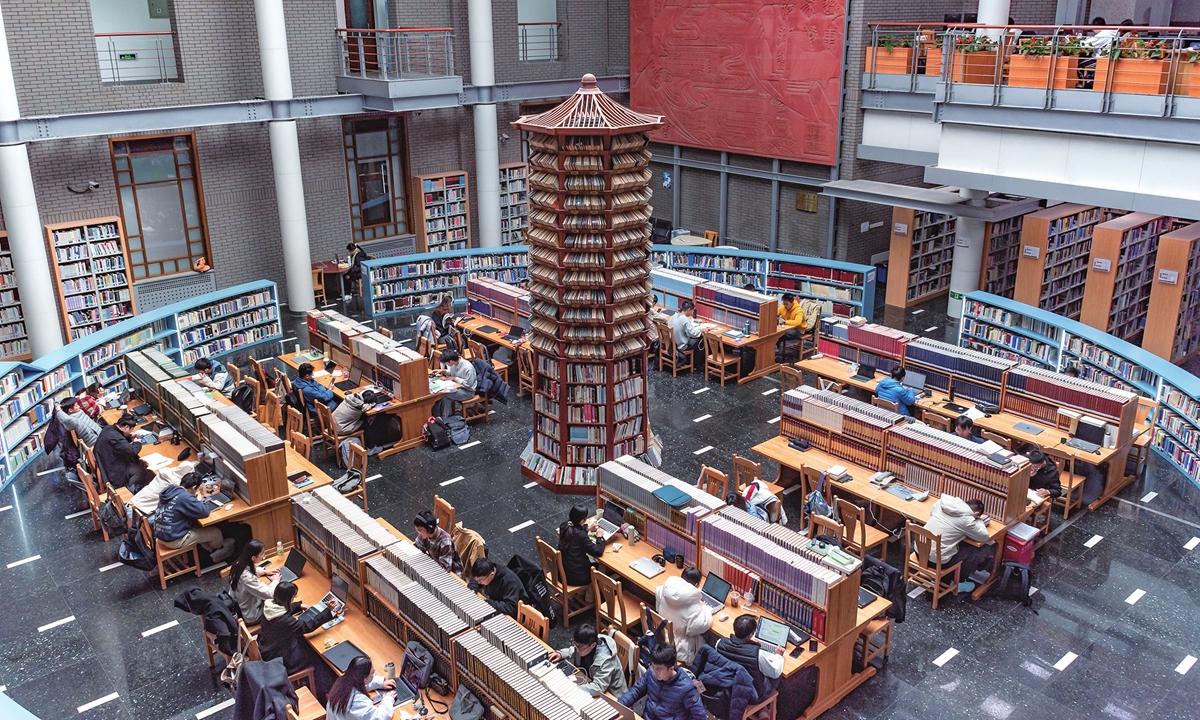
Students read in the Sunny Lobby at the Peking University Library in Beijing on October 23, 2025. Photo: VCG
When the clock strikes eight in the evening, third grader Li Peiwen and her mother Li Jia unlock their phone and are greeted by the warm voice of the "Tianyi Night Reading" program from the Ningbo Library in East China's Zhejiang Province. Late at night over 1,000 kilometers away in Beijing, reader Jia Ying gently turns the pages of a book in the Luyunzhu 24-hour reading area of the Beijing City Library. Meanwhile, residents of a residential community in Foshan, South China's Guangdong Province borrow books they like from a "Family Library" at a neighbor's home.These seemingly independent scenes are interwoven in a vivid and systematic cultural landscape. With the enactment and implementation of the Regulations on the Promotion of Public Reading, libraries across China are breaking through traditional service boundaries, blending technology, community engagement and proactive outreach to create inclusive, reader-centered experiences that bridge digital convenience with the depth of physical books.
As of the end of 2024, a total of 3,248 public libraries received 1.34 billion patrons nationwide, according to a report by the Ministry of Culture and Tourism titled "China Cultural Tourism Development Report 2024-25."
Door to in-depth reading
"Every night at 8 pm, a short reading video starts right on time. Guests from various backgrounds share their reading experiences, bidding the city good night in this way," said Xu Yibo, the director of Ningbo Library, in an interview with the Global Times.
The "Tianyi Night Reading" project follows a "one night, one person, one book" daily format, using 2-3 minutes short videos to attract over 28 million online viewers. It further guides readers to return to the in-depth experience of reading physical books.
For readers, they not only watch but also create their own recommendation videos. Inspired by one session, Li, the student, recommended The One and Only Ivan, a Newbery Medal winner based on a real gorilla's story.
Through the gorilla's eyes, the family explored themes of dignity, love, responsibility, tolerance and harmony between humans and animals. "Parent-child reading is an especially precious form of interaction, and bedtime reading serves as a gentle bond," said Li Jia, the mother.
Such efforts upgrade library services from mere access to emphasizing quality and emotional connection, aligning with the new regulations' call for tailored services for different groups.
'Mobile' space for reading
In the city of Foshan, the "Neighborhood Library" (or "N-Library") initiative, launched in 2018 by the Foshan Library, turns private homes into community hubs. Eligible families - with a solid borrowing history and residency - can borrow up to 200 books annually from the library, name their home library, and receive delivery plus training. Residents can borrow from neighbors without leaving their complex, fostering social ties and book circulation.
Huang Baichuan, director of the Foshan Library, told the Global Times that the project bridges limited public resources with unlimited family needs.
Article 27 of the new regulations supports social entities' involvement in reading services and innovative spaces, providing strong backing for such models. Thousands of families have benefited, with N-Libraries sparking community activities like reading clubs and neighborly interactions in typically reserved urban settings.
Similar rural-urban equity shines in Qingdao, East China's Shandong Province, where young entrepreneurs created the Dashi Countryside Library. Amid the scent of coffee, rooster crows, and tractor sounds, it blends modern reading with rustic charm, exemplifying balanced public cultural access.
Delivering books
For readers like Xiaomin (pseudonym) living in Ninghai's Qiangjiaobandao, a trip to the Ningbo Library once meant a nearly two-hour journey. Now, with a few taps on the "Tianyi Book Reservation" mini-program on WeChat, books are delivered to her doorstep - with a shipping fee of just 4 yuan (57 cents) for up to three books.
"Borrowing books is as convenient as ordering takeout," Xiaomin said. Launched in 2018, this service operates on an innovative model that integrates libraries, an online platform and a logistics network. Leveraging a credit system, it enables online borrowing, home delivery, and even drop-offs at nearby smart book lockers.
When the popular TV series Sunshine in Me neared its finale, many viewers were delighted to find multiple copies of the original novel already available at the Ningbo Library. This timely access resulted from proactive efforts by the library's resource curation team, which anticipated demand and planned ahead.
"The role of librarians has evolved beyond passively accepting orders," explained director Xu.
The team monitors social trends in real-time and maintains close communication with publishers and bookstores to ensure hot books are promptly stocked. On the day the Nobel Prize in Literature is announced, librarians even wait alongside bookstore staff to ensure award-winning works are available for borrowing the very next day.
Reader-centered services
As night falls, most areas of the Beijing City Library close, but the 24-hour reading space on the first floor, Luyunzhu, remains brightly lit. Within two large ring-shaped areas of natural wood tone, readers are fully absorbed - some in books, others taking notes or deep in thought - as if time has stood still.
"Ever since I found this late-night library online, I've been coming here to read after work," said Jia, a reader who sometimes stays until the early morning. The establishment of 24-hour reading spaces not only shatters these time restrictions but also reflects a profound shift in public services from a "supply-oriented" to a "demand-oriented" approach.
"A 'one-size-fits-all' approach is not applicable to public services, which should instead deliver personalized services to different user groups," Xu summarized.
RELATED ARTICLES