IN-DEPTH / IN-DEPTH
Deep focus: China's largest landfill relocation project in Shenzhen reflects nation's leap in waste-to-energy technology, urban governance
Where has the garbage gone?
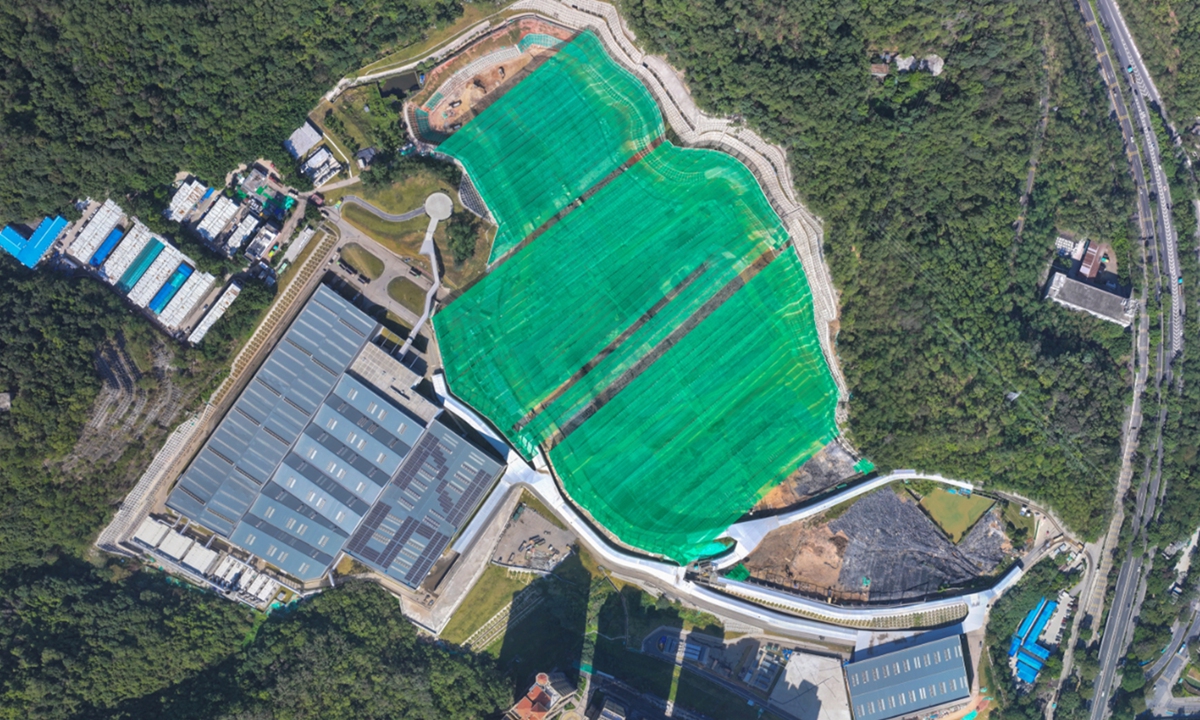
A view of the Yulong landfill, China's largest full-excavation relocation project Photo: Courtesy of Luohu district government
The foot of the Yinhu Mountain in Luohu district in Shenzhen, South China's Guangdong Province, is abuzz with activity in the early morning. The Yulong landfill, once Shenzhen's largest dumping ground, is now undergoing the nation's largest full-excavation relocation project, the Global Times learned from the Luohu district government.About 2.55 million cubic meters of waste has lain undisturbed in the Yulong landfill for two decades - a volume large enough to fill 1,000 international competition-standard swimming pools. Now, a massive green canopy spans 116,900 square meters above the Yulong landfill, and dozens of excavators are operating at full throttle beneath the canopy, making it appear as if the landfill is undergoing an unprecedented "surgery to resect an urban tumor," according to the Luohu district government.
This special "surgery" has sparked public curiosity on China's social media platforms over how the decades of trash are likely to be disposed of. Meanwhile, as a Chinese-funded waste-to-energy plant was launched in December 2025 in Bishkek, the capital of Kyrgyzstan, overseas netizens are also paying greater attention to China's waste treatment technologies. The topic "China is running out of garbage" has even become a hit on overseas social media platforms.
Where has all of China's waste gone? The answer is that it has been converted into energy, powering the daily lives of households nationwide and serving as the most robust driving force in the "capillaries" of urban governance.
From waste to watts
The Yulong landfill was commissioned in 1983 as an urban waste disposal terminal in Shenzhen and was commonly known as "Yulong keng" (Yulong hollow) by locals back then. The landfill was officially closed at the end of 2005.
Located near the city center, the massive waste pile in the Yulong landfill had long been an urban eyesore, plaguing nearby communities with odor, leachate, groundwater pollution, and geological risks. Meanwhile, the acute shortage of land resources has forced the city to fundamentally explore new approaches to tackling this waste pile problem.
In 2024, with the implementation of Shenzhen's strategy of "holistic planning and contiguous development," the landfill saw a transformative turning point.
Now, at the site equipped with sound barriers, trucks transport different categories of waste to screening facilities, environmental parks, and recycling enterprises. The project handles 6,000 cubic meters of excavated refuse daily, with a screening capacity of 5,000 tons, according to the Luohu district government.
The waste in the Yulong landfill includes muck, household waste, construction and demolition waste, sludge, and contaminated soil from the landfill's base. After sorting, light fractions of the household waste are transported to the energy ecological park for incineration, realizing resource valorization, Zhao Lichao, who is in charge of the Yulong landfill project under the Shenzhen Energy Environment Co Ltd (SEE), told the Global Times.
"In the incineration workshop, after full combustion, the flue gas generated remains at a high temperature of over 850 C for at least 2 seconds to completely decompose dioxins. Through multiple stages of purification, the final flue gas emission indicators outperform EU standards," Zhao said. He added that after sorting the aged waste at the Yulong landfill, the designed volume of light combustible materials stands at 330,000 tons, which can generate 100 million kilowatt-hours of electricity upon incineration - equivalent to the annual electricity consumption of 26,000 households.
The benefits of the restoration of the Yulong landfill are more than just power generation.
According to the district government, the restored site will release approximately 300,000 square meters of land for industries, positioned as a "digital innovation valley." It will focus on artificial intelligence, health technologies, and the digital economy aligned with Shenzhen's strategic emerging industries.
'Far ahead' technology
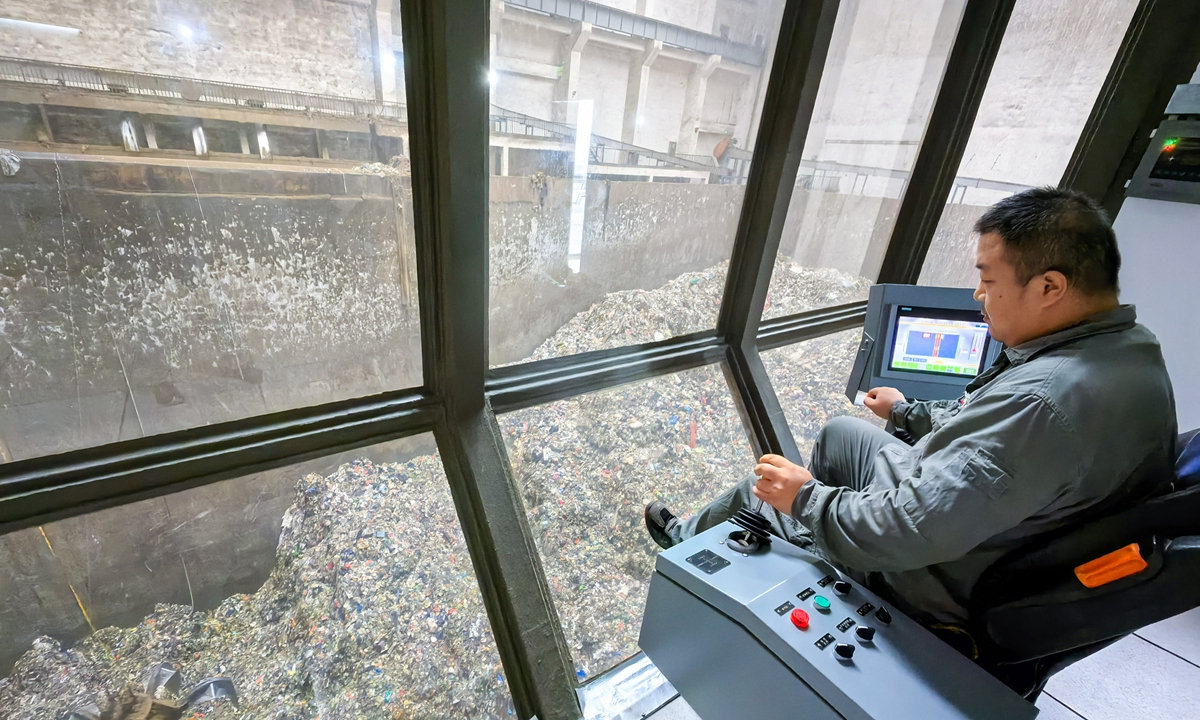
A worker operates a garbage crane to conduct zonal fermentation of waste in Jinan, East China's Shandong Province. Photo: VCG
It is not just Shenzhen that has welcomed this innovation. In recent years, a "revolution" in waste treatment has been quietly unfolding across China. Such a move is more than a simple environmental remediation project; it may reshape the underlying logic of urban development."Aged landfills lack anti-seepage systems and are like a tumor in the urban organism. Full-scale excavation and ecological remediation amount to performing a sophisticated surgical operation on the city, eradicating the lesion completely and allowing this piece of land to regain its vitality. Such a project not only addresses the longstanding environmental problems left over from the past, but also provides a new spatial carrier for the integration of industry and city, as well as new insights for the sustainable development of megacities," Xu Qiyong, deputy director of the School of Environment and Energy, Peking University, was quoted as saying by the Shenzhen Evening News.
Such a nationwide "surgical operation" becomes possible with China's advanced waste-to-energy technologies and comprehensive policy support.
During a visit to the Asuwei Domestic Waste Incineration Power Plant in northern Beijing, Global Times reporters found that the facility, which processes up to 3,000 tons of household waste daily, operates in a clean, orderly, and tightly controlled environment. The plant handles all waste from Changping district as well as the northern parts of Dongcheng and Xicheng districts in Beijing.
From a control room overlooking a massive waste storage pit, reporters observed fully enclosed garbage trucks entering the unloading area after weighing. Instead of being incinerated immediately, the waste is stored for five to seven days for fermentation - a process that increases its calorific value and improves the efficiency of subsequent incineration.
After fermentation, the waste is incinerated and converted into slag through drying, combustion, and burnout, with the released heat used to generate electricity. The plant supplies about 420 million kilowatt-hours of green power to the Beijing grid each year. More than 90 percent of byproducts are reused, including recovered metals such as iron and aluminum and the production of eco-friendly construction materials, the Global Times learned from staff at the plant.
Moreover, advanced flue gas purification technologies keep emissions of major pollutants below EU standards, while treated leachate is recycled through a closed-loop system, achieving zero wastewater discharge.
The facility is also open to public visits, helping residents better understand modern waste treatment.
"Far ahead." That's how Pan Gong, director and chief industry researcher of the E20 Environment Platform's Solid Waste Industry Research Center, described the current state of Chinese waste-to-energy technology.
Pan told the Global Times that Chinese enterprises now lead the world in technology, cost control, and operational experience.
Pan pointed out that the current leading position of China's waste incineration technology is mainly reflected in the following aspects: Based on the country's large population, the tonnage of individual grate furnaces is relatively high; most equipment and components have been domestically produced, achieving independent control over the entire industry chain from waste collection and incineration to flue gas treatment. In many specific application scenarios, China has surpassed other countries.
At a press conference held by the State Council Information Office in September 2025, Vice Minister of Ecology and Environment Li Gao noted that since the start of the 14th Five-Year Plan (2021-25), China has made significant progress in the prevention and control of solid waste pollution.
Li said at the press conference that a historic full ban on foreign waste imports had been implemented in China; the national centralized utilization and disposal capacity for hazardous waste had reached 223 million tons per year, and the daily incineration capacity for household waste had hit 1.141 million tons - representing increases of 58.8 percent and 72.4 percent, respectively, compared with the end of the 13th Five-Year Plan period (2016-2020).
Looking forward, looking outward
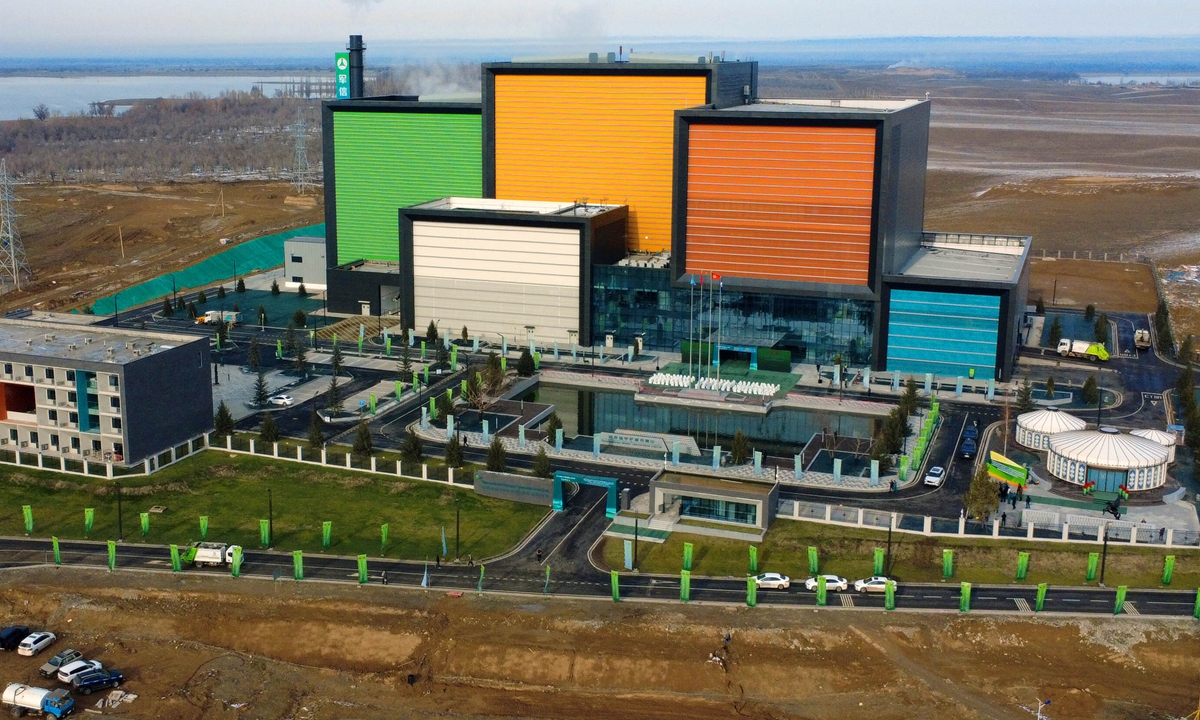
A view of the Chinese-funded Eco-Technological Waste Incineration and Energy Production Facility, which generates electricity from household waste recycling, is pictured in Bishkek, Kyrgyzstan, on December 27, 2025. Photo: VCG
At a regular policy briefing hosted by the State Council Information Office on January 13, it was revealed that in 2026, the National Development and Reform Commission will lead the formulation of the 15th Five-Year Plan (2026-30) for the development of a circular economy, the Xinhua News Agency reported.The plan will focus on key initiatives for the recycling and reuse of traditional renewable resources, rare and precious metals, and the so-called "new trio" of solid waste - decommissioned power batteries, photovoltaic modules, and wind turbine blades, according to the report.
Xinhua quoted the Ministry of Ecology and Environment as saying that by 2030, China is expected to generate approximately 1.5 to 2 million tons of photovoltaic module waste, 500,000 tons of wind turbine blade waste, and 1 million tons of used power battery waste.
China will further promote the construction of "zero-waste cities," aiming to expand the initiative to around 200 cities, the ministry announced at a press conference on January 13.
China is also sharing its experiences and technologies with the world.
Speaking at the launch ceremony of a Chinese-funded waste-to-energy plant, which generates electricity from waste recycling, Kyrgyz President Sadyr Japarov said the factory would help solve waste processing issues while generating electricity and creating jobs. He added that the project would significantly improve environmental conditions in the capital and contribute to electricity supply for the population, Xinhua reported.
According to data released by the China Environmental Protection Association, China's export value of waste treatment equipment in 2025 was expected to break through $5 billion. In addition, as of May 2025, Chinese enterprises had been involved in 79 overseas waste-to-energy projects.
In Southeast Asia, Central Asia, and other regions, waste-to-energy plants constructed with Chinese technologies and standards not only address the challenges of waste disposal, but also supply clean electricity to local communities and drive the green transformation of local economic structures, according to the association.
Faced with differentiated scenarios such as high-calorific-value industrial solid waste in the Middle East and high-humidity municipal solid waste in Southeast Asia, Chinese enterprises have developed innovative technical solutions, ending the long-standing dominance of European and American enterprises in this field. The "going global" of China's waste-to-energy industry has become a key component of China's participation in global environmental governance and international green development, according to the environmental association.
RELATED ARTICLES