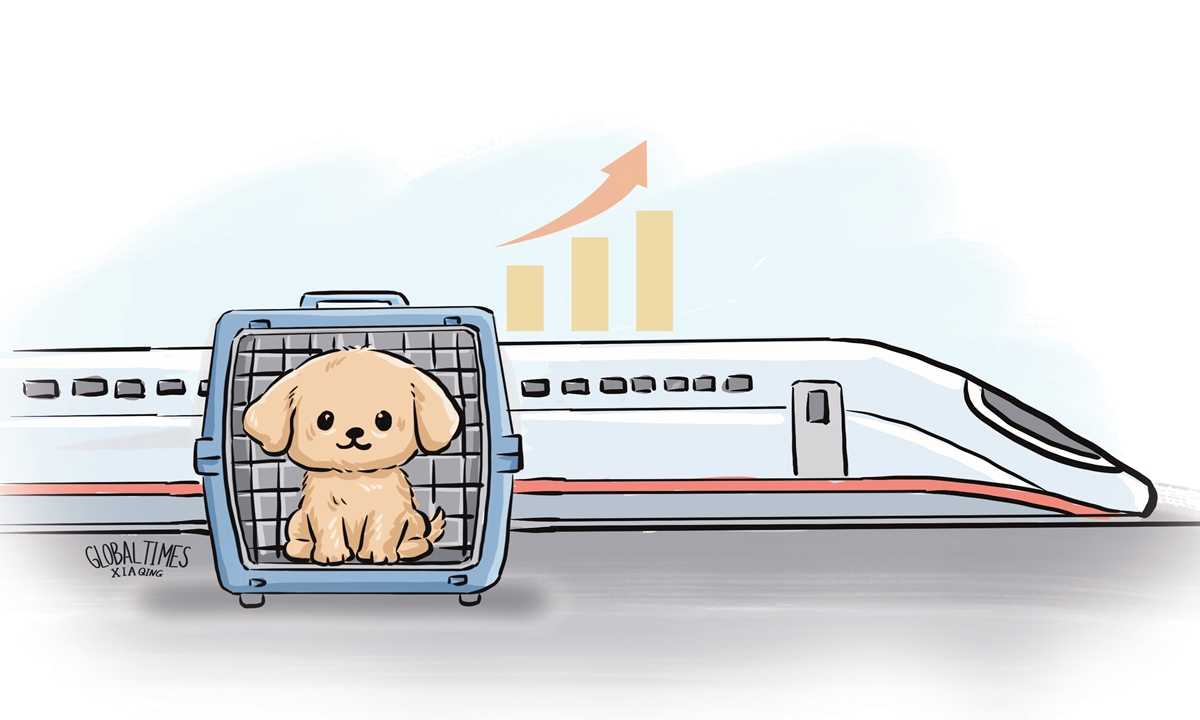
Illustration: Xia Qing/GT
Amid this year's Spring Festival travel rush, the high-speed rail pet transportation service has been extended to 67 additional stations, bringing the total to 110 stations nationwide. The number of high-speed trains offering the service has risen from 54 to 170, CCTV News reported on Thursday. This rapid expansion demonstrates that consumer demand for specialized services is influencing how industries operate at scale in the pet market.The rise of pet-related travel services during the Spring Festival - the busiest time of the year for railway transportation - signals more than rising demand in the pet economy. It reflects how China's economy is evolving to meet more diverse, sophisticated, and emotionally driven consumer demand. By catering to the growing pet market segment that demands quality, personalization, and convenience, businesses are incentivized to innovate across industries, while foreign companies can find entry points in differentiated offerings.
China's booming pet economy is expanding across the entire industrial chain, spanning sectors from travel and fashion to healthcare. The urban market for dog and cat consumption exceeded 300 billion yuan ($43.2 billion) in 2024, a 7.5 percent year-on-year increase, according to a consumption report released by Petdata, a big data online platform in the pet industry.
Another report from iiMedia Research predicted the market will reach a scale of 1.15 trillion yuan by 2028. This sector's size and growth prospects show that pet-related services, from travel to healthcare, are part of a mainstream and expanding consumer economy.
Booming and increasingly diverse consumer demand is driving the emergence of new business models and creating growth opportunities for both domestic and international companies. Beyond the transport sector, including railways and airlines, hotels and other hospitality providers are introducing pet-friendly services, seizing the chance to tap into this fast-growing market. This trend highlights how pet-related consumption is not only expanding in scale but also stimulating innovation across multiple industries, from travel and accommodation to retail and healthcare.
In Changzhou, East China's Jiangsu Province, several tourist attractions have turned pet-friendly amenities into strategic selling points, upgrading pet hotels, adding facilities, and selling related products to attract visitors traveling with their pets, according to an August 2025 report by China City News. These examples demonstrate how consumer preferences are shaping service design, encouraging companies to invest in new business models and customer experiences.
The involvement of foreign companies further underscores the economic significance of China's pet market. International brands have introduced all kinds of products in traditional pet stores and supermarkets and on e-commerce platforms. This shows that China's pet economy opportunities are not confined to domestic firms; the sector offers opportunities for international companies to introduce innovative products and services to an increasingly sophisticated consumer base.
For instance, 1,724 overseas pet brands opened their first stores on Tmall Global in the first three quarters of 2025. In the third quarter alone, 657 new brands joined, averaging seven new entries per day. These new brands came from 43 countries and regions, led by the US, South Korea, Australia, Japan, and New Zealand, with South Korean brands growing the fastest at more than 40 percent year-on-year, China.com.cn reported in October. This rapid influx of international brands highlights both the scale of consumer demand and the appetite for high-quality, differentiated offerings in China's pet market.
The evolution of China's pet economy mirrors broader trends in the country's economic and consumption transformation. First, pet owners are seeking higher-quality, more personalized experiences, whether in transport, hospitality, or healthcare. Second, the market is diversifying, with new niches and sub-sectors emerging, from smart pet devices to specialized insurance and premium dietary products. Third, infrastructure and digital platforms are enabling faster adoption of innovative services, allowing even complex or non-standard sources of demand such as pet travel during the Spring Festival to be met at scale.
These factors illustrate a shift from consumption that emphasizes quantity to consumption that emphasizes quality, convenience, and lifestyle alignment.
The author is a reporter with the Global Times. bizopinion@globaltimes.com.cn
RELATED ARTICLES