Illustration: Liu Xiangya/GT
As of the end of 2025, China's total flying population - people who have taken at least one flight - exceeded 500 million, making it the world's largest, according to Song Zhiyong, administrator of the Civil Aviation Administration of China, as cited by the Xinhua News Agency. The relevance of this milestone extends beyond scale alone. In a country where an extensive high-speed rail network already serves medium- and long-distance travel demand, the continued expansion of air travel offers a revealing window into the evolving dynamics and layered demand of China's vast domestic market.The civil aviation industry carried 770 million passenger trips in 2025, up 5.5 percent year-on-year. Song Zhiyong said that in 2026, the industry is expected to carry 810 million passenger trips, according to Xinhua.
These figures point to a deeper shift in how Chinese people travel over medium and long distances. Despite a well-developed high-speed rail network, air travel continues to expand, reflecting rising cross-regional business trips, interprovincial labor mobility, and tourism. This situation is not the result of short-term stimulus; it is underpinned by stable spending power, the emergence of city clusters, and the coordinated development of industries across regions.
Income growth has strengthened demand for higher-quality travel. According to the National Bureau of Statistics, per capita disposable income in China reached 32,509 yuan ($4,656) in the first three quarters of 2025, a nominal increase of 5.1 percent from the previous year. This not only boosts tourism spending but also expands the willingness to pay for business travel and long-distance visits.
At the same time, the concentration of economic activity in city clusters and ongoing industrial upgrading has driven growth in intercity business travel and labor mobility. In major clusters such as the Yangtze River Delta, Beijing-Tianjin-Hebei, and Guangdong-Hong Kong-Macao, expanding economic scales and population densities have made the demand for fast and flexible air transport more prominent. Under the combined influence of rising incomes and urban spatial distribution, the growth of China's aviation market reflects both consumer upgrading and economic development.
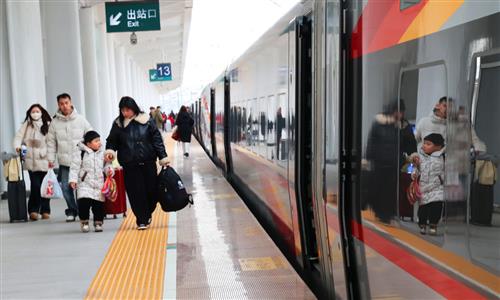
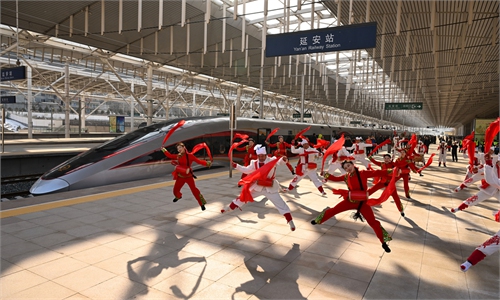
The expansion of air travel does not signal a slowdown in high-speed rail development. On the contrary, China's high-speed rail network continues to advance rapidly. With the opening of the high-speed rail line from Xi'an to Yan'an in Northwest China's Shaanxi Province on December 26, 2025, China's total operational high-speed rail length surpassed 50,000 kilometers - more than the total high-speed rail networks of all other countries combined, Xinhua reported.
China's high-speed rail network continues to expand to more cities and regions. New lines significantly reduce travel time between cities and boost economic development along the routes, creating more "one-hour travel zones" and accelerating high-quality regional development.
The combination of air, rail, and other modes of transport, including road networks, has fostered a rapidly expanding consumer market. As this market grows, it creates significant opportunities for upstream and downstream industries, from aircraft manufacturing to logistics and related services.
China's role as an important consumer market extends well beyond medium- and long-distance travel. In sectors ranging from smartphones to personal computers, the country ranks among the world's most important markets, providing multinational companies with substantial opportunities. These opportunities can be considered along several dimensions.
First, there is scale. With a population exceeding 1.4 billion, China ranks as the world's second-largest consumer market. Such scale offers not only cost efficiencies but also a fertile environment for innovation. Rapid technological iteration in recent years has allowed new technologies to find markets in China quickly, facilitating the practical application of advanced developments - a dynamic closely tied to the advantages of a super-sized domestic market.
Second, there is expansion. The continued rise in aviation volumes reflects the enduring vitality of China's large-scale market. As living standards improve, the aviation population - already surpassing 500 million - is expected to expand further. Similarly, many niche markets retain room for growth even after reaching a substantial size, creating fresh opportunities for investment and innovation.
Third, there is diversity. In the medium- and long-distance travel market, the coexistence of high-speed rail and aviation has produced a multifaceted transport landscape. This diversity of demand is seen across other consumer sectors, where preferences and consumption patterns vary widely, underscoring the market's structural complexity.
For international companies, the value of China's super-sized market is increasingly evident in its scale, dynamism, and diversity. It is through the interplay of these factors that opportunities within China's domestic market become clearest, offering insights for businesses seeking to navigate one of the world's most complex and fast-evolving consumer landscapes.
The author is a reporter with the Global Times. bizopinion@globaltimes.com.cn
RELATED ARTICLES