Merz’s ‘partners not subordinates’ speech highlights EU’s seek for equality, unity in geopolitical realities: Chinese expert
By Published: Jan 30, 2026 02:01 PM

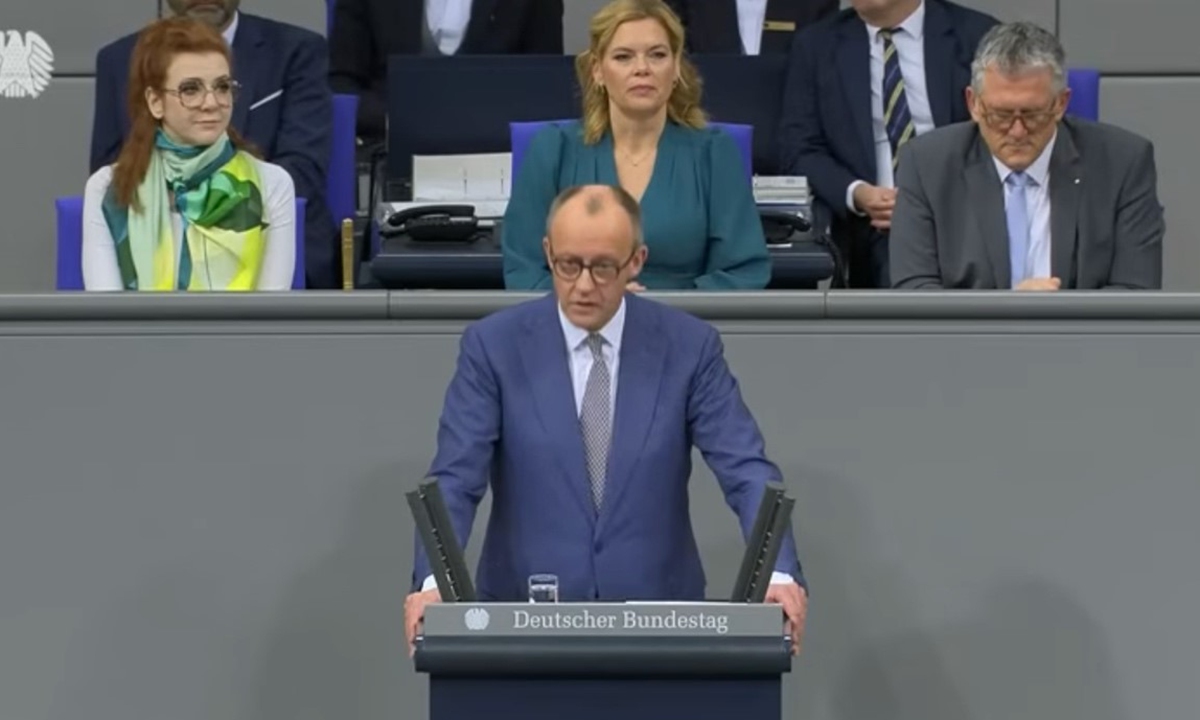
Screenshot of German Chancellor Friedrich Merz's speech to the parliament Photo: DW
In a speech to the German parliament on Thursday, German Chancellor Friedrich Merz said "As democracies, we are partners and allies, not subordinates." The remark, along with his calls for greater EU unity and for pushing back against Washington on multiple fronts, was singled out in some media reports.According to a video released by German media Deutsche Welle (DW), Merz's speech to the Bundestag in Berlin on Thursday lasted around 25 minutes. At the beginning part he said that "for several weeks now, we have been seeing ever more clearly that a world of great powers is beginning to take shape," and added that "we are seeing ever more clearly where these changes are also creating new opportunities — new opportunities for our country, and above all new opportunities for us in Europe."
While talking about the transatlantic relations, Merz said that "as democracies, we are partners and allies, not subordinates." He also noted that "we want to be part of a dynamic and agile network of sovereign states who want to continue working within a rules-based order," according to DW.
He said Germany will always be open to cooperation with the US but only as long as those basic principles remain.
Merz has also hailed Europe's "unity and determination" in standing up to US President Donald Trump's tariff threats over the Greenland crisis and called upon the continent to act with greater self-confidence on the global stage, according to DW. "We were all in agreement that we would not allow ourselves to be intimidated by tariff threats," he said. "If anyone in the world thinks they can play politics by threatening tariffs against Europe, they now know that we can and will defend ourselves."
In his address, Merz sought to deliver a dual message to both Europe and the US: reaffirming the transatlantic alliance as a core strategic value while insisting that Europe be treated as an equal and stressing the need for EU unity in dealing with new geopolitical realities, Sun Keqin, a research fellow at the China Institutes of Contemporary International Relations, told the Global Times on Friday.
Seen as a "conservative Atlanticist," Merz had aligned closely with Washington on key issues after taking office. Yet the US' recent actions toward the EU, especially on Greenland and tariffs have frustrated the Europe and the Germany with increasing voice calling for autonomy, said Sun.
He noted that as Berlin has traditionally acted as a "glue" in transatlantic relations, rather than open confrontation, Berlin follows a strategy of working within alliances and institutions to preserve transatlantic ties while steadily strengthening both European and German capabilities.
While reporting on Merz's speech, many media outlets highlighted his remarks. For example, a Reuters report noted that Merz said on Thursday that Europe had found "self-respect" in standing up for a rules-based global order and called for a stronger NATO within Europe while still extending a hand of cooperation to the US.
Merz's speech underscored how European leaders have been emboldened to try to project European strength and values, after the standoff with Trump over Greenland, global trade ructions and nearly four years of war between Russia and Ukraine, per Reuters.
In a report on Thursday local time, Politico.eu singled out Merz's remarks that Europe will not withstand a new era of rising great-power imperialism unless it embraces the logic of hard power.
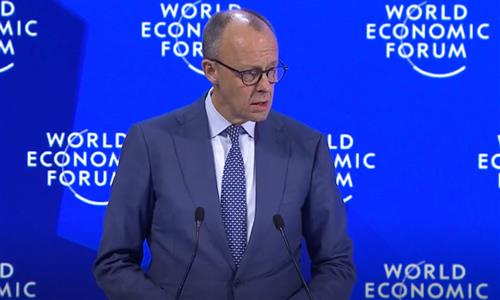
The report also noted that Merz's comments build on a speech the chancellor delivered last week at the World Economic Forum in Davos, in which he warned of a "radically changing" US and "a new world of great powers being built on power, on strength, and, when it comes to it, on force."
Recent US actions have highlighted a mix of conservatism and hegemonic impulses that have frustrated many European countries and other middle powers, including Canada. Whether Germany or any other country will take the lead in pursuing greater strategic autonomy remains to be seen, as different countries are exploring their own approaches to navigate the new geopolitical realities, said Sun.
During a speech at the World Economic Forum in Davos, Merz outlined how the new German government is assessing what he described as "tectonic shifts" in the global landscape and shaping its response, saying he shared the view expressed by Canadian Prime Minister Mark Carney in Davos.
Together with Carney's speech, the remarks of Merz reveal a deeper sense of anxiety in Europe and among some middle powers, including Canada, yet a lack effective means to respond to it, Jiang Feng, a senior research fellow at Shanghai International Studies University, told the Global Times previously. He noted that the current extreme crisis situations may serve as a catalyst for greater European unity but the problem lies in the lack of political resolve to unite around shared strategic goals, said Jiang.
While in an article of Germany's Der Spiegel magazine on January 23, it said that "the EU should still be strong enough to take its fate into its own hands. It simply has to be willing to do so—and must avoid sabotaging itself."
This requires abandoning the illusion that the US under Trump remains a partner, painful as that may be, said the article.
RELATED ARTICLES