IN-DEPTH / IN-DEPTH
Renewed popularity of wolf documentary reveals China’s ongoing commitment to biodiversity and wetland protection
By Published: Jan 30, 2026 10:31 PM

Editor's Note:
Xi Jinping, general secretary of the Communist Party of China (CPC) Central Committee, Chinese president, and chairman of the Central Military Commission, has stressed that the environment concerns the well-being of people in all countries. During his inspections, Xi has always paid great attention to ecosystems, spanning from cities to rural areas, and from enterprises to communities.
Under the guidance of Chinese President Xi Jinping's Thought on Ecological Civilization, China has been advancing the green transition of its economy over the last decade. Regions across the country are actively promoting the construction of ecological civilization and advancing Chinese modernization featuring harmony between humanity and nature. These efforts are creating a "Beautiful China."
The coming five years will be critical to the building of a "Beautiful China." The Global Times is launching a series of stories to explore the progress of ecological civilization projects that Xi is concerned with, delving into the positive environmental changes occurring now, and offering valuable insights and references for both national and global efforts. From these practical examples, we can see how Xi's thought on ecological civilization is put into practice and further inspires public action.
In this installment, we turn our focus to the Ruoergai grassland in Southwest China's Sichuan Province, where patrollers, along with generations of herders, scientists and conservationists, have joined forces to protect the region's precious wildlife and fragile wetland ecosystem.
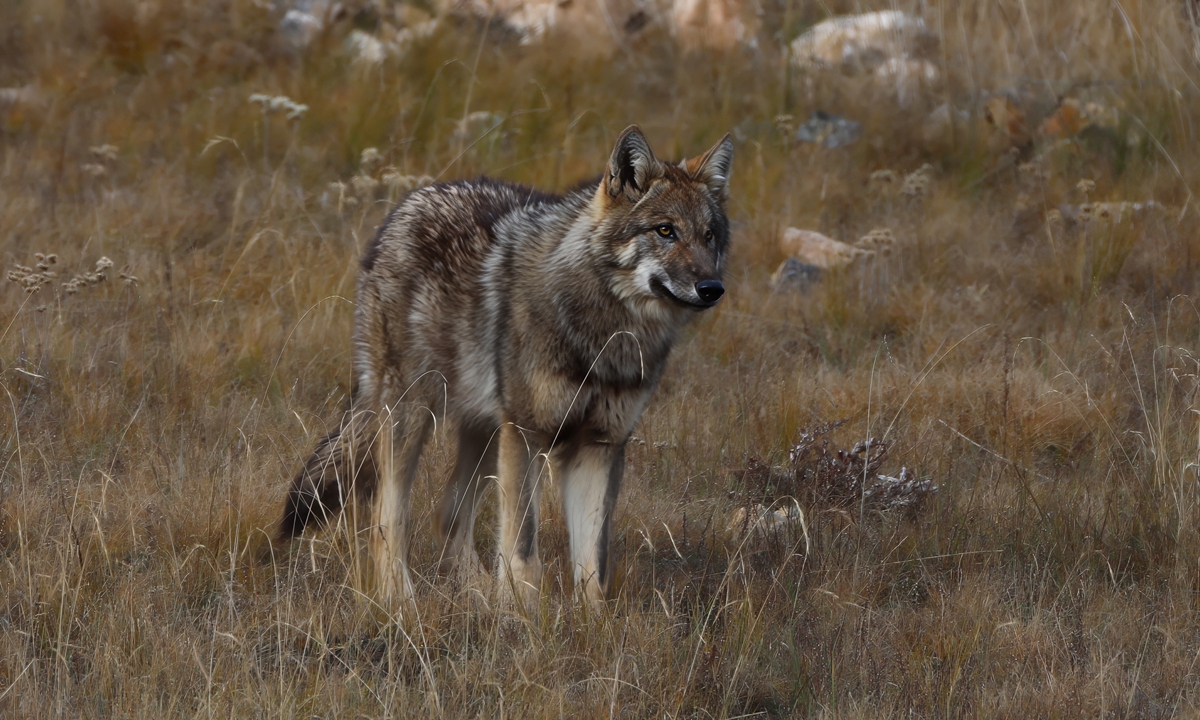
In recent months, a documentary released in 2017, Return to the Wolves, has seen a surge of renewed attention years after its release, bringing wolves - a species native to the Qinghai-Xizang Plateau - back into the public eye.
The story captured on film is frozen in the specific era around 2010, preserving a fragment of memory about the Ruoergai grasslands on the fringe of the plateau.
The documentary Return to the Wolves tells the story of how, in 2010, Li Weiyi, a wildlife painter, rescued a wolf cub on the Ruoergai grasslands in Southwest China's Sichuan Province.
She took the cub home, named it Gelin, and raised it for three months. She later brought Gelin back to the grassland and spent seven months helping it return to a wild wolf pack.
Li and director Yi Feng documented their 10 months with Gelin on camera, producing the documentary. After the film's release, Li continued to follow the fate of wild wolves. In 2020, she was reunited with Gelin on the grassland. The two gazed at each other for a long time, and Li discovered that Gelin had also grown old, according to a report by The Paper.
Nearly a decade later, film commentary videos on short-video platforms have revisited Gelin's story, bringing this fairy-tale-like memory back into the public eye. On Douyin, the most influential commentary video has garnered more than 9.9 million likes, while on Rednote, related topics have accumulated over 330 million views.
However, beyond the camera lens, this high-altitude wetland, located in the upper reaches of the Yellow River and the Yangtze River, has not remained at the point in time when the story unfolded.
Over the past decade or so, in response to real challenges such as grassland degradation, wetland shrinkage and biodiversity protection, local forestry and grassland authorities, along with reserve management institutions, have continued to advance systematic ecological restoration and long-term conservation. One concrete and meticulous task after another has been carried out across the open wilderness.
Today, as people once again talk about "wolves," what truly deserves to be told about Ruoergai is not just the animal itself, but the quiet ecological changes that have taken place over the years, and the continuously functioning governance practices that support the return of life.
Behind the scene
"The film depicts events from more than a decade ago - things were indeed different from now," Sonam Dorje told the Global Times. He is head of the scientific research division at the administration of the Sichuan Ruoergai Wetland National Nature Reserve, and has long been engaged in wildlife monitoring and ecological surveys. In his view, the film captures one slice of the early stages of ecological protection in Ruoergai, rather than a complete picture.
In fact, ecological protection efforts in Ruoergai have not ceased since the period documented in the film. Focusing on grasslands, wetlands and wildlife, local forestry and grassland authorities have steadily advanced systematic governance and long-term monitoring. The story of wolves did not end with the film's conclusion, but was instead incorporated into a more rational and sustained conservation framework.
In wolf monitoring, the reserve has worked with research institutions to carry out multiple rounds of systematic surveys. These efforts are based on infrared camera monitoring and field trace investigations, gradually forming a relatively complete body of data.
As of 2023, the wild wolf population in the three adjacent Sichuan counties of Ruoergai, Hongyuan and Aba - collectively known as the Greater Ruoergai Wetlands - reached 343, up from around 200 in 2020.
This growth reflects extensive ecological efforts.
For instance, wetlands restoration, desertification control, and grassland-livestock balance were advanced through habitat improvement, water conservation, and sustainable grazing practices. Meanwhile, a patrol and monitoring network was established, and public awareness campaigns were carried out to strengthen ecological protection.
Sonam Dorje stressed that the wolves' activity ranges naturally span multiple counties, meaning data from a single administrative area cannot reflect the overall situation. "What we do is long-term monitoring - we look at trends, not the figures from a single survey," he said.
Compared with more than a decade ago, ecological protection work in Ruoergai has steadily evolved into more systematic governance. Through measures such as wetland restoration and grassland management, the area has provided wildlife with more stable habitats and foraging environments. On this basis, top predators such as wolves have been able to maintain relatively stable activity within the plateau ecosystem.
"As long as the environment keeps improving, wild animals will make their own choices," Sonam Dorje said.
Taking root in the wilderness
Conservation efforts rooted in the wilderness are often hidden from sight. For Ruoergai, changes to the grasslands do not happen overnight - they unfold gradually through long-term perseverance.
The Sichuan Ruoergai National Nature Reserve is located at the heart of the Ruoergai wetland. Covering about 1.67 million hectares (approximately 4.13 million acres), the reserve is divided into core, buffer and experimental zones. It spans five towns and two townships, encompassing 28 administrative villages, with some 17,700 residents living and working long term in this alpine wetland and grassland environment.
As a typical alpine peat swamp wetland ecosystem, the reserve is not only an important habitat for rare species such as the black-necked crane, but also a focal point for the complex balance between human activity and ecological preservation.
Despite its vast area of nearly 4.13 million acres, conservation forces at the Ruoergai wetlands remain limited. The Sichuan Ruoergai National Nature Reserve Administration currently employs 29 full-time staff and several oversees protection stations. In addition, 85 conservation personnel - mostly local herders - are stationed in villages and key zones to carry out patrols, monitoring, and daily management duties.
Sonam Dorje and his colleagues are tasked with conducting field surveys, sample line monitoring, and data processing across the expansive reserve. "Each field trip typically takes five days," he said.
The wetlands' marshes pose considerable challenges for fieldwork. Sonam Dorje recalled that in earlier years, limited resources meant patrols and surveys were often conducted on foot or horseback. "In the past, we'd wade through marshes with water up to our waists, pulling ourselves forward with ropes," he said.
In his view, local herders serving as conservation personnel are essential to the reserve's daily operations. "They know the pastures well and are the first to notice changes," he said. Stationed in the areas they oversee, these personnel are responsible for patrolling, reporting information, and public outreach, enabling conservation efforts to extend deep into the vast grassland interior.
According to data provided by the reserve's administration, more than 660 species of wild animals and plants have been recorded within the protected area, including 18 species under first-class national protection and 52 species under second-class national protection. Species such as black-necked cranes, Tibetan foxes, red foxes and wolves have been appearing more frequently, with populations becoming increasingly stable.
Safeguarding China's wetlands
The Ruoergai wetlands are one of the world's largest and best-preserved alpine peat swamp wetlands. It also serves as a vital water recharge area for the upper reaches of the Yellow and Yangtze rivers.
According to the report of People's Daily, during both dry and wet seasons, the wetlands contribute about 40 percent and more than 20 percent, respectively, of the Yellow River's water supply. It is known as the river's "reservoir" and a globally rare "solid plateau reservoir."
Because of its unique ecological role and irreplaceable value, the Ruoergai wetlands have been listed as wetlands of international importance and identified as a key area in the development of China's national park system.
In recent years, China has made progress in wetlands conservation.
In November 2022, China unveiled new ambitions for wetlands conservation during the 14th Meeting of the Conference of the Contracting Parties to the Ramsar Convention on Wetlands (COP14), held in Wuhan and Switzerland's Geneva. Addressing the opening ceremony via video, Chinese President Xi Jinping said China would promote high-quality development in the wetlands conservation cause, according to the Xinhua News Agency.
Calling for scaling up global action on wetlands conservation, Xi said, "It is important that we advance the global process of wetlands conservation, redouble efforts to preserve authenticity and integrity, include more important wetlands in nature reserves, improve cooperation mechanisms and platforms, and increase the coverage of wetlands of international importance."
According to the National Forestry and Grassland Administration, During the 14th Five-Year Plan period (2021-25), China has advanced comprehensive efforts to protect and restore wetland ecosystems, launching over 1,000 wetland conservation projects and scientifically restoring 4.34 million mu of wetlands. As of now, the country's total wetland area has reached 834 million mu, securing the ecological safety baseline for wetlands, CCTV reported in December 2025.
Xi Jinping, general secretary of the Communist Party of China (CPC) Central Committee, Chinese president, and chairman of the Central Military Commission, has stressed that the environment concerns the well-being of people in all countries. During his inspections, Xi has always paid great attention to ecosystems, spanning from cities to rural areas, and from enterprises to communities.
Under the guidance of Chinese President Xi Jinping's Thought on Ecological Civilization, China has been advancing the green transition of its economy over the last decade. Regions across the country are actively promoting the construction of ecological civilization and advancing Chinese modernization featuring harmony between humanity and nature. These efforts are creating a "Beautiful China."
The coming five years will be critical to the building of a "Beautiful China." The Global Times is launching a series of stories to explore the progress of ecological civilization projects that Xi is concerned with, delving into the positive environmental changes occurring now, and offering valuable insights and references for both national and global efforts. From these practical examples, we can see how Xi's thought on ecological civilization is put into practice and further inspires public action.
In this installment, we turn our focus to the Ruoergai grassland in Southwest China's Sichuan Province, where patrollers, along with generations of herders, scientists and conservationists, have joined forces to protect the region's precious wildlife and fragile wetland ecosystem.
A wild wolf roams across the grasslands of Ruoergai. Photo: Courtesy of Namejiu
The story captured on film is frozen in the specific era around 2010, preserving a fragment of memory about the Ruoergai grasslands on the fringe of the plateau.
The documentary Return to the Wolves tells the story of how, in 2010, Li Weiyi, a wildlife painter, rescued a wolf cub on the Ruoergai grasslands in Southwest China's Sichuan Province.
She took the cub home, named it Gelin, and raised it for three months. She later brought Gelin back to the grassland and spent seven months helping it return to a wild wolf pack.
Li and director Yi Feng documented their 10 months with Gelin on camera, producing the documentary. After the film's release, Li continued to follow the fate of wild wolves. In 2020, she was reunited with Gelin on the grassland. The two gazed at each other for a long time, and Li discovered that Gelin had also grown old, according to a report by The Paper.
Nearly a decade later, film commentary videos on short-video platforms have revisited Gelin's story, bringing this fairy-tale-like memory back into the public eye. On Douyin, the most influential commentary video has garnered more than 9.9 million likes, while on Rednote, related topics have accumulated over 330 million views.
However, beyond the camera lens, this high-altitude wetland, located in the upper reaches of the Yellow River and the Yangtze River, has not remained at the point in time when the story unfolded.
Over the past decade or so, in response to real challenges such as grassland degradation, wetland shrinkage and biodiversity protection, local forestry and grassland authorities, along with reserve management institutions, have continued to advance systematic ecological restoration and long-term conservation. One concrete and meticulous task after another has been carried out across the open wilderness.
Today, as people once again talk about "wolves," what truly deserves to be told about Ruoergai is not just the animal itself, but the quiet ecological changes that have taken place over the years, and the continuously functioning governance practices that support the return of life.
Behind the scene
"The film depicts events from more than a decade ago - things were indeed different from now," Sonam Dorje told the Global Times. He is head of the scientific research division at the administration of the Sichuan Ruoergai Wetland National Nature Reserve, and has long been engaged in wildlife monitoring and ecological surveys. In his view, the film captures one slice of the early stages of ecological protection in Ruoergai, rather than a complete picture.
In fact, ecological protection efforts in Ruoergai have not ceased since the period documented in the film. Focusing on grasslands, wetlands and wildlife, local forestry and grassland authorities have steadily advanced systematic governance and long-term monitoring. The story of wolves did not end with the film's conclusion, but was instead incorporated into a more rational and sustained conservation framework.
In wolf monitoring, the reserve has worked with research institutions to carry out multiple rounds of systematic surveys. These efforts are based on infrared camera monitoring and field trace investigations, gradually forming a relatively complete body of data.
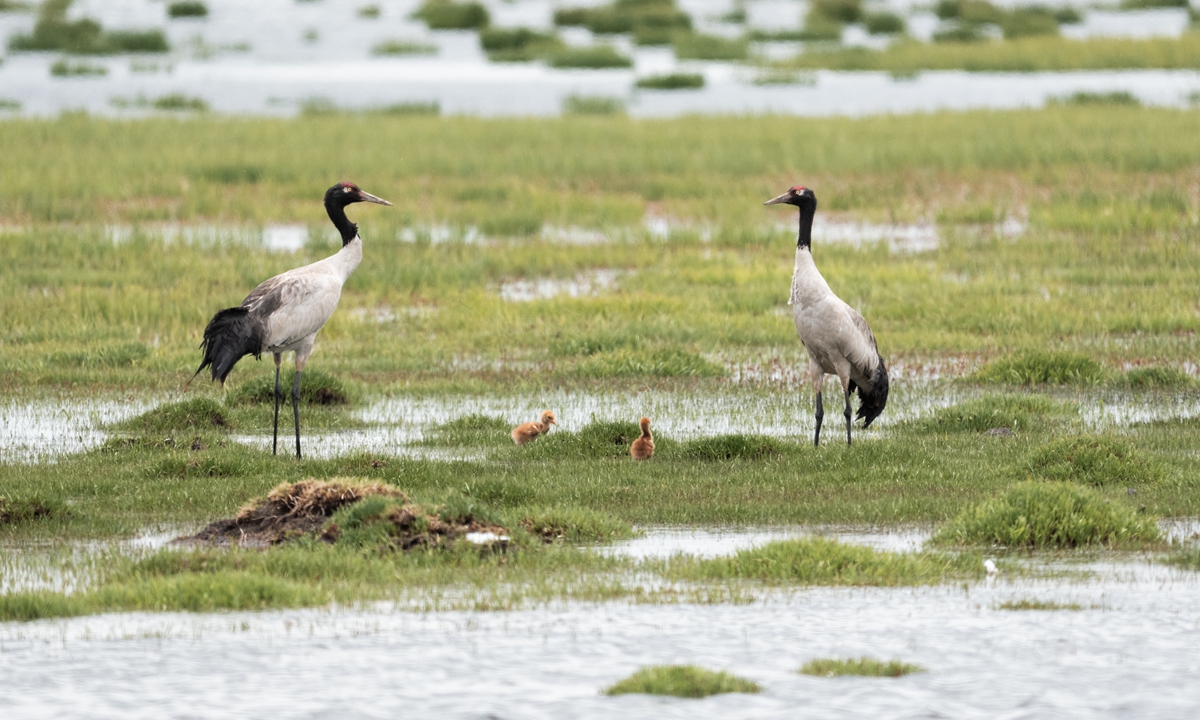
Black-necked cranes and their babies are seen in the wetlands of the Ruoergai grasslands in Southwest China's Sichuan Province. Photo: Courtesy of Namejiu
As of 2023, the wild wolf population in the three adjacent Sichuan counties of Ruoergai, Hongyuan and Aba - collectively known as the Greater Ruoergai Wetlands - reached 343, up from around 200 in 2020.
This growth reflects extensive ecological efforts.
For instance, wetlands restoration, desertification control, and grassland-livestock balance were advanced through habitat improvement, water conservation, and sustainable grazing practices. Meanwhile, a patrol and monitoring network was established, and public awareness campaigns were carried out to strengthen ecological protection.
Sonam Dorje stressed that the wolves' activity ranges naturally span multiple counties, meaning data from a single administrative area cannot reflect the overall situation. "What we do is long-term monitoring - we look at trends, not the figures from a single survey," he said.
Compared with more than a decade ago, ecological protection work in Ruoergai has steadily evolved into more systematic governance. Through measures such as wetland restoration and grassland management, the area has provided wildlife with more stable habitats and foraging environments. On this basis, top predators such as wolves have been able to maintain relatively stable activity within the plateau ecosystem.
"As long as the environment keeps improving, wild animals will make their own choices," Sonam Dorje said.
Taking root in the wilderness
Conservation efforts rooted in the wilderness are often hidden from sight. For Ruoergai, changes to the grasslands do not happen overnight - they unfold gradually through long-term perseverance.
The Sichuan Ruoergai National Nature Reserve is located at the heart of the Ruoergai wetland. Covering about 1.67 million hectares (approximately 4.13 million acres), the reserve is divided into core, buffer and experimental zones. It spans five towns and two townships, encompassing 28 administrative villages, with some 17,700 residents living and working long term in this alpine wetland and grassland environment.
As a typical alpine peat swamp wetland ecosystem, the reserve is not only an important habitat for rare species such as the black-necked crane, but also a focal point for the complex balance between human activity and ecological preservation.
Despite its vast area of nearly 4.13 million acres, conservation forces at the Ruoergai wetlands remain limited. The Sichuan Ruoergai National Nature Reserve Administration currently employs 29 full-time staff and several oversees protection stations. In addition, 85 conservation personnel - mostly local herders - are stationed in villages and key zones to carry out patrols, monitoring, and daily management duties.
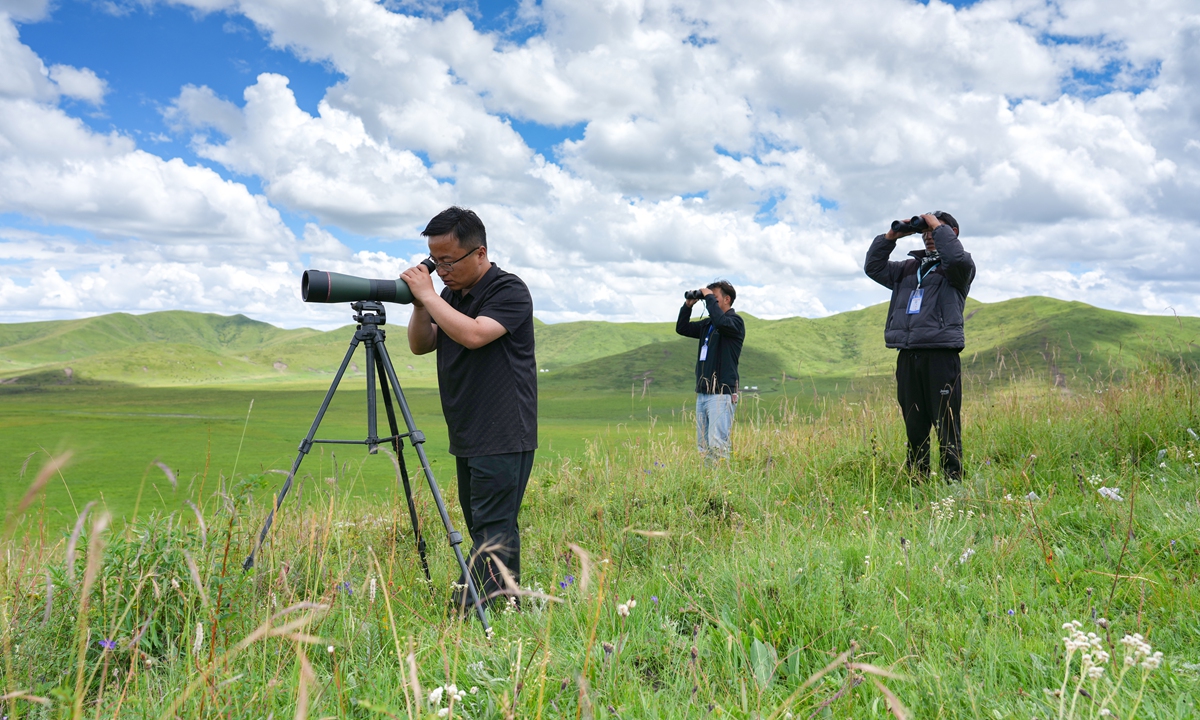
Sonam Dorje and his colleagues are tasked with conducting field surveys, sample line monitoring, and data processing across the expansive reserve. "Each field trip typically takes five days," he said.
Patrollers conduct environmental monitoring on the Ruoergai grasslands in Southwest China's Sichuan Province, on August 22, 2025. Photo: Courtesy of Namejiu
The wetlands' marshes pose considerable challenges for fieldwork. Sonam Dorje recalled that in earlier years, limited resources meant patrols and surveys were often conducted on foot or horseback. "In the past, we'd wade through marshes with water up to our waists, pulling ourselves forward with ropes," he said.
In his view, local herders serving as conservation personnel are essential to the reserve's daily operations. "They know the pastures well and are the first to notice changes," he said. Stationed in the areas they oversee, these personnel are responsible for patrolling, reporting information, and public outreach, enabling conservation efforts to extend deep into the vast grassland interior.
According to data provided by the reserve's administration, more than 660 species of wild animals and plants have been recorded within the protected area, including 18 species under first-class national protection and 52 species under second-class national protection. Species such as black-necked cranes, Tibetan foxes, red foxes and wolves have been appearing more frequently, with populations becoming increasingly stable.
Safeguarding China's wetlands
The Ruoergai wetlands are one of the world's largest and best-preserved alpine peat swamp wetlands. It also serves as a vital water recharge area for the upper reaches of the Yellow and Yangtze rivers.
According to the report of People's Daily, during both dry and wet seasons, the wetlands contribute about 40 percent and more than 20 percent, respectively, of the Yellow River's water supply. It is known as the river's "reservoir" and a globally rare "solid plateau reservoir."
Because of its unique ecological role and irreplaceable value, the Ruoergai wetlands have been listed as wetlands of international importance and identified as a key area in the development of China's national park system.
In recent years, China has made progress in wetlands conservation.
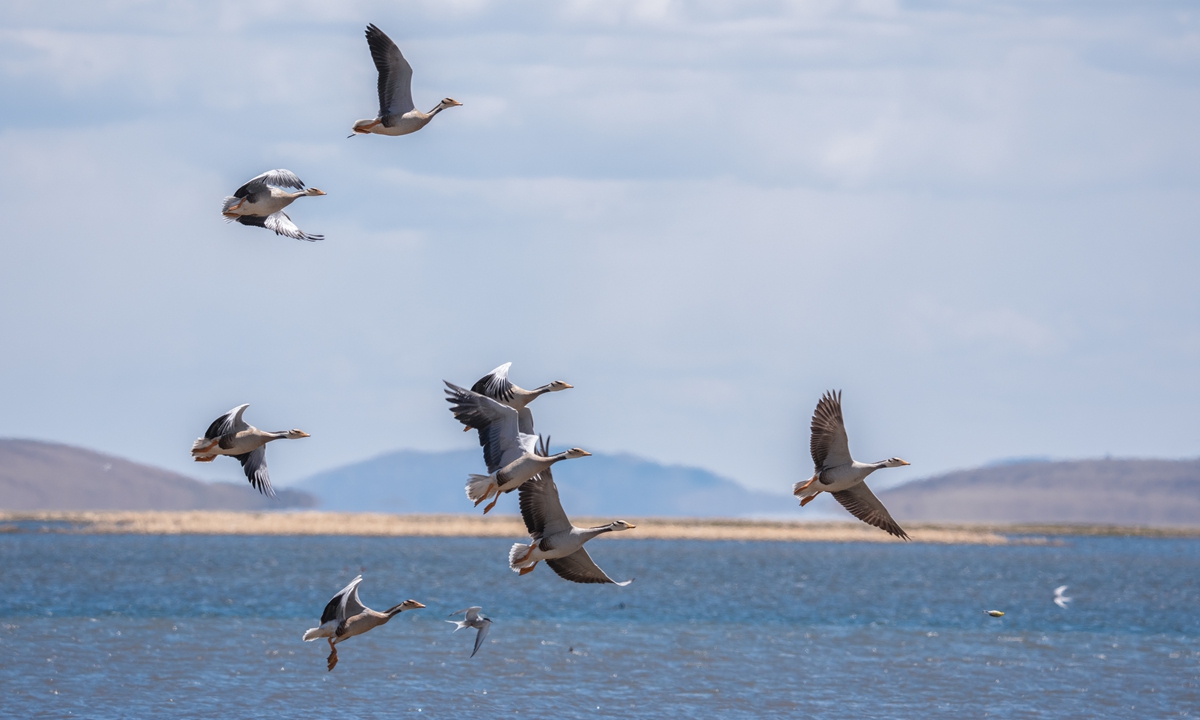
Bar-headed geese fly over the Ruoergai wetland.. Photo: Courtesy of Namejiu
In November 2022, China unveiled new ambitions for wetlands conservation during the 14th Meeting of the Conference of the Contracting Parties to the Ramsar Convention on Wetlands (COP14), held in Wuhan and Switzerland's Geneva. Addressing the opening ceremony via video, Chinese President Xi Jinping said China would promote high-quality development in the wetlands conservation cause, according to the Xinhua News Agency.
Calling for scaling up global action on wetlands conservation, Xi said, "It is important that we advance the global process of wetlands conservation, redouble efforts to preserve authenticity and integrity, include more important wetlands in nature reserves, improve cooperation mechanisms and platforms, and increase the coverage of wetlands of international importance."
According to the National Forestry and Grassland Administration, During the 14th Five-Year Plan period (2021-25), China has advanced comprehensive efforts to protect and restore wetland ecosystems, launching over 1,000 wetland conservation projects and scientifically restoring 4.34 million mu of wetlands. As of now, the country's total wetland area has reached 834 million mu, securing the ecological safety baseline for wetlands, CCTV reported in December 2025.
RELATED ARTICLES