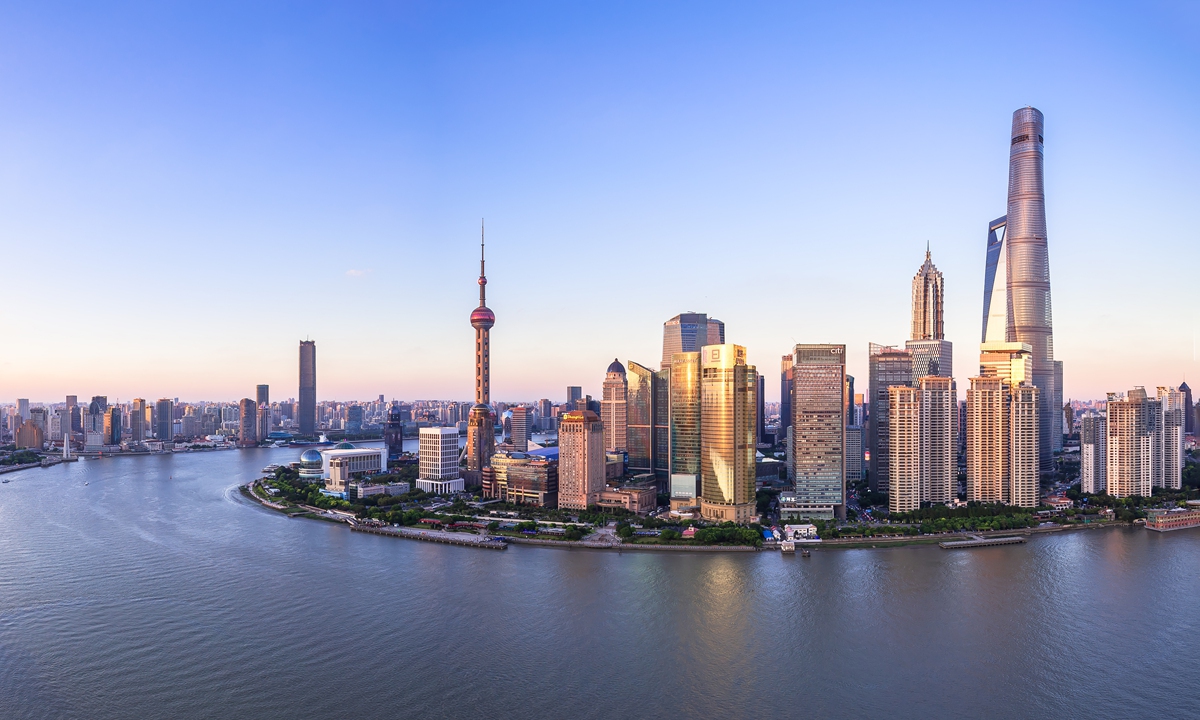
A view of Shanghai Photo: VCG
For decades, the world has relied on multilateral institutions and processes - such as the United Nations system, the Bretton Woods institutions (IMF and World Bank), and frameworks like the Paris Agreement - to coordinate collective action on economic development, trade rules, and climate-related issues. These bodies constitute what scholars call the global governance, in which global coordination is achieved through shared rules and negotiated policy frameworks.
Yet, we must acknowledge something essential: The solutions we have developed so far are imperfect. And this acknowledgement is not an exercise in pessimism. It is the foundation for progress. Because improving global governance requires countries - rich or poor, large or small - to make sacrifices for global compromise and consensus, including in areas such as market access, financial regulations, and development responsibilities.
We are living through an era of extraordinary change: geopolitical fracturing, technological disruption, economic anxiety, and a planetary environmental crisis. These forces make the strengthening of global governance more complicated, but also more urgent, particularly as the global economy increasingly faces headwinds and disruptions.
The central problem lies in the structure of global governance: Who has the authority to act? Who has the capability to implement solutions? And most importantly, who is accountable when global responsibilities - such as maintaining financial stability or addressing climate-related economic risks - are shared among many?
Today, we have agencies that monitor world peace, negotiate trade rules, or coordinate development, yet no single institution can claim the legitimate authority to defend global interests as a whole. When responsibility is diffuse, accountability becomes diluted. The result is a crowded landscape of actors who are sometimes coordinated, but often working at cross-purposes.
Kishore Mahbubani, a seasoned Singaporean diplomat and prolific writer, provides a compelling analogy. In the past, the world could be imagined as more than 100 separate boats - each with its own captain, each navigating its own waters. Today, humanity lives not in separate vessels but in different cabins on a single large boat. Each cabin has its own captain, but no one is responsible for steering the ship. A captain focused only on one cabin cannot protect its passengers from storms that affect the entire boat. The contradiction between national interests and global interests becomes painfully clear.
This metaphor resonates deeply in the Global South, where communities often bear the brunt of global crises they did not create - whether it is rising sea levels, uneven financial shocks, or inequitable access to energy, water, and digital connectivity.
Another major challenge is representation and legitimacy. Many people, particularly in Asia, Africa, and Latin America, do not see their voices reflected in key global institutions that shape economic rules, lending conditions, and development priorities. Power imbalances are not always acknowledged, even though recognizing them is essential to designing institutions that are legitimate and effective.
Of course, the global system cannot operate on a "one person, one vote" model. If it did, India, China, Africa, and Southeast Asia - together representing more than half of humanity - would command a majority. Yet global institutions must still earn the trust of this demographic majority while gaining the support of the world's most powerful economies.
Fortunately, we do not need to reinvent the entire system. First, we must expand and deepen global dialogue, especially among the Global South, but also between East and West, and between North and South. Dialogue is humanity's oldest and most reliable method for building understanding. Today, the Global South accounts for over 40 percent of global economic output and contributes around 80 percent of global economic growth. It is high time for global conversations that genuinely integrate their perspectives in shaping global norms, rather than relegating them to the margins.
Second, we must retire outdated approaches to multilateralism. Let us be frank: Weakening global institutions for short-term gain is irresponsible. A stronger multilateral system serves the long-term interests of all - large and small, East and West, North and South.
Third, we must cultivate a global ethic. This idea recognizes that our moral community has expanded over time, propelled by technology that brings distant suffering into our homes, and moral logic that insists all human beings possess the same rights. Principles such as "treat others as we wish to be treated" are universal; they appear in every civilization. Building global governance on such shared ethical foundations is not only possible, but also necessary.
Let's end on a hopeful note: Humanity has solved seemingly impossible problems before. The task ahead is not to design a perfect system, but to build a better one - more inclusive, more legitimate, more representative, and more attuned to the needs of all of humanity.
And in this endeavor, the voice of the Global South must be not an afterthought, but a guiding force. Our security is collective. Our prosperity is shared. And our governance must be, too.
The author is a senior assistant professor in the Department of International Relations, Universitas Indonesia. bizopinion@globaltimes.com.cn
RELATED ARTICLES