Japanese business representative reportedly urges Takaichi to 'act normally'; rising economic pressures spark backlash against political adventurism: Chinese expert
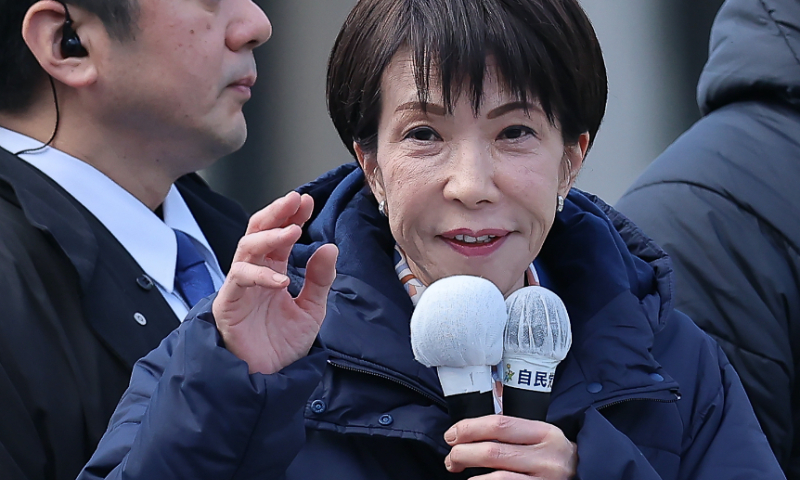
Japanese Prime Minister and Liberal Democratic Party President Sanae Takaichi speaks during the election campaign rally on January 29, 2026 in Himeji, Japan. Photo: VCG
In an article published by Asahi Shimbun on Friday, the Japanese newspaper noted a growing dissatisfaction within Japan's business community over Prime Minister Sanae Takaichi's policy on China-Japan relations. The report said her remarks on the Taiwan question have intensified bilateral tensions, prompting criticism from the industrial sector, quoting one industry insider as saying that Takaichi should just act normally as a national leader and stop doing unnecessary things.
A Chinese expert told the Global Times on Saturday that it reflects the Japanese business community's growing discontent with Takaichi's China policy, and such criticism is something that happens sooner or later and will intensify over time.
The report titled "Prime Minister's 'careless' Diet response worsens China ties, business community voices discontent, path to resolution?" cited an executive from an auto parts manufacturer as saying, "I hope the prime minister would just act normally and stop doing unnecessary things." Another representative from an economic organization criticized her approach, stating, "The way of fighting is wrong. She's overstimulating China."
Broader sentiment in the business community also includes complaints that "despite claiming to prioritize the economy, she destroyed relations with her own words," Asahi Shimbun reported.
Tensions in China-Japan relations stemmed from Takaichi's claims on November 7 at a Diet meeting that the Chinese mainland's "use of force on Taiwan" could constitute a "survival-threatening situation" for Japan, triggering strong backlash from China and within Japan.
In response, Chinese ministries and government agencies expressed strong protests and issued stern warnings. China also tightened dual-use export controls destined for Japan in January, applying them to all items on China's control list, including rare-earth-related products.
The report by Asahi Shimbun predicted that if shortages of rare earth supplies worsen and begin to affect factory operations and production, dissatisfaction within the business community toward the Takaichi administration could intensify.
"As supply chain crises become evident and corporate costs continue to climb, criticism from the business and economic community has grown increasingly sharp over time. This is the inevitable backlash of economic rationality against political adventurism," Xiang Haoyu, a distinguished research fellow at the China Institute of International Studies, told the Global Times on Saturday.
According to Xiang, the call for "acting normally" refers to respecting the political foundation of China-Japan relations; ceasing dangerous rhetoric and military provocations related to the Taiwan question; ensuring the stability of supply chains for critical materials such as rare earths and semiconductors; promoting the resumption of high-level exchanges between China and Japan, as well as the normal flow of business people, tourists, and other people-to-people exchanges; and abandoning the current approach of political provocation.
In addition to the backlash over her erroneous remarks on the Taiwan question, Takaichi has also faced criticism for dissolving the lower house to call a snap general election. Beyond discontent from the business community, public dissatisfaction has also been reflected in a decline in her approval rating.
Following the dissolution of the Japanese lower house, the approval ratings of the cabinet of Takaichi declined to 57 percent in a nationwide Mainichi Shimbun opinion poll conducted on January 24 and 25, down 10 percentage points from the 67 percent recorded in the previous survey in December, Mainichi Shimbun reported.
According to the report, the disapproval ratings of the cabinet climbed 7 points to 29 percent from the 22 percent in the previous poll conducted on December 20 and 21 last year.
In the comment section of the Asahi Shimbun's report on social media platform X, many Japanese netizens also voiced dissatisfaction. One user named "kumon" wrote in Japanese: "Hmm, her November remarks on Taiwan were clearly a provocation toward China, yet this prime minister doesn't even seem to recognize them as such. I don't think it's possible for her to 'behave normally as a prime minister.'"
Another user, "NewWave," said: "This alone is enough to show that a change of government is necessary. A government should prioritize national interests and realistic risk management, but the Takaichi administration is completely failing to fulfill that role."
Instead of showing any remorse, Takaichi has repeatedly tried to "justify" herself. According to Japan's Nikkei Asia, Takaichi asserted Japan's response to a potential "Taiwan contingency" during a TV program on January 25 night.
Takaichi has sparked renewed criticism by claiming "when something serious happens, we must go to rescue Japanese and American citizens in Taiwan," again referring to evacuation operations. She claimed Japan would "respond while comprehensively assessing the situation within the scope of current laws," and that the US-Japan security alliance would "collapse" if Japan did not respond to any attack on US forces during a Taiwan Straits crisis.
"We once again urge the Japanese side to abide by the spirit of the four political documents between China and Japan and Japan's own political commitments made to China, do soul-searching, correct its wrongdoings, and stop their manipulation and reckless moves on the Taiwan question," said Chinese Foreign Ministry spokesperson Guo Jiakun on Takaichi's latest remarks on January 26.
Guo said that the remarks by the Japanese side once again reveal the Japanese right-wing forces' ambitions to provoke antagonism, make trouble, and take the opportunity to keep remilitarizing Japan and to challenge the post-war international order.
"This has severely threatened regional peace and stability and the political foundation of China-Japan relations. The international community must stay on high alert and firmly reject that," the spokesperson said.
While leaders from several Western countries made their visits to China one after another showing a more pragmatic adjustment in their China policies, Japan has continued to take a tough stance toward Beijing. This approach not only causes Japan to miss opportunities for cooperation with China, but also risks pushing the country to the margins, leaving it in a passive position in areas such as critical mineral supply chains and, in the long run, further isolating it on the international stage, Xiang noted.
RELATED ARTICLES