Global Times hosts symposium exploring new farmers’ role in empowering China’s rural revitalization
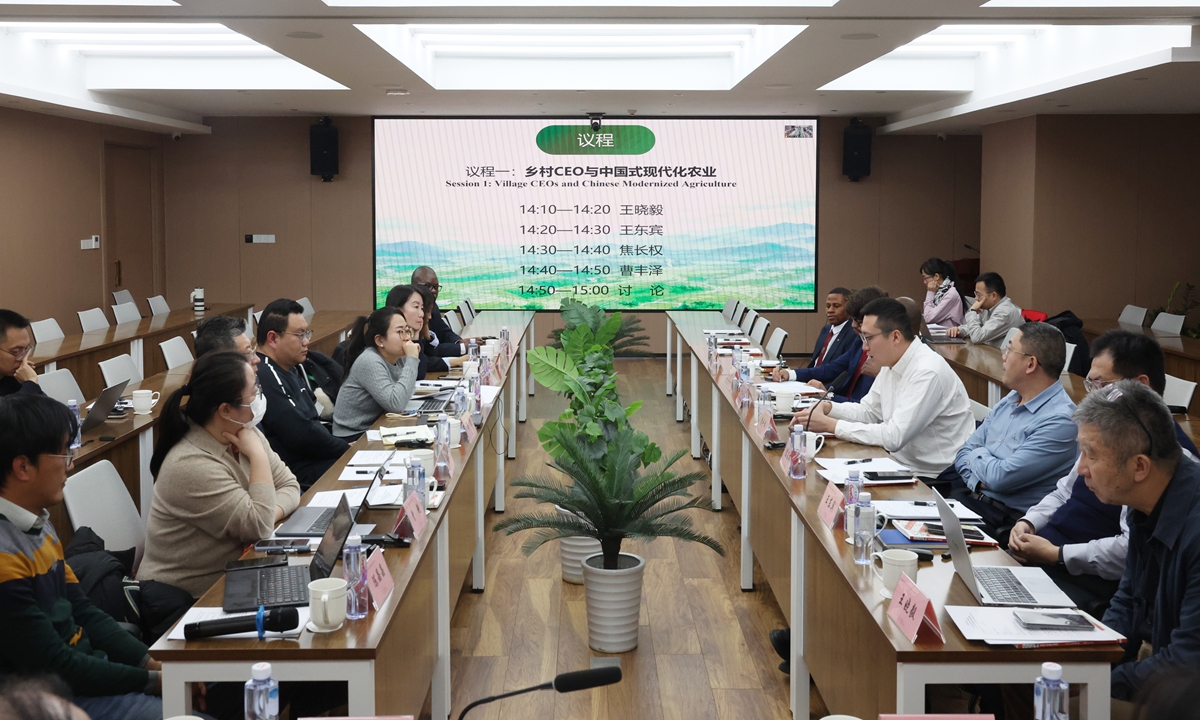
A forum themed "Friends of Global Civilization: New Farmers and the New Practice of Chinese Modernized Agriculture," is hosted by Global Times in Beijing on January 30, 2026. Photo: Cui Meng/GT
A symposium themed "Friends of Global Civilization: New Farmers and the New Practice of Chinese Modernized Agriculture" was held in Beijing on Friday.
Hosted by the Global Times, organized by Beijing Culture Review magazine, and co-organized by Tencent's Sustainable Social Value Organization (SSV) and China Agricultural University's College of International Development and Global Agriculture. The event brought together industry experts, representatives of young rural entrepreneurs, and international students studying in China to discuss how new farmers can leverage advantages, such as modern industrial thinking, business concepts, and digital technologies - to empower rural revitalization.
Participants also discussed three-dimensional integration of farmers, rural areas, and agriculture, with the aim of comprehensively enhancing the overall quality and efficiency of rural revitalization, fostering new business formats in urban-rural integration and the collective economy, and further building a new form of Chinese agricultural civilization.
"The modernization of agriculture and rural areas concerns the overall landscape and quality of Chinese modernization, and doing a good job related to agriculture, rural areas and farmers is essential to solidifying the foundation of Chinese modernization. To advance modernization of agriculture and rural areas, practice must come first, with people at the core," a representative from the Global Times said at the symposium.
In recent years, the groups of "new farmers" and "farmer-entrepreneurs" have continued to grow steadily. According to statistics from relevant government departments, as of February 2025, more than 12 million people nationwide have returned to or moved to rural areas to engage in entrepreneurial activities. This group has injected new vitality into rural development and accumulated a wealth of referable and replicable experience for the modernization of agriculture and rural areas, the representative said.
Yang Ping, director of the Beijing Longway Economic and Social Research Foundation, said at the symposium that an important reason youth and rural revitalization intersect in many ways and are held in high regard is that a large number of young people are returning to rural areas to seek new development paths and explore new opportunities for growth.
Wang Xiaoyi, a professor at the School of Sociology and Ethnology of the University of Chinese Academy of Social Sciences, said at the symposium that an important perspective for understanding China's agricultural and rural modernization is to emphasize the endogeneity of rural areas and the subjectivity of farmers.
Rural CEOs, as new farmers in the new era, are modern agricultural operators equipped with new concepts, new technologies, business models, and production organization methods. However, to fully tap their potential as one of the key drivers of rural revitalization, it is essential to establish a mechanism integrating three elements: collective assets, principals, and high-level agents, Wang said.
Wang Dongbin, a program director at the China Institute of Fudan University, said that in advancing rural revitalization, many rural areas face the challenge of attracting young talent - a task that requires the joint efforts of the government, society, and non-profit organizations.
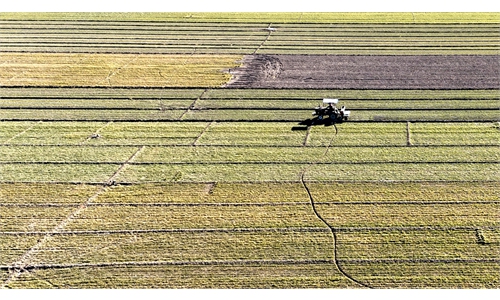
Cao Fengze, an engineer working abroad with a Chinese state-owned company, has rented 1,200 mu (80 hectares) of land in Russia's Far East region for soybean cultivation.
"Like Russia's Far East region, there are many underutilized land resources globally. In contrast, China's land resources are relatively scarce," he said. Against this backdrop, the value of China's rural areas and agriculture largely stems from differentiated competition, for example, developing organic farming, leafy vegetable cultivation, organic fruit cultivation to compete differently from staple grain production, and pursuing characteristic agriculture and high-value-added agricultural development.
As a highly modern symbol, the concept of the rural CEO is conducive to attracting ambitious young people aspiring to develop agriculture and rural areas, Zeng Yan, a senior project manager at Tencent SSV Village Development Laboratory, said at the symposium.
She introduced the development history of Tencent's rural CEO training program over the past four years. By the end of 2025, it had cumulatively supported the training of 4,740 program participants, with a reserve talent pool reaching 98,440.
At the symposium, international students from South American and African countries at China Agricultural University also shared their views. According to this group, the experience of contemporary Chinese youth returning to their hometowns as new farmers and engaging in frontline rural revitalization work has provided new blueprints and model references for agricultural and rural development in their home countries.
Moreover, they noted that China is not only committed to its own rural revitalization but also, through initiatives such as the Belt and Road Initiative and South-South cooperation, provides significant support for agricultural and rural development in many developing countries in terms of resources, technology, talent, and experience.
RELATED ARTICLES