SPORT / OLYMPICS
Managing expectations for China at Winter Olympics
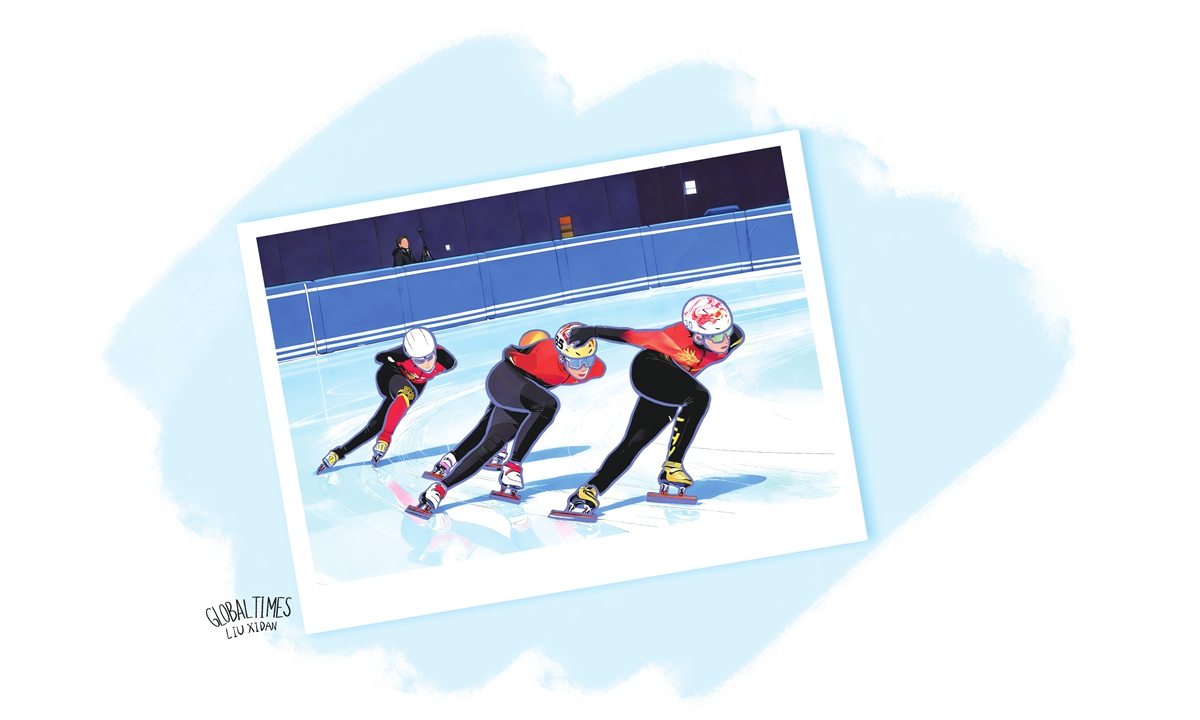
Illustration: Liu Xidan/GT
As the Milan-Cortina 2026 Winter Olympic Games are drawing near, the spotlight turns once again to China's evolving role in winter sports. The echoes of Beijing 2022 still resonate with China's historic haul of nine gold medals, four silvers and two bronzes. This best-ever Winter Olympic performance propelled the nation to the third place in the medal table.This triumph, achieved on home soil, ignited unprecedented enthusiasm toward ice and snow sports in China. Yet, as expectations soar for Milan, it is crucial to ground them in reality. China remains fundamentally a "chaser" in global winter sports, not yet a dominant force like China's presence at the Summer Olympics. Rational anticipation, rather than inflated hype, should guide our outlook, which should be focused on sustainable progress over fleeting glory.
The narrative of China's winter sports journey is one of the remarkable expansions, but it's essential to dissect the facts without succumbing to overoptimism. At Beijing 2022, China's successes were concentrated in a handful of events, particularly freestyle skiing and snowboarding, where stars like Gu Ailing, who clinched two golds and a silver, and Su Yiming, who won a gold in big air snowboarding, shone brightly. These victories were bolstered by home advantages, including familiar venues and massive national investment after winning the Olympics bid in 2015. However, extrapolating that singular breakthrough to predict dominance in Milan overlooks the broader context.
For Milan 2026, China has assembled its largest-ever overseas Winter Olympic delegation: 126 athletes competing across seven major sports, 15 disciplines and a record 91 events. This represents about 78.4 percent of the total 116 events, a significant leap from previous overseas outings. The previous best abroad record was registered at Vancouver 2010, where China fielded 91 athletes and secured 11 medals (five golds).
The increase in athlete numbers and event coverage underscores a strategic shift toward broader participation. This expansion aligns with China's long-term vision, initiated after Salt Lake City 2002, where it first won medals in short track speed skating. Investments in infrastructure, such as the National Sliding Center and international training partnerships, have yielded dividends, enabling younger athletes to emerge.
Yet, scale alone doesn't equate to medals. In ice disciplines, China faces formidable headwinds from traditional powerhouses in Europe and North America. Though qualification data shows China secured 41 berths across 29 ice events in four sports, the competition has intensified. Countries like the Netherlands in speed skating, Canada in figure skating and short track, and the US in various ice events have deepened their talent pools, often dominating international circuits.
Short track speed skating remains China's ice stronghold, where it has historically claimed over half its Winter Olympic medals. Veterans like Fan Kexin, a Beijing gold medalist in the mixed team relay, return for Milan, bolstering hopes. However, the landscape is shifting. Canada, with its technical prowess, and emerging threats from the Netherlands, South Korea as well as the host Italy, have elevated the field. China's qualification efforts yielded maximum team sizes in short track, five men and five women, but performances in recent World Tour events show vulnerabilities.
In snow disciplines, China's snow sports have seen explosive growth since Beijing 2022, with the freestyle skiing aerials and big air events becoming medal magnets. Gu and Su headline the squad again, with Gu aiming to defend her titles and Su targeting repeats in slopestyle and big air. In World Cup and qualification races, Chinese athletes have notched medals, including Gu's victories in halfpipe and big air during the 2025 season. Veteran Xu Mengtao, the Beijing 2022 aerials gold medalist, adds experience to the mix.
However, snow events are notoriously variable, influenced by weather, venue conditions, and judging subjectivity. Unlike ice rinks, which offer a more controlled environments, snow slopes in northern Italy could introduce unfamiliar challenges, gusty winds, variable snow quality, or altitude effects that favor European athletes acclimated to Alpine terrains. Many of China's snow competitors are products of the post-2015 acceleration, young talents in their early 20s making overseas Olympic debuts.
The progress in participation versus podium potential highlights China's transitional phase from targeted breakthroughs to systemic building. The Milan cycle has prioritized youth development, with an average team age of 25, signaling investment in future cycles like 2030 or beyond. Initiatives such as the Harbin Asian Winter Games in 2025 served as key prep, where Chinese athletes tested their mettle against regional rivals, but global benchmarks at events like the world championships exposed gaps.
This chaser status isn't a setback but a realistic waypoint in China's winter sports journey. The Beijing legacy, sparking mass participation, with over 300 million Chinese engaging in ice and snow activities by 2022, has laid a foundation for longevity. Yet, chasing implies patience, expecting another nine golds in Milan ignores the difference between Games at home and overseas.
Critics might argue that tempered views dampen national spirit, but hype risks disillusionment. Remember Pyeongchang 2018, where China won just one gold amid high hopes after Sochi 2014. Milan 2026 offers a chance to build resilience. Rationality ensures the flame of progress burns steadily, paving the way for future dominance.
The author is a reporter with the Global Times. life@globaltimes.com.cn
RELATED ARTICLES