China’s courts conclude 23,732 1st-instance drug cases in 2025, an 82.93 percent decrease from peak in 2015
By Published: Feb 02, 2026 11:21 AM

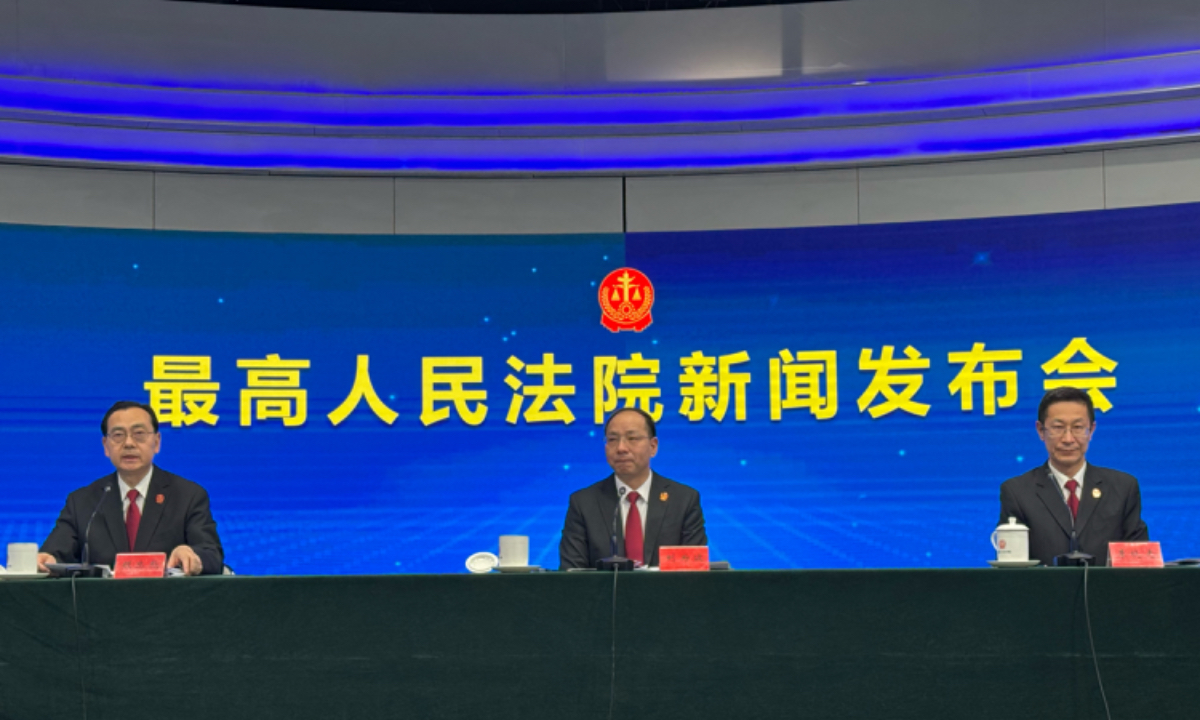
A press conference held by China's supreme people's court on February 2, 2026. Photo: Zhao Yusha/GT
In 2025, courts across China concluded 23,732 first-instance drug cases, bringing caseloads back to pre-2000 levels. At the same time, cases involving new types of drugs have followed a different trajectory over the past three years, surging initially before easing, but showing an overall upward and volatile trend, an official from China's Supreme People's Court said on Monday.
In 2025, Chinese courts nationwide concluded 23,732 first-instance drug cases, continuing the steady downward trend seen since 2015. This figure represents an 82.93 percent decrease from the 2015 peak of 139,000 cases, and a 33.82 percent drop compared with 36,000 cases in 2024, bringing caseloads back to pre-2000 levels, Liu Weibo, an official from China's Supreme People's Court said at a press conference on Monday.
From 2023 to 2025, Chinese courts nationwide concluded 93,000 first-instance drug cases, involving 133,000 defendants whose judgments became legally effective, said Liu. He noted that among them, 27,000 defendants were sentenced to fixed-term imprisonment of five years or more, representing a 20 percent rate of severe sentences, about 13 percentage points higher than the average for all criminal cases during the same period.
Liu said that judging from trial practice, traditional drugs have been effectively curbed, prompting some offenders to shift their focus to medical narcotic drugs, psychotropic substances, and new psychoactive substances.
According to incomplete statistics, courts nationwide concluded approximately 4,000 first-instance cases involving new types of drugs in 2023.
Over the past three years, cases involving new types of drugs have shown a pattern of sharp growth followed by a gradual decline, reflecting a fluctuating upward trend overall. Meanwhile, new-type drug cases have begun to surpass traditional drug cases, with their proportion exceeding 50 percent in some provinces, said Liu.
Notably, in South China's Guangdong Province, new-type drug cases accounted for 82.6 percent in 2024 and 70.7 percent in 2025 of all drug cases handled by courts in the province, mainly involving etomidate.
Based on cases heard by China's courts, abuse of etomidate has now far surpassed heroin, making it the second most prevalent drug after methamphetamine.
Another notable feature is the diverse sources and wide range of substances involved. Drugs linked to criminal cases include those smuggled from overseas, illegally manufactured domestically, as well as medical narcotic and psychotropic drugs diverted from hospitals, pharmacies, and pharmaceutical companies within China, said Liu.
Differences in the scope and intensity of controls on narcotic and psychotropic substances between China and other countries have been exploited by criminal networks. In some cases, offenders have colluded with overseas accomplices to smuggle substances such as triazolam from neighboring countries and Europe, along with so-called "weight-loss drugs" containing controlled ingredients.
At the same time, medical institutions—including hospitals, clinics and pharmacies—have emerged as a source of diverted drugs. A small number of medical staff and pharmaceutical practitioners, driven by illegal profits, have abused their positions to illegally supply or sell controlled medicines, Liu noted.
In other cases, patients and individuals receiving methadone maintenance treatment have exploited regulatory loopholes to obtain such drugs and resell them at higher prices.
Liu said that substances involved in drug cases are becoming increasingly concealed and heavily disguised. New types of drugs now appear in a wide range of forms, moving beyond traditional crystals, powders and tablets. They are often marketed in the guise of everyday products, including chocolates, cookies and other foods, as well as beverages such as so-called "kava liquor" and "fairy water," and even e-cigarettes.
Moreover, Liu noted that drug abuse is increasingly affecting younger age groups, with juveniles playing a growing role both as users and as offenders. Many adolescents, he said, lack the maturity to distinguish right from wrong and are particularly susceptible to temptation, making them vulnerable to involvement in drug-related activity.
Drug crimes are also becoming more networked and technologically sophisticated. Online and offline operations are now closely intertwined, as noncontact trafficking models—combining internet platforms, logistics delivery and electronic payments—have become the new norm. Traffickers use online channels to make contact, rely on courier services or "drop-off" methods to distribute drugs, and conduct transactions using virtual currencies such as Bitcoin.
This growing separation of people from drugs and money, Liu added, has significantly complicated detection, evidence collection and adjudication, posing new challenges for judicial authorities.
RELATED ARTICLES