IN-DEPTH / IN-DEPTH
Canadian PM Mark Carney’s Davos address highlights rifts within the West, as US allies shift pragmatically toward China
Echoes of defiance
By Published: Feb 02, 2026 10:06 PM

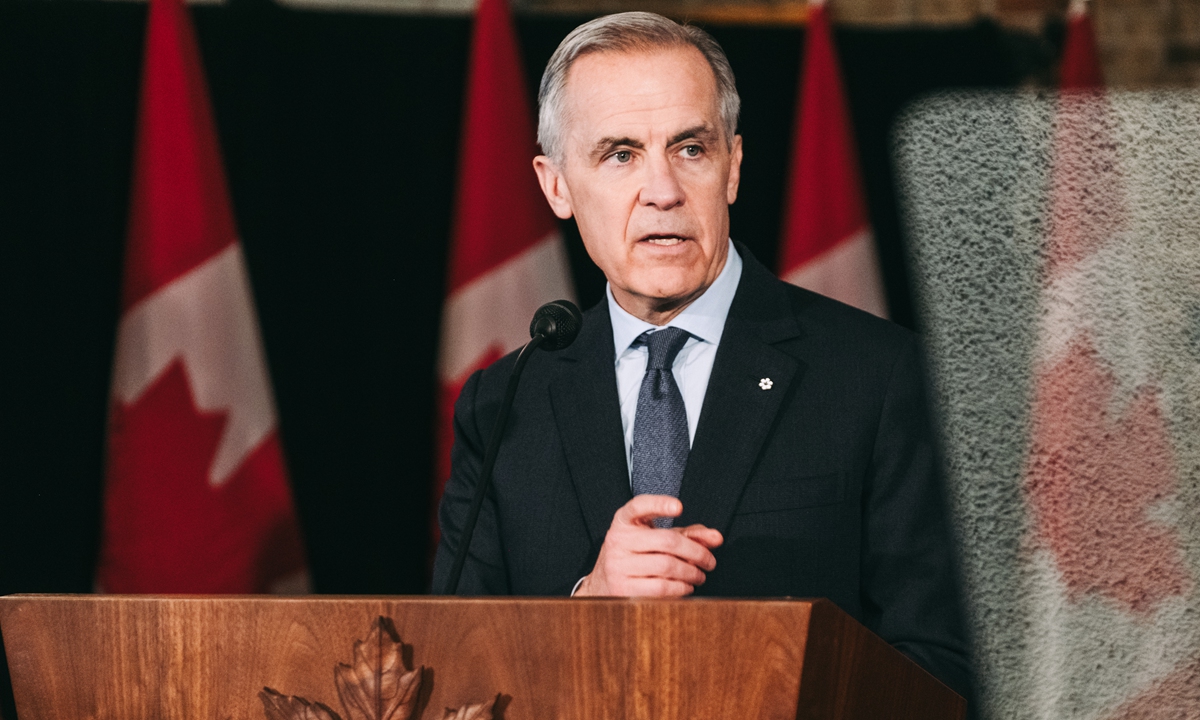
Mark Carney, Canada's prime minister, speaks in Quebec City, Canada, on January 22, 2026. Photo: VCG
In a recent speech at the World Economic Forum in Davos, Switzerland, Canadian Prime Minister Mark Carney sharply criticized great powers have begun using economic integration as weapons; tariffs as leverage. Carney urged that "middle powers must act together because if we're not at the table, we're on the menu." His remarks have sparked ongoing international debate: While some media outlets have framed them as a stinging rebuke of US policies, analysts interpret them as a direct reflection of the deepening rifts within the Western bloc.
Chinese netizens have also raised a flurry of questions: Who is Mark Carney, and where does he get the courage to openly challenge US hegemony? Will there be more leaders like Carney in the Western camp?
The fallout from Carney's Davos speech has yet to subside, and leaders of multiple US allied countries have launched successive visits to China - a phenomenon that has ignited heated discussions across the media landscape and society. A key question lingers across traditional and social media: Are US allies moving closer to China to hedge against Washington's unilateral coercion?
UK Prime Minister Keir Starmer's recent visit to China not only led to a bilateral consensus on visa exemptions and tariff reductions, but also secured substantial investment cooperation deals. Earlier visits by the leaders of Canada, Finland, South Korea, and other nations yielded similar pragmatic outcomes. Observers noted that this signals an increasingly clear trend of US allies pursuing strategic hedging through visits to China. In the wake of Starmer's trip, international public opinion has been rife with discussions about a potential "pivot East" among US allies, and this wave of visits to China by numerous Western countries is profoundly mirroring the new dynamics of global geopolitics.
From imposing tariffs on Europe to publicly humiliating leaders at international meetings, US hegemonic acts have eroded allies' trust. Amid this, "looking eastward" has become a clear global trend: US allies are visiting China frequently, and China's home-ground diplomacy is thriving with tangible results. More pragmatic Western politicians like Carney, who dare to break free from US hegemonic constraints, may emerge, Yang Xiao, a researcher at China Institutes of Contemporary International Relations, told the Global Times.
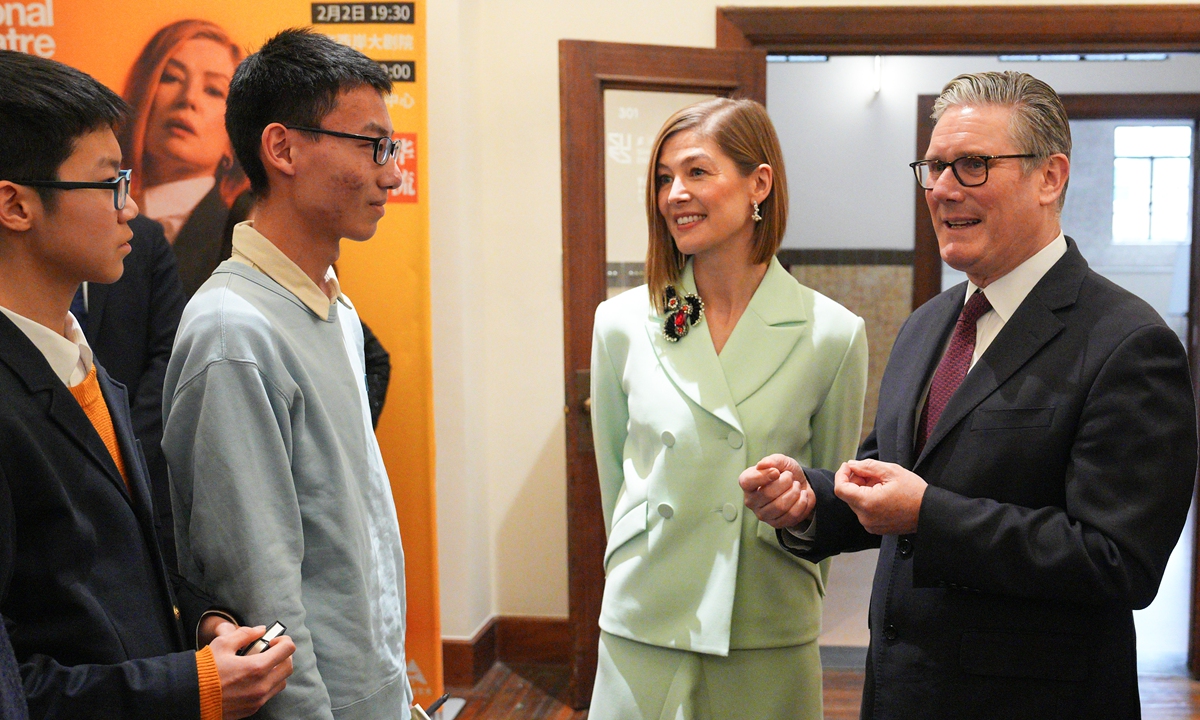
UK Prime Minister Keir Starmer meets drama students during a visit to the Design Innovation Institute Shanghai on January 31, 2026. Photo: VCG
Banker turned politician
Born in Fort Smith, Northwest Canada, Carney grew up in Edmonton. He earned his undergraduate degree in economics at Harvard University, followed by master's and doctoral degrees at the University of Oxford, awarded in 1993 and 1995 respectively. Becoming a banker wasn't always the obvious career choice, he told The Guardian newspaper in a 2021 interview. Instead, he fancied being a marine biologist but prioritized banking as he found it the most "most effective way" to pay off his student loans, according to a report by Financial Post.
He worked at the Goldman Sachs Group for 13 years in various roles, including as a managing director in the investment banking division before joining the Bank of Canada as deputy governor in 2003.
When Carney became the Bank of England's governor in June 2013, he was the first non-Briton to be appointed in the bank's 300-year history. He came after a successful stint as Canada's central banker, where he was credited for shielding the country from some of the worst effects of the 2008 financial crisis, according to BBC.
He was elected Leader of the Liberal Party of Canada and sworn in as Prime Minister in March 2025.
Experts noted that Carney's outstanding professional accomplishments have earned him extensive support among Liberal Party lawmakers in Canada, and his profound expertise in the economic field is widely recognized by the international community.
In April 2025, Carney vowed to fight back against American tariffs and stand up for Canadian sovereignty. A New York Times analysis wrote as:"Elbows Up," a hockey phrase, became the campaign rallying cry of Canada's Liberal Party this spring, whipping up a swell of patriotism in the face of US President Donald Trump's menacing posture toward America's neighbor. Media and analysts believe that the US administration's radical trade policies and remarks about "making Canada the 51st state" have stoked nationalist sentiments among the Canadian public, further boosting Carney's electoral prospects.
Lü Xiang, a research fellow at the Chinese Academy of Social Sciences, told the Global Times that unlike his predecessor Justin Trudeau - who embodied the image of a "traditional politician" - Carney's pragmatic leadership style is likely to bring a new atmosphere to bilateral relations. Endowed with rich experience as a top financial executive and central bank governor, Carney excels at both micro- and macro-economic management. He is known for his straightforward and resolute approach, and shuns political grandstanding - traits that help him focus on delivering pragmatic results in national policymaking.
In contrast, Trudeau was born into a political family and is a typical career politician who formulates strategies by reading the room, a factor that contributed to his defeat in the party election, Lü noted. Carney's landslide victory in the Liberal Party leadership race hinges on his pragmatic style. Public records show that Carney speaks concisely, resolutely and directly - his criticism of the US is unflinching, and his statements on China-Canada cooperation are clear and pragmatic. Lü pointed out that this is closely linked to his long career as a top financial executive.
In his address in Davos, Carney also warned that the world is "in the midst of a rupture" of the international order and urging middle powers to be both principled and pragmatic, while citing newly concluded strategic partnerships with China and Qatar as part of Canada's efforts to diversify its external relations.
Carney's remarks quickly drew wide attention from Western media, many of which interpreted the speech as a pointed reflection on the erosion of the postwar order following US actions in recent years. The New York Times reported that Carney described the end of the era underpinned by US hegemony, calling the current phase "a rupture."
Carney's courage to openly defy the US stems not only from his personality, but more importantly from his clear strategic judgment, the scholar said. He firmly recognizes that over-reliance on the US is no longer sustainable in the current era of global restructuring.
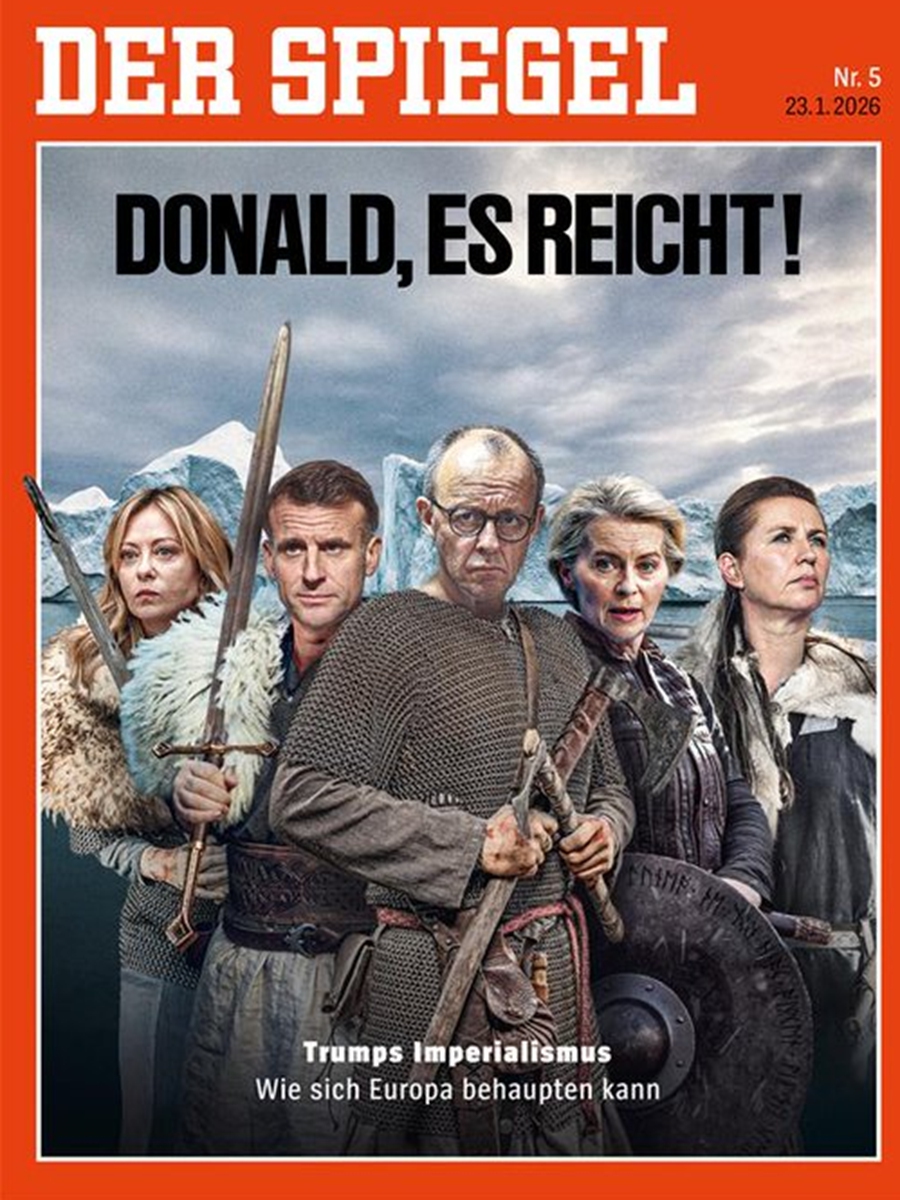
The cover page of Germany's Der Spiegel on January 23, 2026 Photo: Screenshot of Der Spiegel
Europe's pushback and China pivot
The January 23 issue of Germany's Der Spiegel features a cover headlined "Donald, Enough!". It depicts five European leaders, with German Chancellor Friedrich Merz at the center, flanked by French President Emmanuel Macron, European Commission President Ursula von der Leyen, Italian Prime Minister Giorgia Meloni and Danish Prime Minister Mette Frederiksen. All are dressed in hunting attire and holding weapons, set against the backdrop of Greenland's glaciers.
The cover design reflects growing frustration in Europe over mounting pressure from Washington, Zhao Junjie, a senior research fellow at the Institute of European Studies at the Chinese Academy of Social Sciences, told the Global Times in a previous interview. The expert noted that transatlantic relations have entered a critical period marked by increasing friction and uncertainty, and that while the EU is aware of the importance of strategic autonomy, achieving it will require time and greater unity.
The EU should still be strong enough to take its fate into its own hands. It simply has to be willing to do so - and must avoid sabotaging itself, according to Der Spiegel's article, noting that this requires abandoning the illusion that the US under Trump remains a partner, painful as that may be, especially in light of Ukraine.
More Western leaders are sending out stern warnings about past approach of overly depending on the US. Belgian Prime Minister Bart De Wever warned at a "Future of Europe" high-level forum hosted by a major Belgian media outlet in late January that Europe has long relied on the US "big stick" for protection - only to find that the same stick is now being wielded against its own allies. Coupled with his related remarks that Europe could slide from a "happy vassal" into a "miserable slave" if it fails to draw red lines, his comments quickly went viral on social media on Monday.
Zhao noted that the transatlantic relationship appears to be approaching a critical inflection point - verging on strategic decoupling and heightened confrontation. Trust has eroded sharply, and rivalry is becoming more pronounced.
Canadian mainstream media outlet the Globe and Mail called Carney's speech at Davos "a manifesto for a new age." It stated that the speech "offered a map to which many countries are now thinking of turning to, to the point of following him in planning trips to Beijing where they can, like him, start "engaging broadly, strategically, with open eyes."
The US-led alliance system has shown obvious signs of loosening, and its allied countries are displaying a trend of awakening. The long-term unilateral and reckless actions of the US have gradually yielded undesirable results. Currently, initial signs of joint efforts to safeguard the post-war international order have emerged, and the East has become the most crucial stabilizer of the global order. As a core defender and important pillar of the post-war international order, China, with its strong economic scale and comprehensive strength, has become a key force in safeguarding the stability of the international order, Yang told the Global Times.
Recently, leaders of many Western countries set off a wave of visits to China: From the applause garnered by Carney's call for "middle powers to act together" at the World Economic Forum in Davos, to successive visits or expressed intentions to visit China by leaders of the South Korea, Canada, Finland, the UK, Germany and other nations. Analysts point out that against the backdrop of unilateralism and hegemonism roiling in the world, strengthening cooperation with China has gradually become a prevailing trend among Western countries. This development is no isolated incident; it is likely a symbolic juncture in the wave of major transformations of the international order.
This stark East-West contrast will push more Western countries to recognize US' unilateral recklessness, unite to uphold the post-war international order, and build greater synergy for a fairer and more reasonable global order, Yang said.
RELATED ARTICLES