Washington and Ottawa rift deepens as Carney demands respect for Canadian sovereignty amid US meddling in Alberta separatism, tariff threats
By and Ma Tong Published: Jan 30, 2026 09:54 PM

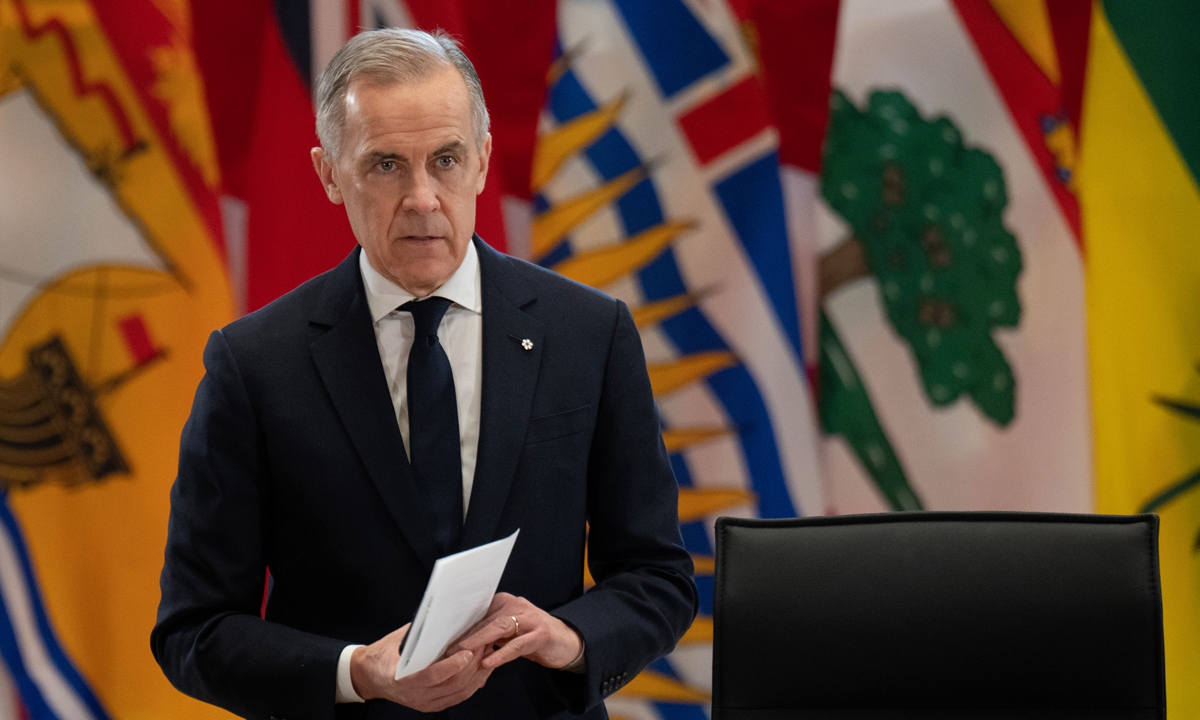
Mark Carney, Canada's prime minister, arrives for a First Ministers' Meeting in Ottawa, Ontario, Canada, on Jan. 29, 2026. Photo: VCG
Canadian Prime Minister Mark Carney on Thursday local time said he expects the US to "respect Canadian sovereignty" after media reported that US officials had met with a group advocating the separation of the province of Alberta from Canada several times.
The latest clash between Washington and Ottawa came amid a deepening rift between the neighbors and former close allies, as US president has repeatedly threatened to turn Canada into its "51st state," alongside additional tariff threats from the White House following Carney's official visit to Beijing.
Speaking at a press conference in Ottawa after meeting with Canadian provincial and territorial leaders, Carney addressed the issue when asked about the reported meetings between US officials and the Alberta Prosperity Project (APP), a separatist group pushing for a referendum on the province's independence, according to media reports.
"I expect the US administration to respect Canadian sovereignty," Carney said. "I'm always clear in my conversations with President Trump to that effect, and then move on to what we can do together," CNN reported.
Compared to Prime Minister Carney's restrained and concise diplomatic language, some provincial leaders in Canada expressed their outrage far more bluntly and directly, Global Times noticed.
Earlier, Alberta Premier Danielle Smith told reporters on Thursday that the US should stay out of Alberta and Canadian politics, saying she would ask her government's delegate in Washington to raise her concerns with the Trump administration, according to the CBC.
British Columbia Premier David Eby also rebuked the meetings between US officials and the Alberta separatist group. "To go to a foreign country and to ask for assistance in breaking up Canada, there's an old-fashioned word for that, and that word is treason," Eby told reporters on Thursday. The CNN added that Eby's voice "wavered with emotion" as he expressed his anger with the separatists who went to Washington.
Ontario Premier Doug Ford told reporters that the meetings between the separatist group and US officials were "unacceptable" and "unethical," according to Toronto Today.
The tension arose after a Financial Times (FT) report said on Thursday that leaders of APP had met with US State Department officials in Washington three times since April last year. The FT described the APP as "a group of far-right separatists who want the western province to become independent."
The group is reportedly seeking another meeting next month with State Department and Treasury officials to request a $500 billion credit facility to support the province in the event of a successful independence vote. Such referendum is yet to be called, according to FT.
Regarding the meetings, a White House official told CNN on Thursday that US government officials met with "a number of civil society groups," but that "no support or commitments were conveyed."
However, the Financial Times reported that US Treasury Secretary Scott Bessent "caused a flurry of excitement" among Alberta separatists last week when he described the province — the single biggest source of foreign oil in the American market — as "a natural partner for the US."
He described Albertans as "very independent people" in talks with right-wing podcaster Jack Posobiec, according to the FT.
Li Haidong, a professor at China Foreign Affairs University, told the Global Times on Friday that the US diplomatic meddling in Canada's domestic separatist issues has far exceeded the boundaries of normal state-to-state interaction. It starkly reveals America's habitual disregard for other nations' sovereignty and territorial integrity, its contempt for international law, and its signature pattern of hegemonic bullying.
From Venezuela to Greenland and now Canada, the US is likely reviving a territorial expansion agenda aimed at turning the Western Hemisphere into "America's Americas," Li said.
The CNN mentioned that Alberta has oil sands that account for about 84 percent of Canada's total crude oil production. And politically, it is considered the bastion of conservatism in Canada. Separatist Albertans argue the federal government's efforts to stop climate change are holding back Alberta's oil industry, and their conservative values are drowned out by the more liberal and populous eastern provinces.
According to the CNN, separatist Albertans argue the federal government's efforts to stop climate change are holding back Alberta's oil industry, and their conservative values are drowned out by the more liberal and populous eastern provinces.
"The return of Trump, a pro-oil conservative, to the White House has buoyed the secession movement and, for some, reshaped its end goal," CNN said.
At present, the paramount external threat to Canada's territorial integrity originates from the US. The most binding external limitation on its economic growth likewise stems from the US, according to the expert.
"The downward spiral is likely to persist… US-Canada ties are unlikely to return to what they once were," Li said.
Deepening rifts
The US-Canadian rift over the separatist group serves as a microcosm of the deepening contradictions between the two countries in recent months.
According to the Associated Press, US President Donald Trump on Thursday local time threatened Canada with a 50 percent tariff on any aircraft sold in the US, following his previous threat to impose a 100 percent tariff if Ottawa went forward with a planned trade deal with China.
Specifically, the US president claimed that the US would decertify all Canadian aircraft, including planes from its largest aircraft manufacturer, Bombardier, in retaliation for Canada's refusal to certify jets from Savannah, Georgia-based Gulfstream Aerospace.
John Gradek, who teaches aviation management at McGill University, said certification is about safety and it would be unprecedented to decertify for trade reasons. "This is really a smokescreen that's basically throwing up another red flag in the face of Mr. Carney," Gradek said. "This is taking it to the extreme. This is a new salvo in the trade war."
The current scale of Canada's aircraft manufacturing industry is relatively limited, which means the US tariff threats against Canadian aircraft are not genuinely aimed at addressing trade fairness issues: they are primarily a form of political pressure designed to deter Canada from deepening economic and trade cooperation with China, said Gao Lingyun, a researcher at the Chinese Academy of Social Sciences.
He noted that the China-Canada cooperation framework contains no exclusive clauses that restrict US participation, and expanded cooperation between Canada and China helps enlarge the overall market size, which means American companies could also benefit indirectly through global supply chain linkages and market spillover effects.
This zero-sum mindset, attempting to reshape trade relations by forcing allies to take sides, reflects the deep anxiety and unease in the US over its allies' pursuit of diversified trade partnerships, Gao said.
Previously, in an X post on Tuesday local time, Carney said that the Canada-China relationship is "at its best" and "has created massive opportunities for both our peoples."
On the same day, Carney denied US Treasury Secretary Scott Bessent's claim that he had walked back the comments he made in Davos at the World Economic Forum, in which Carney condemned economic coercion by great powers on smaller countries without mentioning Trump's name, according to media reports.
"The world has changed, Washington has changed. There is almost nothing normal now in the US," Carney told the elected House of Commons on Tuesday, per the BBC.
Both Chinese experts believed that US actions are steadily eroding the foundation of trust between the US and its allies, forcing countries to reassess their strategic autonomy and external economic and trade options. In the opening month of 2026, a notable wave of high-level Western diplomacy has unfolded toward China. Prime Ministers from Ireland, Finland, Canada, and the UK have all visited Beijing, while German Chancellor Friedrich Merz is reported to be scheduled for a visit in February.
Given Canada's unique position as both a geographic neighbor and a historic "special relationship" ally of the US, Ottawa's response to Washington will serve as a highly influential model for how countries around the world approach and adjust their dealings with the US, Li said.
RELATED ARTICLES