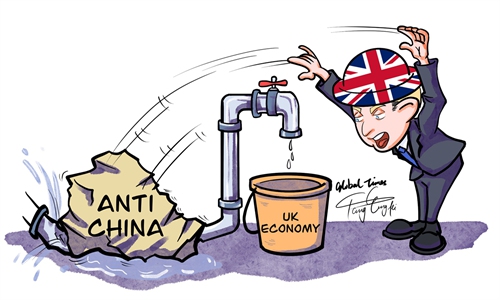
Starmer’s China visit likely to signal a shift in the mood music; we should not exaggerate the extent of the European shift: Martin Jacques
By Published: Feb 02, 2026 11:17 PM

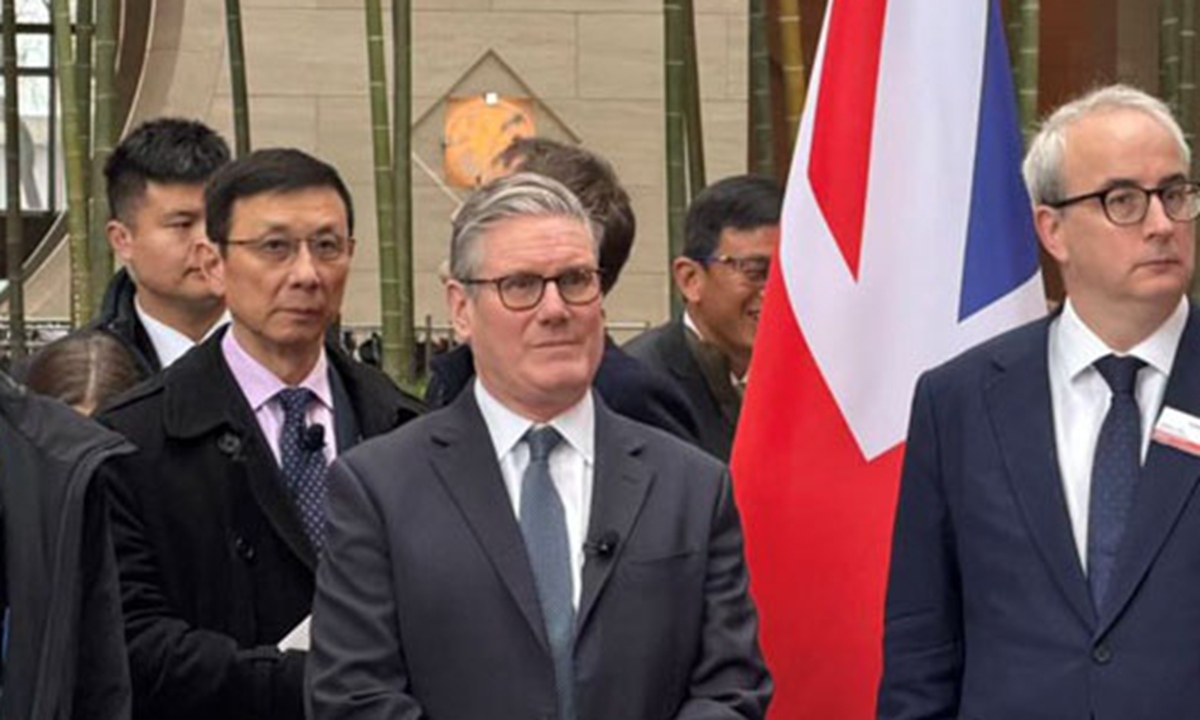
Visiting British Prime Minister Keir Starmer attends a business forum in Beijing on January 30, 2026. Photo: Chen Qingqing/GT
For a decade, the China-skeptic forces have held sway in Britain. Any move in the direction of closer relations with China has been fiercely contested. As a result, no British prime minister visited Beijing for eight years. And China's proposal for a new much larger embassy in London met powerful resistance. That the new mega embassy has been approved and Keir Starmer's visit to Beijing deemed a success represents a very positive development in China-UK relations.It is not surprising that Britain has been somewhat of a laggard in the growing trend of European leaders making their way to Beijing to explore the possibility of closer relations. Ever since 1945, Britain has been an enthusiastic advocate of its "special relationship" with the US and the belief that it is America's closest ally. It was entirely predictable that Britain would be totally unprepared for the US' downgrading of its alliances. The UK has desperately wanted to believe that nothing has really changed in Washington. One consequence of the US shift, especially its threat to Greenland, has been a new willingness on the part of European countries to engage with China. Britain has also been persuaded to do likewise.
We should not exaggerate the extent of the European shift. The Canadian Prime Minister Mark Carney's recent speech at Davos stands alone among Western leaders in its willingness to acknowledge that there is a new world order, one that requires a new kind of response from Western countries. The US threat to invade Greenland has certainly had a profound impact on European leaders, though none have been so open and strategic as Carney.
The agreements reached last week between China and Britain represent very significant progress. There was £2.2 billion in new export deals, £2.3 billion in greater market access and many hundreds of millions of new investments. The most important consequence, however, is likely to be a shift in the mood music, that eight years of non-communication has been brought to an end, and that China should again be seen as a partner with whom we can and should do business. The visit will encourage the government, companies and cultural institutions to seek new agreements with China. The fact that China is willing to actively consider granting unilateral visa waiver to British people is an important signal to ordinary people that China is open and accessible rather than distant and closed.
The hostile attitude toward China has been driven by an emphasis on security, that China cannot be trusted and should be seen as a threat, rather than, as prior to 2016, an emphasis on China as an economic opportunity. The argument over the new Chinese embassy, or whether Starmer should visit China, has been played out in these terms. The subsequent response to the visit has largely been in terms of China as an economic opportunity. To what extent this will last depends in part on whether in the longer run the deal delivers major economic benefits. As the case of many Western European countries, UK economic growth is close to zero and has been ever since the Western financial crisis in 2008. In this bleak economic environment with nowhere obvious to turn, there is hope that China might provide some economic consolation.
One of the most important opportunities is offered by Chinese electric vehicles. Unlike the EU and the US, the UK has not imposed tariffs on the import of Chinese EVs, on the contrary, it has welcomed them. Sales of Chinese EVs have been growing very rapidly over the last year and a growing number of Chinese EV companies are entering the UK market. The next step would be for Chinese companies to establish manufacturing plants in the UK. This now seems increasingly likely.
There are many potential benefits. Chinese EVs would increasingly be seen as British rather than foreign, as happened over previous decades with Ford, Nissan and many others. Chinese plants would provide employment and enable the UK to learn about and acquire the latest technologies. In the process, it would also help to change the public's perception of China. This is already beginning to happen. Chinese EVs have increasingly become synonymous with excellence, reliability, value for money, advanced technology and modernity. They are not just dry statistics. Chinese EVs speak a language that people can understand and identify with. They break down barriers. They help to transform the very meaning of being Chinese.
The author is a visiting professor at the Institute of Modern International Relations at Tsinghua University and a senior fellow at the China Institute, Fudan University. Follow him on X @martjacques. opinion@globaltimes.com.cn
RELATED ARTICLES