Illustration: Liu Xidan/Global Times
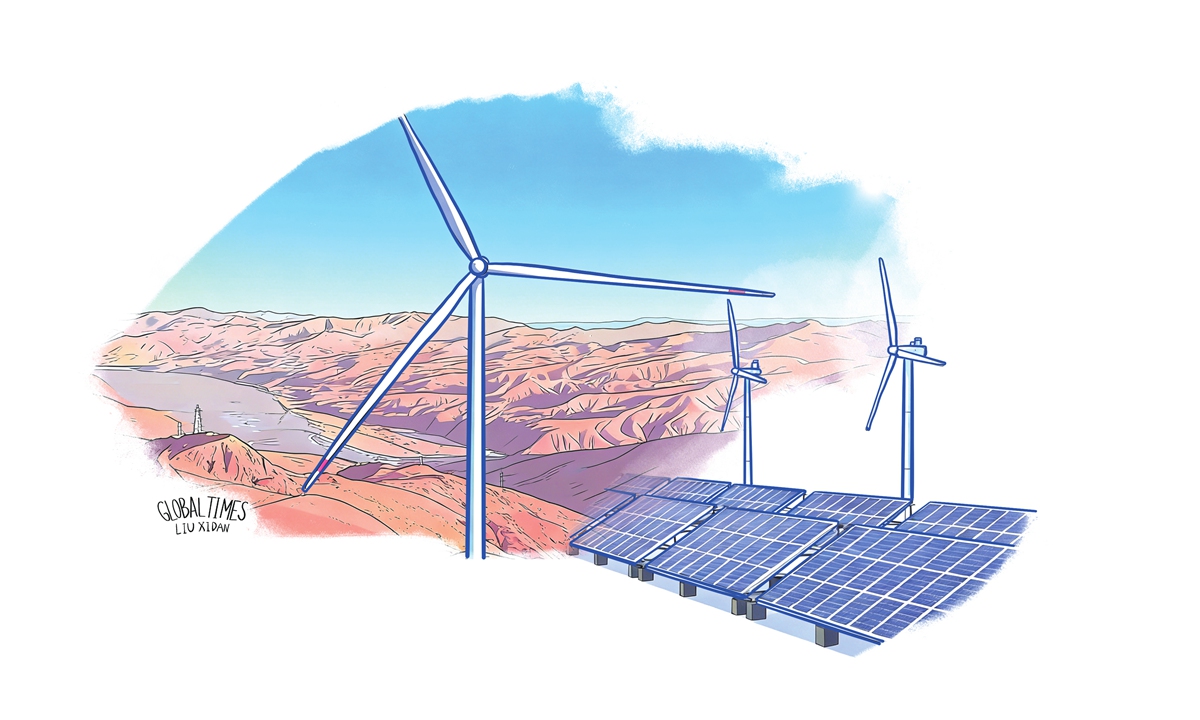
A wind power project in Akqi county, Northwest China's Xinjiang Uygur Autonomous Region, has successfully connected its first batch of turbines to the grid, CCTV News reported on Monday. This milestone is part of Xinjiang's broader efforts to expand its renewable energy capacity. Situated at an elevation of 3,700 meters, the project is reportedly the highest operational wind farm in China's northwest. The project reflects China's growing capability to deploy renewable energy infrastructure in challenging environments, while also contributing to the region's economic development.Once fully operational, the project is expected to generate enough electricity to meet the energy demand of approximately 20,000 households, according to CCTV News. This capacity highlights the growing contribution of renewable energy to local energy resilience.
In recent years, Xinjiang has seen notable progress in its renewable energy sector, particularly in wind and solar power. As of the end of 2025, Xinjiang had built six 10 million kilowatt level new energy bases, with its new-energy installed capacity reaching 167 million kilowatts, accounting for 64 percent of the region's total power capacity.
New energy has become Xinjiang's largest power source, surpassing traditional thermal power, marking a historic shift in the region's energy structure. Leveraging its unique resource endowment, Xinjiang is transforming into a clean energy hub, playing an important role of the northern corridor for the "west-to-east power transmission," according to local media outlet Tianshannet.
In recent years, some Western politicians have persistently targeted Xinjiang's industries, citing so-called forced labor as a pretext. However, the region continues to demonstrate tangible signs of progress, particularly in the development and deployment of renewable energy. Far from stagnating, Xinjiang is steadily positioning itself as an important contributor to the clean energy transition. Projects such as the one in Akqi not only underscore the region's growing involvement in sustainability efforts but also reflect its active role in the broader shift toward more diversified and environmentally sustainable energy sources.
Renewable energy provides a green foundation for Xinjiang's economic growth, contributing to the broader region's economic development amid the low-carbon transition and efforts toward high-quality development.
With the progress of China's nationwide long-distance power transmission network, Xinjiang's capacity to transmit electricity generated from new energy has been significantly enhanced. For example, according to an article posted in October on the National Development and Reform Commission's website, it takes only 7 milliseconds for electricity from Xinjiang to reach Southwest China's Chongqing Municipality; in just 10 seconds, nearly 20,000 kilowatt-hours of Xinjiang power can be delivered to other regions across the country.
Xinjiang delivered 141.3 billion kilowatt-hours of electricity in 2025, an 11.5 percent year-on-year increase. Of this, new energy accounted for 44.4 billion kilowatt-hours, a 13.03 percent rise, representing 31.41 percent of the total electricity dispatched, according to the Xinhua News Agency. This growth underscores Xinjiang's increasingly important role as a source of clean energy.
Xinjiang's desert, Gobi, and plateau regions, historically less economically developed due to their challenging geography, are now seeing growth driven by the development of the new-energy sector. This shift is largely driven by the continuous progress in China's new-energy technologies and the rapid expansion of the renewable energy sector. These advancements have proven to be not only environmentally beneficial but also economically transformative.
As Xinjiang continues to open up and deepen its engagement with international markets, new energy emerges as an area with significant potential for collaboration. The region's expanding expertise and infrastructure in clean energy offer substantial opportunities for cross-border cooperation, with the potential to drive long-term, sustainable development.
The Akqi project exemplifies the adaptability of China's renewable energy technologies, particularly in challenging environments such as high altitudes. These advancements are not only propelling the growth of Xinjiang's new-energy sector but also opening up new opportunities for broader regional development.
The author is a reporter with the Global Times. bizopinion@globaltimes.com.cn
RELATED ARTICLES