Listen
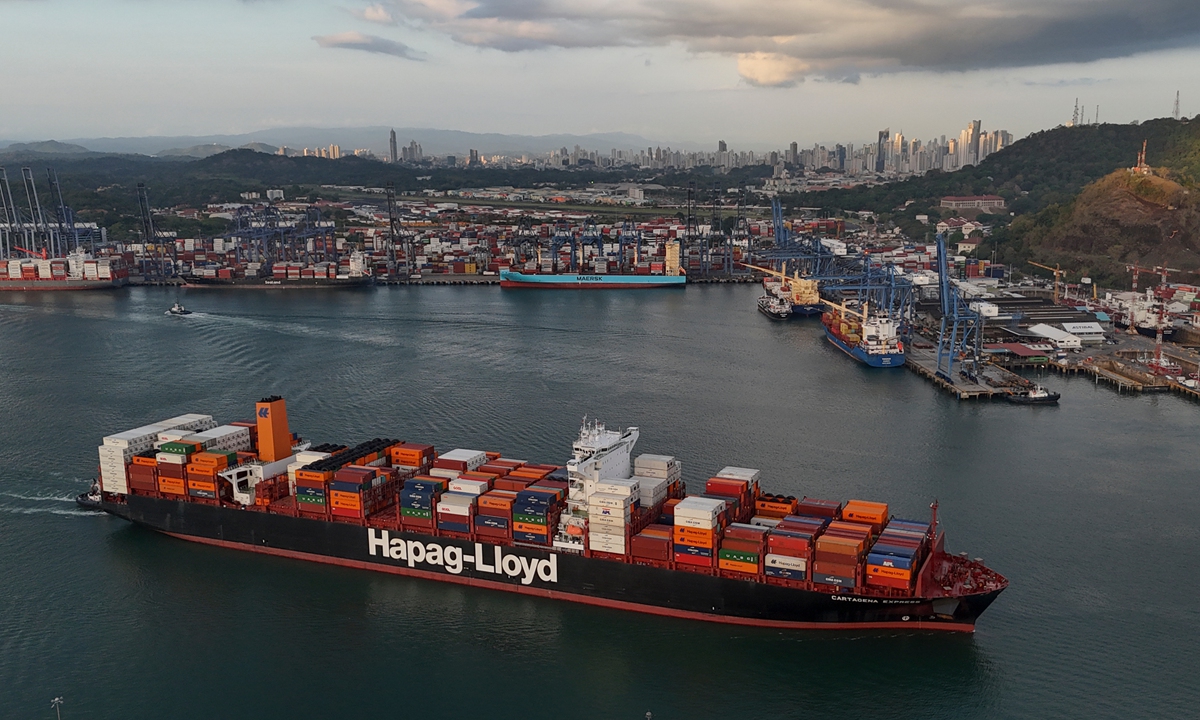
A cargo ship sails past the Panama Canal's Port of Balboa, managed by CK Hutchison Holdings, in Panama City, March 13, 2025. Photo: VCG
Since the Supreme Court of Panama ruled that CK Hutchison's concession contract to operate Panama Canal ports was "unconstitutional," the most elated individuals over the past few days have undoubtedly been certain US politicians and media outlets. US Secretary of State Marco Rubio quickly posted on social media that the US is "encouraged," while some American media outlets claimed this marks a "major victory" for Washington in curbing Chinese influence. The Wall Street Journal even issued a blunt threat, stating that other countries "might re-examine their ties to the world's second-biggest economy."The cries of "victory" coming from the US confirm widespread outside suspicions and further expose Washington's hegemonic arrogance in using geopolitical means to interfere with commercial cooperation and undermine trade rules. Although the US formally handed over control of the Panama Canal in 1999, in Washington's Cold War mentality, this area remains an "inner lake" that others are not allowed to touch. The US has repeatedly expressed desire to "retake control of the Canal," and Secretary of State Rubio chose Panama for his first overseas visit, threatening the country that it "must reduce Chinese influence." Therefore, when the Supreme Court of Panama issued its so-called ruling, it is difficult for the international public opinion not to question its independence.
However, if one follows Washington's rhythm and views this turmoil through the lens of "US-China competition," they fall into a cognitive trap set by the US, and the focus on this matter becomes misplaced. These ports have never been, and should never be, bargaining chips in a geopolitical game. In fact, CK Hutchison has operated these ports for nearly 30 years; in such a long span of time, where has there ever been a shadow of a "Chinese threat"?
On the contrary, under the company's management, these ports have been developed, benefiting the local area and contributing to global free trade. In this process, the US itself has been one of the beneficiaries. Therefore, regarding the attention on Panama's port operation rights, if one must talk about winners and losers, the core should lie in the contest between free trade and hegemonism, and the confrontation between the spirit of contract and power politics.
Whether it is the ports along the Panama Canal, Australia's Darwin Port mired in controversy, or the case of Nexperia in the Netherlands, the same "invisible hand" looms in the background. Some countries repeatedly claim to uphold a "rules-based order"; yet in practice, what they defend is an "order based on the interests of a single country." This is, in essence, a targeted demolition of global investment credibility. If commercial contracts can be nullified at the whim of politicians or under pressure from allies, then no long-term investment within the Western system is truly safe. From Southeast Asia to the Middle East, global investors are watching closely, asking whether today's rapacious acts will tomorrow descend upon any profitable industry.
International investment law does indeed recognize "security exceptions," but these are by no means a universal master key for hegemonism. The core of international commercial law is certainty: companies that operate in compliance with the rules deserve the protection of the law. By using diplomatic coercion to push allies into rulings that defy legal principles, the US is eroding from within the very credit foundations on which the capitalist world depends. In the short term, Washington may have secured a few "strategic footholds"; however, in the long term, this has fundamentally undermined the international credibility of the US and the space for transnational commercial interactions. It is foreseeable that when the law ceases to be a fair arbiter and becomes a political tool, global capital will have to seek safe havens independent of the dollar system and the US "long-arm" influence.
What is even more concerning to the international community is that the geopolitical will of the US often surpasses the constitutions of some sovereign nations. This is a mockery of the principle of sovereign equality enshrined in the United Nations Charter. From the case of Alstom years ago to the current controversy over Darwin Port, the methods used by the US to attack competitors and seize interests are strikingly similar. The international business community needs a fair, just, and non-discriminatory business environment, not a "law of the jungle" dominated by hegemonic will. If this trend of politicizing economic and trade issues and weaponizing legal tools continues unchecked, the ultimate victim will be the entire international economic and trade order. Those who attempt to curb their rivals by undermining the rules will also find themselves facing a bankruptcy of credibility.
As an important maritime passage that carries about 5 percent of global shipping trade, the Panama Canal ports have become a crucial cargo hub on a global scale, and they should not waver under the shadow of hegemonism. According to reports, concessions for the Panama Canal ports will now need to be auctioned off.
In this context, it is hoped that the Panamanian side will truly demonstrate its "independence" by providing a predictable environment for fair competition for all bidders, rather than trying by any means to "ensure that China is blocked from the bidding" as some US media outlets have trumpeted. The whole world is watching everything that happens there.
RELATED ARTICLES