Illustration: Liu Xidan/GT
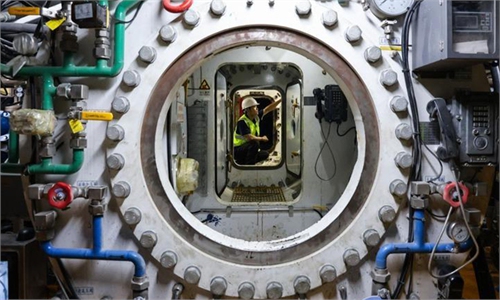
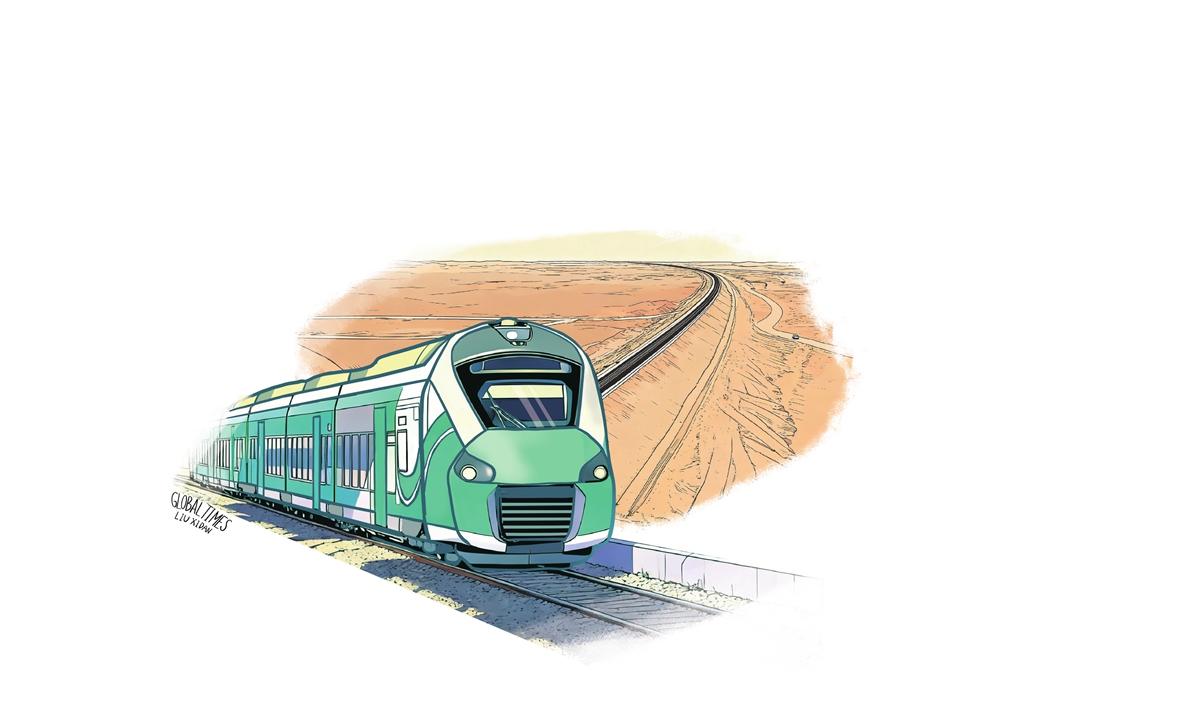
Railway infrastructure frequently features in the discussions of international connectivity and development, in part because it sits at the intersection of engineering, logistics, and long-term investment.In this context, Africa's first heavy-haul railway built under desert conditions has recently entered operation in the Sahara. The line spans approximately 950 kilometers, including 575 kilometers of newly built mainline delivered through joint implementation by Chinese and Algerian enterprises.
The project has drawn attention partly due to the construction and operation of a heavy-haul railway under desert conditions that impose sustained constraints on the construction and long-term maintenance. According to a report by the People's Daily, China Railway Construction Corp's technical design and construction expertise ensured the project's success in the harsh desert conditions.
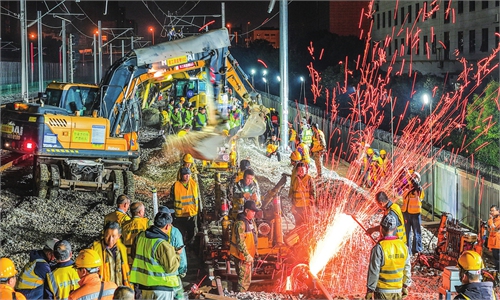
Over the two-year construction period, Chinese and Algerian teams worked under conditions where peak temperatures exceeded 50 C, and access to water, fuel, and reliable communications was extremely limited.
The challenges posed by the desert were gradually addressed through targeted engineering adaptations. Chinese engineers adopted a narrow-waist sleeper design with integrated sand-drainage openings, intended to limit sand accumulation, improve track stability, and reduce the need for intensive maintenance over time. According to media reports, the track-laying was completed ahead of schedule, highlighting how context-specific engineering adaptations can mitigate the operational constraints imposed by harsh desert conditions.
The track-laying accomplished under such harsh conditions underscores the value of adaptive engineering in translating established railway practices to challenging environments, reflecting the practical resilience and maturity of Chinese railway technology.
China has built the world's largest railway network, with related technologies continuing to advance. China's national railway network has reached 165,000 kilometers in operating length, including more than 50,000 kilometers of high-speed rail, forming the world's largest and most advanced high-speed railway network, according to the China News Service.
In the freight sector, the transition toward modern logistics has driven measurable progress. The national railway system carried 4.066 billion tons of cargo in 2025, a year-on-year increase of 2.1 percent, marking nine consecutive years of growth. Daily railcar loadings exceeded 200,000 for the first time.
Focusing more closely on heavy-haul operations, China's railway sector has achieved notable progress in both transport capacity and technological innovation. For instance, as of August 2025, the cumulative freight volume of the Datong-Qinghuangdao Railway, often called China's first heavy-haul railway, had exceeded 9 billion tons, according to media reports.
Advanced technologies such as synchronized control systems and automated traction are being deployed to increase train weights and capacity further. In December 2025, China completed a world-first 35,000-ton heavy-haul train group test on the Baotou-Shenmu (Baoshen) Railway, where seven individual 5,000-ton freight trains were operated in coordinated formation through wireless "virtual coupling" technology. This was a major advancement in heavy-haul operations that could dramatically boost capacity on existing tracks without laying new lines.
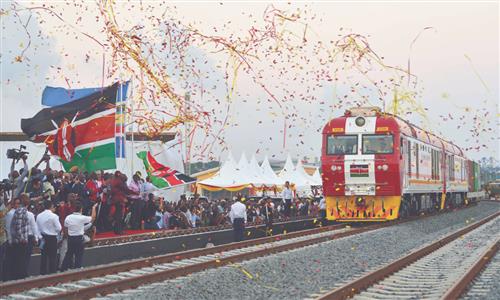
China's advances in railway technology have opened further opportunities for international collaboration. The Sahara heavy-haul railway in Algeria demonstrates how Chinese engineering practices can be adapted to local conditions, meeting operational requirements while maintaining efficiency. Beyond reflecting the maturity of China's technical capabilities, the project illustrates the practical potential of applying Chinese expertise in international contexts, showing that complex railway systems can operate effectively even in extreme environments.
Chinese Ambassador to Algeria Dong Guangli said in a July 2025 interview with local media that the project had created a large number of jobs in construction, engineering, and related services in Algeria. When completed, the project will further improve Algeria's national railway network, promote the upgrading of local energy and mining sectors, connect mining areas, industrial zones, and ports, and support connectivity and economic development in Algeria's southwestern provinces.
In recent years, Chinese involvement in international infrastructure projects has attracted attention. The global infrastructure gap remains substantial, and cooperation that draws on established technical expertise can deliver tangible economic benefits.
Railway projects in particular give host countries the opportunity to modernize their transport systems, improve their logistics efficiency, and support regional development, showing how technically guided cooperation can deliver practical, measurable outcomes.
The author is a reporter with the Global Times. bizopinion@globaltimes.com.cn
RELATED ARTICLES