Photo: Courtesy of Hudong-Zhonghua Shipbuilding
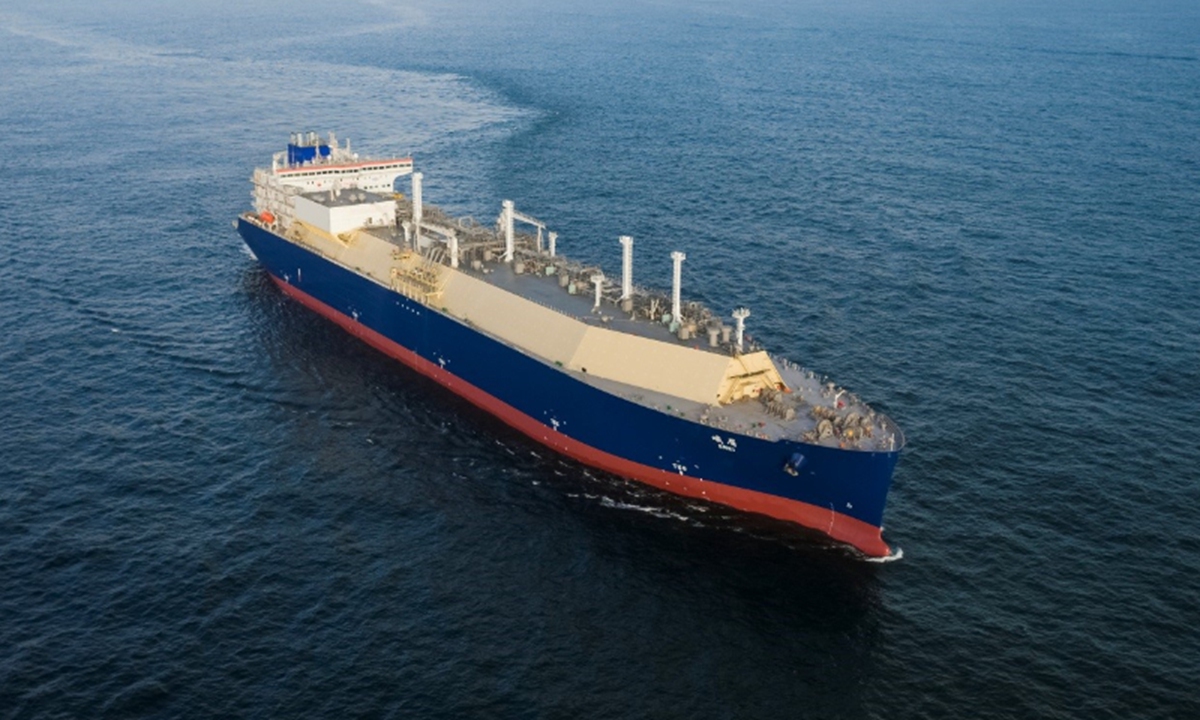
Hudong-Zhonghua Shipbuilding, a subsidiary of China State Shipbuilding Corp (CSSC), has delivered the 174,000-cubic-meter liquefied natural gas (LNG) carrier Tianshan in Shanghai, marking the delivery of its 60th large-scale LNG carrier, CSSC said on its official WeChat account on Monday.Leading Chinese shipyards received large orders for LNG carriers from both foreign and local shipowners in January. Last week, Malaysian LNG shipper MISC, a unit of Petronas, ordered three LNG carriers from Hudong-Zhonghua. Jiangnan Shipyard, another subsidiary of CSSC, recently signed a shipbuilding deal with Singapore's Eastern Pacific Shipping for two LNG carriers.
These developments again underscore China's growing prowess in high-end shipbuilding.
LNG carriers are known as one of the three "jewels" in the crown of shipbuilding, together with aircraft carriers and large cruise ships. Safely transporting LNG at an ultra-low temperature of -163 C imposes extremely high requirements on materials, craftsmanship and system integration, featuring high technologies, high manufacturing difficulties, and high added value.
This sector was long dominated by South Korean shipbuilders. But through decades of continuous investment and technological accumulation, China's shipbuilders have promoted the nation's LNG shipbuilding capacity and gradually narrowed the gap with the world's most advanced levels.
Progressing from technology introduction to independent innovation, and from single-vessel breakthroughs to repeated construction, Chinese shipbuilders have steadily overcome key technological barriers, establishing a complete, self-reliant technological system.
Take Hudong-Zhonghua as an example. Since delivering China's first domestically built large LNG carrier in 2008, Hudong-Zhonghua has significantly shortened the construction cycle from an initial 36 months to about 16 months now, while continuously increasing the localization rate. These advancements are not only manifestations of China's shipbuilding strength but also vivid illustrations of its manufacturing sector's high-end transformation. Moreover, surging orders from international shipowners further testify to the rising competitiveness and growing market recognition of Chinese manufacturing in this field.
More importantly, the overall improvement of China's LNG shipbuilding capacity carries significance that extends far beyond the industry itself. Amid an accelerating shift toward cleaner, low-carbon energy structures, the importance of LNG, as an important transitional energy source, continues to rise.
Global demand for LNG is forecast to rise by about 60 percent by 2040, largely driven by economic growth in Asia, emissions reductions in heavy industry and transport, as well as the impact of artificial intelligence, according to Shell's LNG Outlook 2025 report.
On the supply side, estimates from market and industrial intelligence platforms S&P Global Energy, Kpler and Rystad Energy forecast at least 35 million metric tons of new LNG capacity coming online this year, primarily from the US and Qatar. This rising supply, coupled with growing demand, will further fuel the need for modern carrier fleets.
In this context, the enhancement of China's shipbuilding capacity has not only strengthened the country's self-sufficiency and security in LNG resource transportation, but also provided stable and reliable support for the smooth flow of global LNG by supplying the high-quality, high-efficiency vessels.
South Korean shipyards retain a significant share of the global LNG carrier market, yet the rise of Chinese manufacturing has distinctly reshaped the competitive landscape. The constructive competition between the two countries is driving continuous advances across the industry, while also fostering greater diversity and resilience in the global LNG transportation supply chain.
China's advancement in LNG shipbuilding is not merely an expansion in scale but rather high-quality development grounded in innovation. From breakthroughs in key technologies to the widespread adoption of dual-fuel power systems, and forward-looking preparations for future fuel options including ammonia and hydrogen, Chinese shipbuilders have overcome their technical hurdles while also contributing significantly to steering the global LNG vessel industry toward greener and smarter development.
This technology‑led competitiveness has deeply integrated China into the global high‑end supply chain, establishing it as an indispensable stabilizing force.
Yet, the development of China's LNG shipbuilding industry still faces challenges. Some core equipment and key materials still rely on imports, and there are still gaps in cutting-edge areas such as design optimization for large LNG carriers. Furthermore, the accelerating global trend toward decarbonization in shipping has sparked a new race in the research and development (R&D) of vessels powered by alternative fuels such as ammonia and hydrogen, demanding sustained and increased innovation efforts from Chinese shipbuilders.
It is precisely this process of continuous R&D and open cooperation that demonstrates the determination and path of China's manufacturing industry to climb toward the high end of the industry. As more Chinese-built LNG carriers are put into global service, China is poised to play a more important role in the field of energy equipment, contributing more solutions rooted in manufacturing excellence and international collaboration to advance the global energy transition.
RELATED ARTICLES