Politicized critical minerals groupings unreliable, posing risks to global supply chains, Chinese experts say amid reports of some 30 countries eyeing US-led bloc

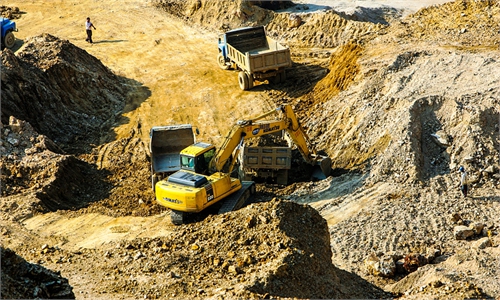
Rare earth Photo:VCG
China's position on maintaining the stability and security of global critical mineral industrial and supply chains remains unchanged, and all sides have the responsibility to play a constructive role in this regard, a Chinese Foreign Ministry spokesperson said on Wednesday.
Lin Jian, spokesperson of the Chinese Foreign Ministry, made the remarks at a regular press conference on Wednesday in response to a question saying that dozens of foreign ministers are set to convene on Wednesday and the EU is going to pitch a broad partnership plan with the US to try to reduce their dependency on China for critical minerals.
On the proposal between the EU and the US, Lin said China maintains that countries need to follow the principles of market economy and international economic and trade rules, step up communication and dialogue, jointly keep the industrial and supply chains stable and unimpeded, and advance the steady growth of world economy.
The comments came after The Guardian reported that ministers from the US, EU, UK, Japan, Australia, and New Zealand would meet in Washington this week to discuss a strategic alliance over critical minerals.
The summit is being seen as a step to repair transatlantic ties fractured by a year of conflict with the US administration and pave the way for other alliances to help countries "de-risk" from China, including one centered on steel, the report said.
Furthermore, Reuters reported that about 30 countries want to join a US-led club of allies and partners on trading critical minerals, while Bloomberg reported that the EU is seeking closer coordination with Washington in the sector, moves that Western official have framed as efforts to "reduce reliance on China."
Chinese experts said that such politicized groupings may prove unreliable in safeguarding supply chain security, arguing that excluding China — the world's leading rare-earths producer — could instead increase risks to global industrial and supply chains.
The club would have tariff-free trade and exchanges and a price floor for minerals, US Interior Secretary Doug Burgum said, Reuters reported on Wednesday.
Burgum used a "dominant" player that is able to manipulate supply as an excuse to defend the move of establishing the club, claiming that while the US "believes in free markets" and does not want to intervene, the situation changes when a dominant player is able to manipulate supply.
"Whether in terms of supply stability, technological coordination or industrial chain security, pragmatic engagement with China remains an inescapable reality for the international community in the field of critical minerals," Wang Guoqing, research director with the Beijing-based Lange Steel Information Research Center, told the Global Times on Wednesday.
From the perspective of technological development, market dynamics and practical feasibility across the global rare-earths supply chain, a rational and viable option for Western economies is to deepen cooperation with China, rather than exclude it through politicized groupings and attempt to rebuild supply chains from scratch, Wang noted.
Critical minerals have featured repeatedly in discussions among Western economies in recent years, including a rare-earth deal struck between the US and Australia last October and the establishment of a G7 "critical minerals production alliance." However, tangible outcomes from these initiatives have remained limited.
Notably, the EU will pitch the US on a critical minerals partnership to "curb China's influence," looking to shape the Trump administration's push to strike global agreements this week, Bloomberg reported on Tuesday. The EU is prepared to sign a memorandum of understanding with the US to develop a "Strategic Partnership Roadmap" within three months, according to people familiar with the matter, the report said.
According to the report, the partnership aims to jointly find ways to source critical minerals, which are needed for most modern technologies, without relying on China.
It's irrational for the EU to adopt this approach especially amid a growing rupture in the US-EU relationship, analysts said.
The US-EU relationship nearly ruptured in recent weeks after the US administration signaled plans to buy Greenland, a territory of EU member Denmark, according to Bloomberg.
Amid structural frictions in current US-EU relations and Washington's frequent pressure on its allies, the reliability of the US itself remains uncertain, meaning such cooperation may not achieve the outcomes Europe originally expects, said Jian Junbo, director of the Center for China-Europe Relations at Fudan University's Institute of International Studies.
Approaching critical minerals through a lens of globalization and interdependence is essential to preserving secure and resilient supply chains, whereas building walls and hardening defenses risks fueling instability and disrupting global industrial flows, Jian said.
In April last year, China announced export controls on seven categories of medium and heavy rare-earth-related items, citing the need to better safeguard national security and interests and fulfill non-proliferation and other international obligations. Since then, Chinese authorities have repeatedly stressed the use of facilitation measures, including general licenses, to promote compliant trade in dual-use items and safeguard the stability of global supply and industrial chains.
On December 18, China's Ministry of Commerce spokesperson He Yadong said that some Chinese exporters had preliminarily met the basic requirements for applying for general licenses, adding that a number of applications submitted by Chinese exporters had already been approved.
RELATED ARTICLES