Uruguayan president visits university in Beijing, highlighting flourishing China-Uruguay cultural exchanges
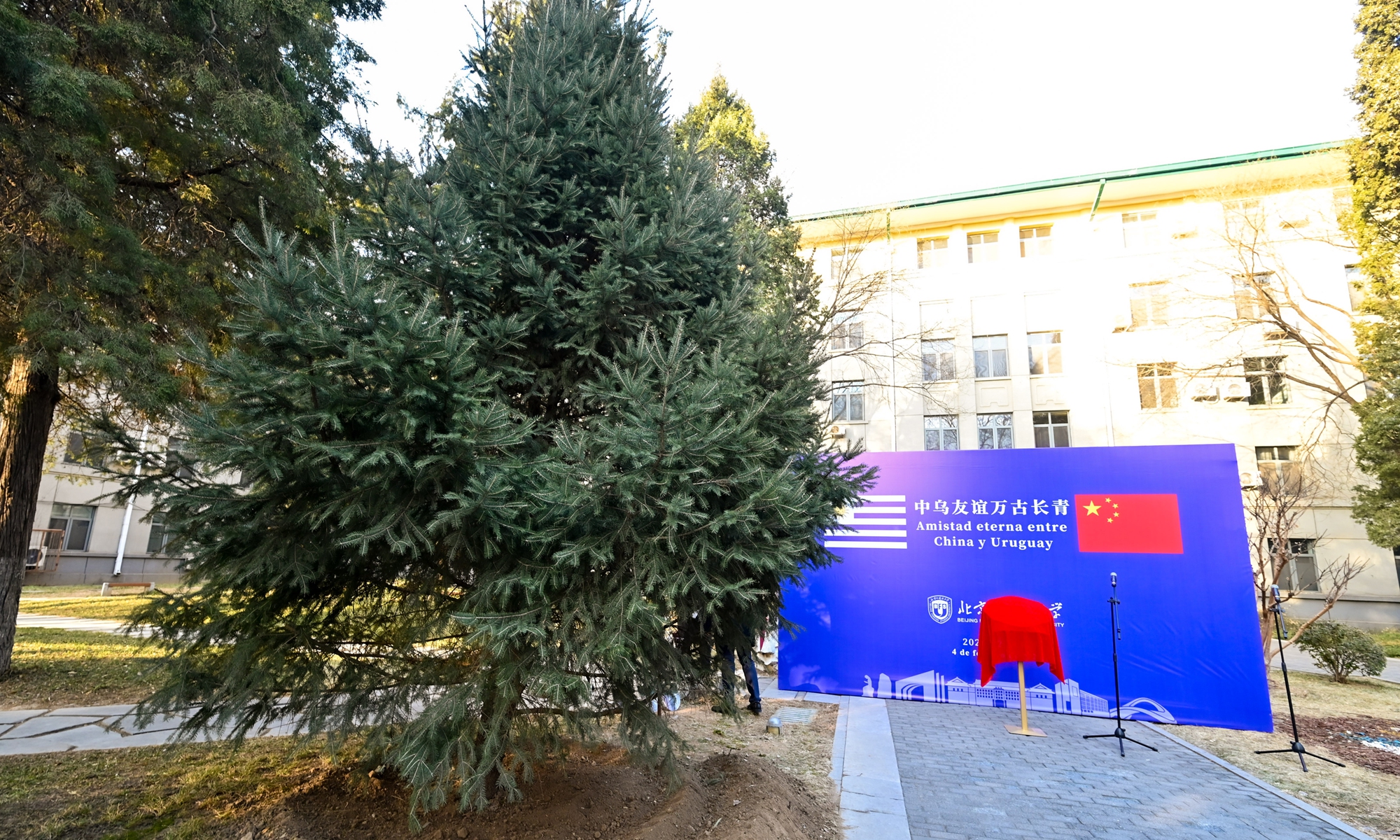
A cloud cedar tree flourishes beside the main building at Beijing Foreign Studies University on February 4, 2026. The tree bears witness to the flourishing cultural and people-to-people bonds between China and Uruguay. Photo: Courtesy from Beijing Foreign Studies University
Bathed in the first rays of sunlight on Wednesday, a 13-year-old cloud cedar tree flourishes beside the main building at Beijing Foreign Studies University. Lush and full of life, this tree bore witness to the flourishing cultural and people-to-people bonds between China and Uruguay.
On Wednesday morning, President of the Oriental Republic of Uruguay Yamandu Orsi visited the university, loosened the soil around the tree, and delivered a speech with warm interactions with teachers and students, highlighting growing exchanges between the two countries.
In 2013, during a visit to China, former Uruguayan President Jose Mujica visited the university and planted the cloud cedar tree, symbolizing the friendship between China and Uruguay, the Global Times learned from the university.
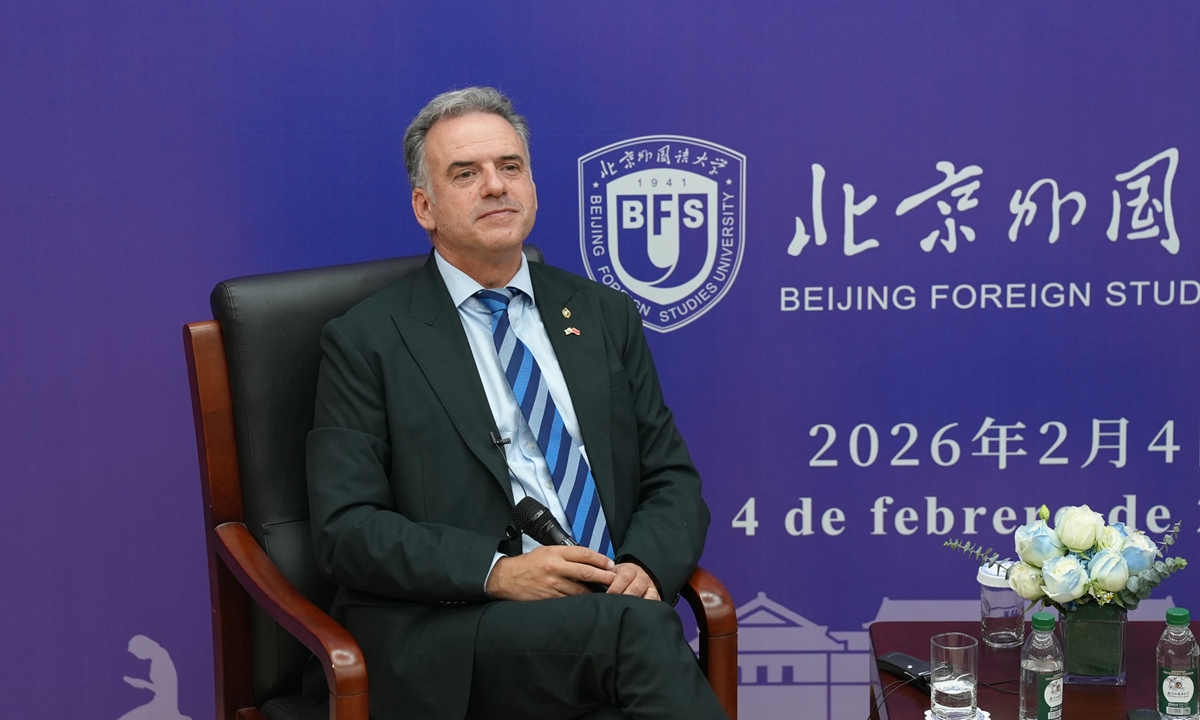
President of the Oriental Republic of Uruguay Yamandu Orsi visits Beijing Foreign Studies University on February 4, 2026. Photo: Pang Yue/GT
At that time, Orsi accompanied Mujica on his visit to Beijing Foreign Studies University, the Global Times learned from the university. In his speech on Wednesday, Orsi said that he came to the university, so as to ensure that the tree may grow healthy, strong and leafy, just as the bilateral relationship between China and Uruguay.
He noted that those strong roots — as everything indicates when one looks at and sees the size of that tree — enable this relationship to remain firm even when gusts of wind and inclement weather lash at it and pass by. "Especially now, as we face a fierce storm in international geopolitics, the strength of those roots is truly being put to the test. And that is why I believe it is particularly valuable to be here today in China, at this university, caring for this beautiful tree that we want to continue growing," Orsi said.
During the speech, Orsi highlighted the importance of academic exchanges. "When a student travels, when a researcher shares their work, when a university opens its doors to another culture, something is built that no trade agreement can guarantee: trust between peoples. Scientific and academic cooperation not only drives innovation, it also strengthens peace," he said.
During his tour at Beijing Foreign Studies University, a fourth-year student named Li Yuelin, who is majoring in Spanish, performed a song by Uruguayan singer Ana Prada. The Global Times learned that before concluding his campus itinerary, the Uruguayan President specially arranged a video call with Ana Prada, allowing Li to speak with her on the phone.
Li told the Global Times on Wednesday that she observed that during her performance, the Uruguayan President recorded a video, and the Uruguayan guests joined in singing along with her. "Especially the call with Ana Prada caught me completely by surprise and made me incredibly happy - because there's about a 12-hour time difference between Uruguay and China, being able to connect with her live in real time felt truly special," she said.
"By revisiting and carrying forward the tradition of people-to-people exchanges, the Uruguayan President's campus visit can further nurture, advance, and elevate the depth of China-Uruguay cooperation," Yuan Dongzhen, deputy director of the Institute of Latin American Studies at the Chinese Academy of Social Sciences, told the Global Times on Wednesday.
The visit to the university took place on the fourth day of Orsi's seven-day state visit to China. The Uruguayan President has continuously shared updates on social media, actively sharing his China itinerary, ranging from information and videos from his arrival in Beijing, meetings with the Chinese leader, his visits to the Great Wall, the Palace Museum and the Museum of the Communist Party of China, as well as interactions with staff at a Beijing restaurant selling Uruguayan beef.
During his speech on Wednesday, Orsi also highlighted the importance of cooperation with China in a wide range of areas. He said that climate change, pandemics, food insecurity, biodiversity loss, financial instability, armed conflicts, and organized crime are problems that transcend borders. The response to these problems cannot be isolation or unilateralism without rules. "That is why, for us, multilateralism is not an abstract slogan, but an obvious necessity," Orsi noted.
"For small countries like Uruguay, it is also a minimum guarantee of voice and dignity. Despite all the attacks it has been suffering, we believe in the importance of an international order based on rules… In this context, the relationship between Uruguay and China is of strategic importance. It is not just a matter of trade, but of building a long-term relationship based on trust, cooperation, and mutual learning," the Uruguayan President said on Wednesday.
Orsi said that despite the notable differences between China and Uruguay, the relationship has become a model of collaboration between two countries with different geographical, demographic, and economic dimensions.
Yuan noted that at present, China-Uruguay cooperation has already transcended purely economic and trade dimensions. While "hard" cooperation in areas such as technology remains important, exchanges in the "soft" dimensions — humanities, culture, education, arts, and beyond — are becoming increasingly vital. "Through people-to-people exchanges and mutual learning of experiences, China-Uruguay bilateral cooperation, along with China-Latin America relations as a whole, becomes more complete and comprehensive," the expert said.
RELATED ARTICLES