China remains key market for Uruguayan beef: industry rep
High-level visit expected to boost trade dialogue, co-op: industry rep
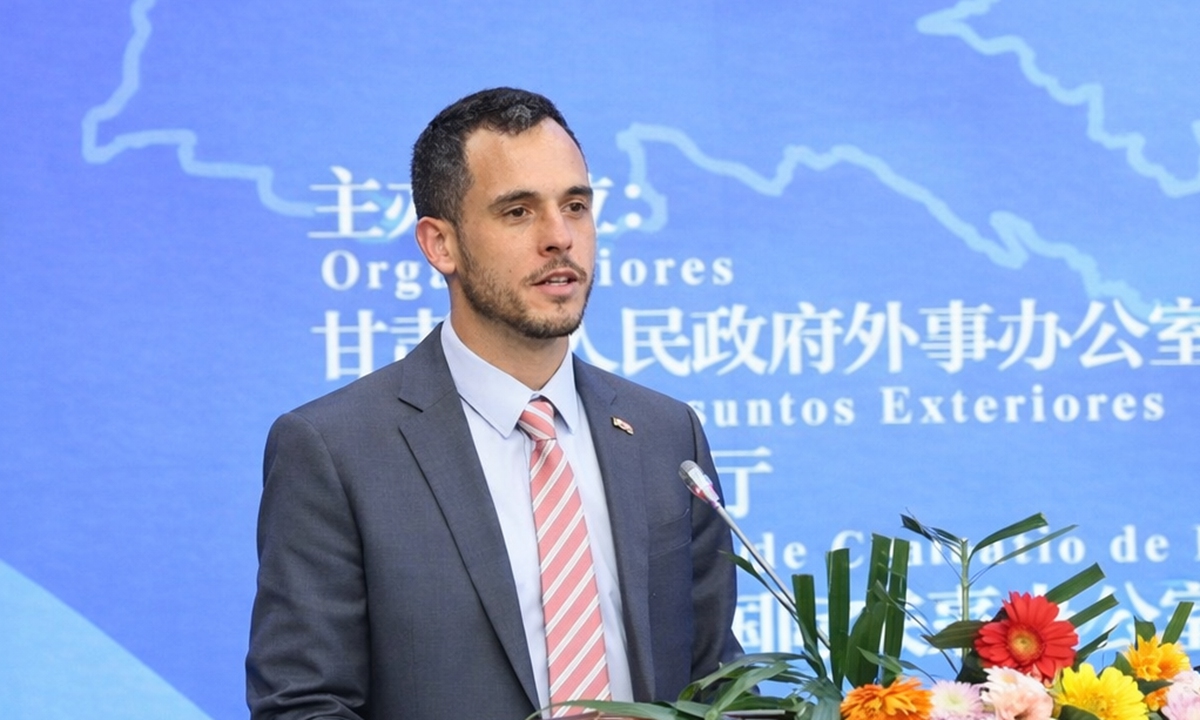
Christian Shaw, head of market access and development of the National Meat Institute of Uruguay Photo: Courtesy of Christian Shaw
China is a key market for Uruguay, especially for the agricultural and food sectors. It is one of the main destinations for Uruguayan beef and plays a central role in the diversification and scale of our exports, Christian Shaw, head of market access and development of the National Meat Institute of Uruguay, told the Global Times in an exclusive interview on Monday.
The remarks were made on the sidelines of the ongoing state visit of the President of Uruguay Yamandu Orsi to China, which takes place from Sunday to Saturday, marking his first state visit to China.
China has been Uruguay's largest trading partner, biggest export market, and largest buyer of its major export products such as pulp, soybeans, and beef for more than a decade, according to China's Ministry of Commerce. As the main destination for Uruguay's beef exports, China accounted for nearly half of the country's total beef export value, industry data shows.
The presidential visit to China is highly significant for Uruguay's trade agenda and, in particular, for the beef sector, Shaw said, noting that these high-level missions reinforce mutual trust, provide political backing to the commercial relationship, and create an enabling environment for long-term trade stability.
For the beef industry, the industry representative said that "the visit helps strengthen institutional dialogue, supports ongoing technical and sanitary cooperation, and highlights Uruguay's commitment as a reliable supplier of safe, high-quality and fully traceable beef."
In 2025, Uruguay's beef exports to China showed a solid performance, maintaining China as one of the South American country's main export destinations despite a context of global market adjustments, according to the National Meat Institute of Uruguay.
Both export volumes and values reflected the importance of the market and the resilience of the bilateral trade relationship, Shaw said, commenting on the positive trade results last year.
The trend seen in 2025 is expected to continue, as Shaw said that Chinese demand for beef continues to evolve. "While volume remains important, we are clearly seeing growing interest in higher-quality products, differentiated cuts, and assurances related to food safety, sustainability, and traceability," he said, noting that these are areas where Uruguay has strong competitive advantages.
On a further note, the industry representative said that "We see solid medium- and long-term growth potential for Uruguayan beef in China, particularly by consolidating our position in the mid- to high-quality segments and expanding the presence of branded and value-added products."
Shaw said that expectations for this year are "cautiously optimistic." While global demand conditions and policy developments will continue to influence trade flows, Uruguay is well-positioned to sustain and potentially increase its beef exports to China, supported by strong institutional cooperation, stable market access, and continued promotional efforts by the National Meat Institute of Uruguay.
While beef takes an important share in South America's trade with China, more potential is being unleashed in wider agricultural sectors. Shaw said that beyond beef, Uruguay sees strong potential in other agricultural and agro-industrial products in the Chinese market, giving examples of products such as sheep meat, dairy products, poultry, and selected value-added food products "that align with changing consumer preferences."
China's market increasingly values quality, safety, and reliability, and Uruguay's production systems are well-suited to meet these expectations, he said.
Wang Youming, an expert at the China Institute of International Studies in Beijing, said on Monday that the president's visit will inject new momentum into economic and trade relations between China and Uruguay, which he said show strong and growing complementarity.
Uruguay is often dubbed the "Switzerland of South America," with its agricultural products and tourism sector performing well, Wang said. However, he noted that the country's economic structure remains relatively concentrated, relying primarily on exports from agriculture and livestock farming. Meanwhile, China has been Uruguay's major export destination for many years, even as the South American country pursues more diversified trade ties, making the two countries ideal trading partners.
In terms of imports, Chinese electric vehicles have been particularly popular in Uruguay. Chinese electric buses, including those produced by domestic companies such as Yutong, are well-received in the local market, Wang added.
As bilateral ties deepen, Wang said that there will be more opportunities for cooperation in areas including green energy, infrastructure development, and industrial upgrading, underscoring the strong synergies in their economic and trade relations.
RELATED ARTICLES