IN-DEPTH / IN-DEPTH
From a Chinese festival to global celebrations, overseas Spring Festival Galas evolve into dynamic platforms for international cultural exchanges
Lanterns and legacies
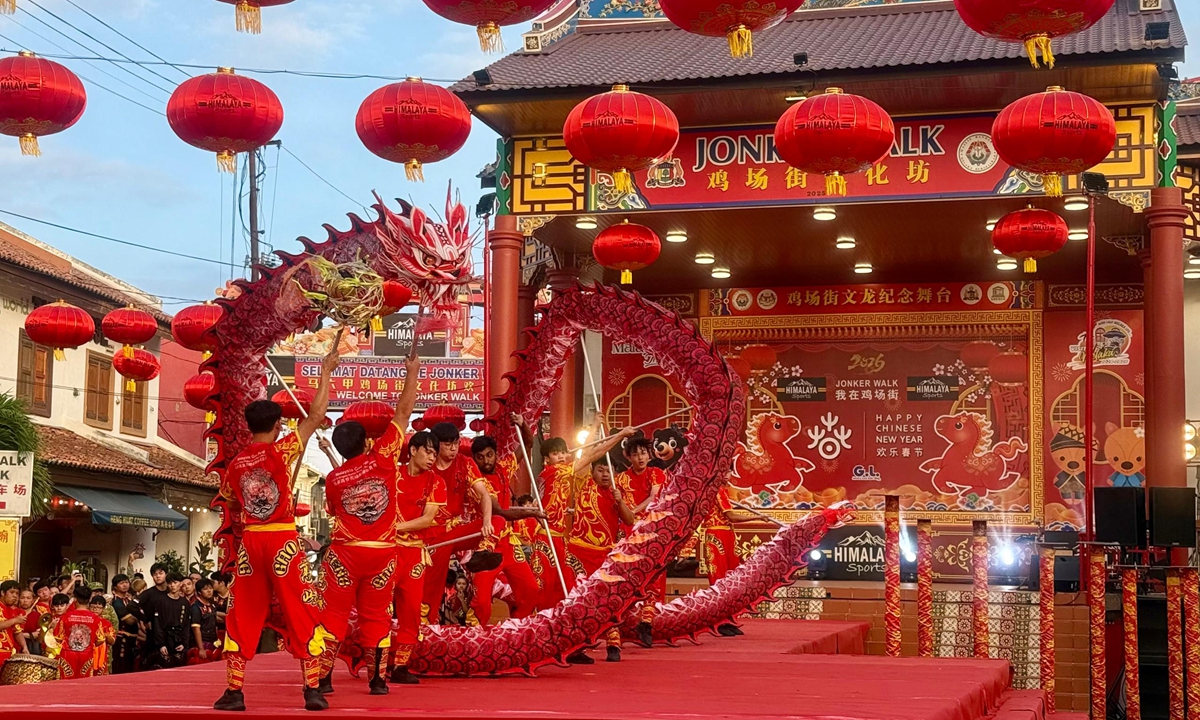
A view of the Jonker Street, a historic thoroughfare in Malacca, Malaysia Photo: Courtesy of Gan Tian Loo
Jonker Street, a historic thoroughfare in Malacca, Malaysia, is now bathed in the warm glow of red lanterns strung high overhead.Several Spring Festival Galas are being recorded here, capturing a vibrant scene: Beneath the hanging lanterns, the rhythmic beats of the 24 Solar Terms Drums echo through the street. Chinese and Malaysian performers unite in chanting "culture knows no borders, blessings connect us all," attracting visitors of diverse backgrounds to stop and watch.
Half a world away, in Berlin, Germany, another Spring Festival Gala has successfully concluded. On the evening of February 1, the 2026 Berlin-Brandenburg Spring Festival Gala was held at the Technical University of Berlin, bringing together nearly 1,400 Chinese and German attendees from the surrounding areas to welcome the Spring Festival, which marks the start of the traditional Chinese Lunar New Year.
During the performance, the powerful martial arts show, orchestral ensemble and saxophone quartet created a dynamic fusion of Chinese and Western artistic sparks.
From the street fairs in Malacca to the campus stage in Berlin, a series of Spring Festival cultural feasts held across the globe are drawing people from diverse cultural backgrounds to actively participate in and experience this unique oriental charm.
With the UNESCO inscribed Spring Festival, social practices of the Chinese people in celebration of the traditional new year, on the Representative List of the Intangible Cultural Heritage of Humanity in December 2024, its global influence continues to grow.
According to the People's Daily Overseas Edition, today, nearly 20 countries have recognized the Spring Festival as a public holiday, and celebrations are held in nearly 200 countries and regions, with about one-fifth of the world's population joining in the festivities in various forms.
In this context, overseas Spring Festival Galas have also evolved, transforming from early gatherings that primarily served as nostalgic reunions for overseas Chinese into dynamic platforms for international cultural exchanges. Through these galas and the festive atmosphere they generate, more international audiences are gaining a taste of China's cultural charm and experiencing the cultural resonance.
A festival shared by all communities
Finalizing the performance schedules, overseeing the installation of festive arches and giant lion dance props, coordinating the venues and logistics... Gan Tian Loo, chairman of the Jonker Walk Working Committee, has been keeping an extremely busy schedule lately.
The Jonker Walk Malacca, a renowned Chinese community in Malacca, once a base for Admiral Zheng He's fleet during the Ming Dynasty (1368-1644), is now revitalized with cultural energy.
"This year, Jonker Street is hosting overseas segments for the Spring Festival Galas from several Chinese regions, while also organizing our own Chinese Lunar New Year carnival," Gan told the Global Times. "We aim to preserve the nostalgic essence for the overseas Chinese while making the celebrations accessible and enjoyable for Malay, Indian, and [the other] international visitors."
Behind this vision lies three decades of profound change. "Overseas Spring Festival Galas are nothing like they used to be," Gan said.
He still remembers that decades ago, the events were held in cramped, modest venues. Most performers were children from Chinese communities and overseas Chinese enthusiasts passionate about traditional culture, and the programs were simple song-and-dance routines. "Back then, they were more like internal get-togethers for the Chinese community, a chance to reunite, have fun, and ease homesickness."
Today, this 36-year-old festive tradition has transformed from a small community gathering into a sprawling cultural extravaganza spanning multiple venues across the nation, becoming a cherished annual memory for people in Malacca. This evolution, he stressed, has not only preserved and revitalized traditional Chinese culture for younger generations but has also turned the Spring Festival into a cultural tourism highlight, creating economic opportunities for local businesses.
At the preparation site in Jonker Street, a giant lion dance head set to be erected has attracted particular attention.
"This symbolizes the joint Malaysia-China effort to nominate lion dance for the UNESCO Representative List of the Intangible Cultural Heritage of Humanity," Gan said. "Precisely such considerations guide our planning: We strive to maintain the authenticity of Chinese elements while ensuring they resonate locally, achieving both cultural exchanges and audience engagement."
This approach to cultural communication - preserving traditions while embracing innovation, and fostering openness and inclusiveness - is not unique to Malacca. Thousands of kilometers away in Brazil, a similar story of cultural breakthrough is unfolding.
As a key organizer of local Chinese New Year events, Lee Qingxia has witnessed the Spring Festival's journey from an internal celebration within the Chinese community to a widely recognized cultural occasion among Brazilians.
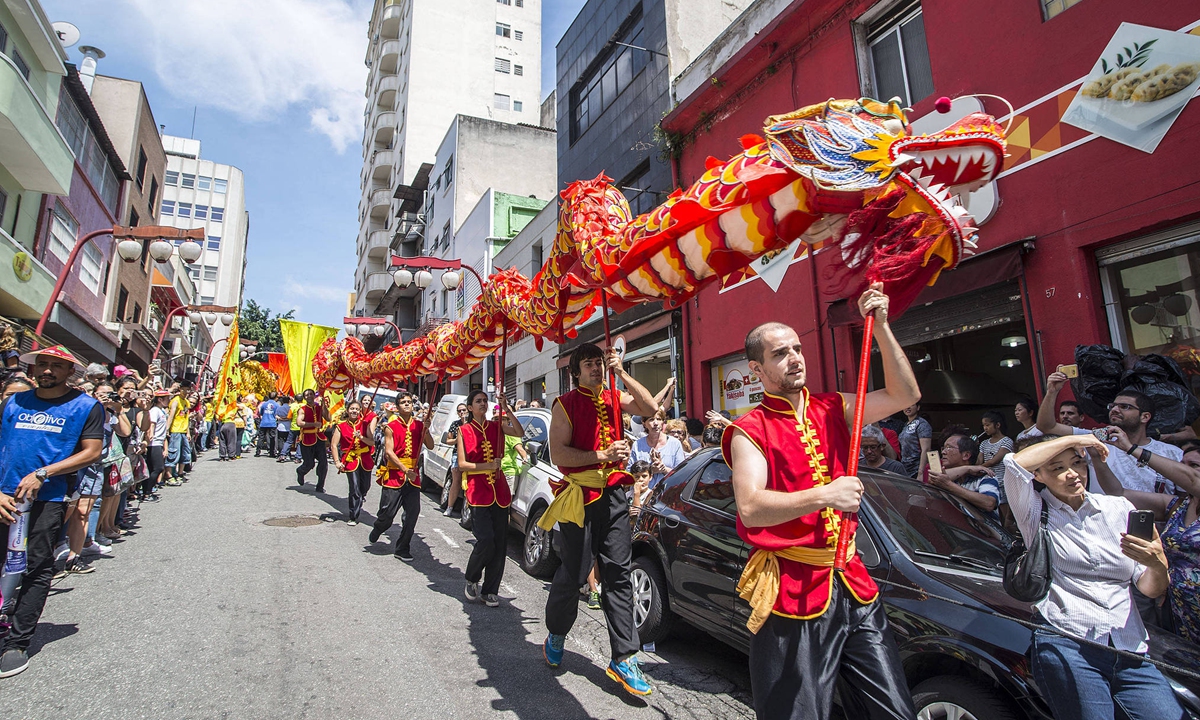
The dragon and lion dance is performed during the celebrations marking the Year of the Horse, the upcoming Chinese Lunar New Year, in Sao Paulo, Brazil, on January 31, 2026. Photo: VCG
"In the early days, our Spring Festival Galas in Brazil attracted almost exclusively Chinese audiences, with self-organized performances," Lee told the Global Times. "Today, the festivities have expanded beyond galas to include flash mobs, park fairs, and lantern festivals, engaging not only the overseas Chinese but also broader Brazilian society,"Lee said what encourages her most is that the Spring Festival has gradually gained stable cultural recognition in Brazil. For example, local shop owners are familiar with traditional Chinese New Year symbols like red lanterns and festive drum music, and many Brazilian families now make a special trip to attend garden parties.
"We invite local Brazilian artists to co-create our events and provide Portuguese explanations of the cultural meanings, such as 'reunion' and 'praying for blessings', behind the performances," Lee said. "This intentional integration is what transforms the Spring Festival from a distant tradition into an emotional feast that transcends cultural boundaries, making it a celebration truly shared by all."
From one-way display to two-way dialogue
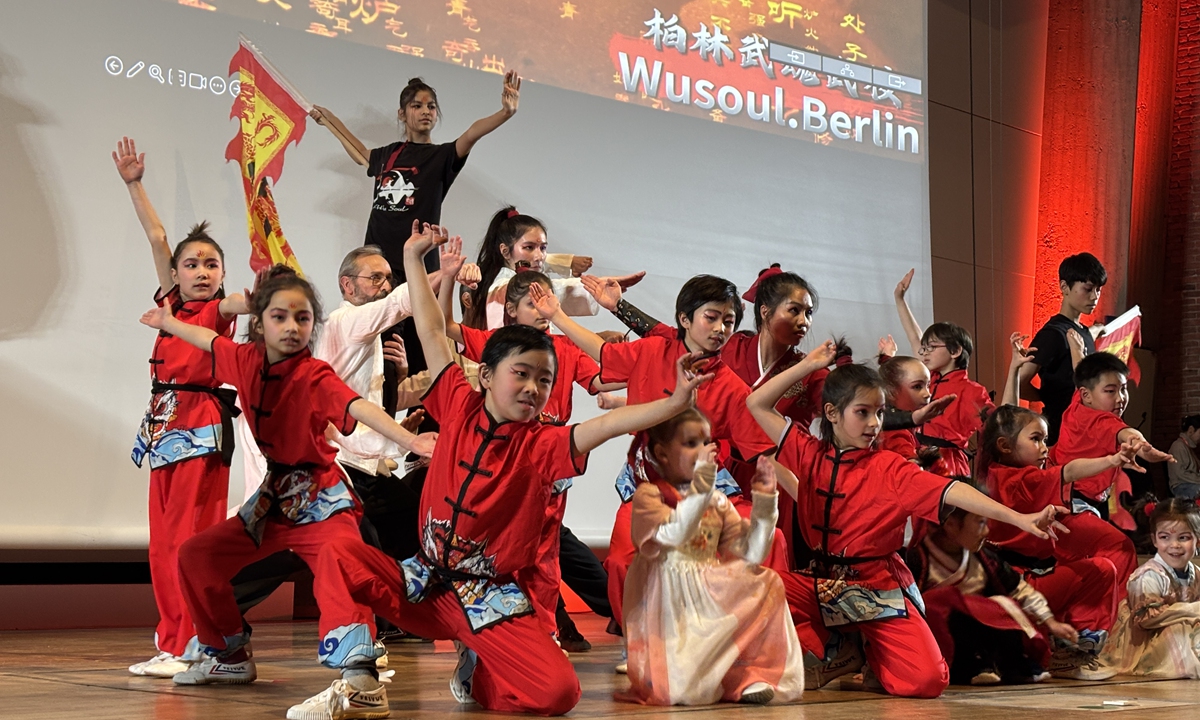
The 2026 Berlin-Brandenburg Spring Festival Gala is held at the Technical University of Berlin on February 1, 2026. Photo: Courtesy of He Wenyan
Overseas Spring Festival Galas are no longer just showcases of Chinese culture. They have evolved into spaces for cross-cultural co-creation, where shared efforts forge genuine connections.For He Wenyan, a former Chinese national martial arts athlete who now runs a kung fu school in Berlin, this shift is vividly reflected in her gala experience.
"The gala acts like a cultural magnet; it gathers people not only to soothe nostalgia but also to forge genuine connections," He told the Global Times. "My goal is simple: to give my students a stage and convey the warmth of Chinese culture through martial arts."
This year, she led a group of Chinese and German students in a kung fu performance in the 2026 Berlin-Brandenburg Spring Festival Gala. She acted as the choreographer, among her other duties.
The performance, tailored for the Year of the Horse, blended traditional moves with hoofbeats, horse roars, and thunderous drumbeats, creating a powerful "galloping horses" vibe that resonated with audiences.
"Watching them go from beginners to confident performers together - that joy of achieving something as a team touches me more than the show itself," she said.
French-born Johannes Regnier, who has lived in Berlin for 15 years, joined He's team for the second time.
"Progressing in kung fu takes patience, but we train as a team. We correct one another's forms and support one another," he said.
Beyond mastering the skills, he cherished the small, universal moments that bridged cultural gaps: "We all share similar joys - discussing ideas, making jokes and sharing good dinners."
Regnier emphasized that cultural understanding often accumulates through small, shared experiences rather than single transformative events.
"Sharing the stage and participating in the festival is itself a form of dialogue. In my experience, it's not one single story but an accumulation of these little anecdotes and discoveries that gradually deepen our understanding of another culture," Regnier said.
This gradual immersion transformed his initial curiosity about unfamiliar cultural references into a proactive desire to connect: "I want to pick up Chinese so I can better understand my teammates and their perspectives."
He observed a similar dynamic during the two months of intensive rehearsals. Her students did not merely "execute moves"; they actively questioned and suggested ideas from their own cultural perspectives.
"That kind of proactive co-creation is what gives a performance genuine cross-cultural vitality," she noted.
"These events showcase Chinese culture as an open, inclusive and evolving entity to the world, while also enabling the Chinese public to reflect on our own culture's distinct traits and adaptability through overseas feedback," Zhu Wei, a professor at the China University of Political Science and Law, told the Global Times.
In the long run, the grass-roots goodwill and co-creation experience built via these events can lay a solid social foundation for deeper institutional dialogues, academic collaborations and value exchanges, Zhu said.
Forging time-honored resonance
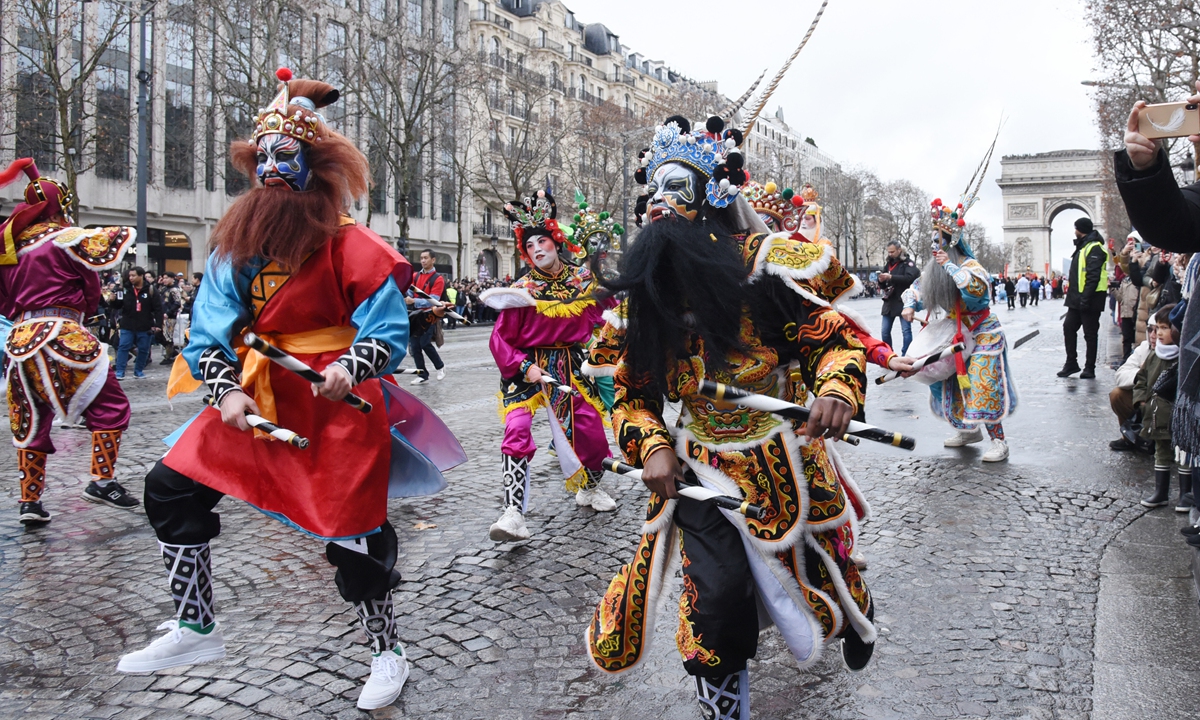
A Spring Festival parade is held on the Champs-Elysees?in Paris, France, on February 1, 2026 to celebrate the upcoming Chinese Lunar New Year. Photo: IC
As overseas Spring Festival Galas evolve, the focus of many organizers and participants has shifted from simply presenting Chinese culture to fostering meaningful, cross-cultural resonance. This transition is driven by intentional content innovation and a growing emphasis on shared human experiences.In Brazil, Lee's annual flash mob events are a case in point, each themed to mirror the zeitgeist and voice overseas Chinese aspirations.
This year's "Ode to Peace" resonates deeply amid global turmoil, channeling universal yearnings for stability amid conflicts around the world.
"We want the performances to carry a message that resonates beyond the overseas Chinese, something universal," Lee said.
He Wenyan envisions a tech-infused creative future for these galas, where robotics and digital stages could bring traditional performances into dialogue with globally relevant themes, offering Eastern perspectives on progress, innovation, and sustainability.
Meanwhile, Gan advocates going further by harnessing AI and the metaverse to transform static cultural displays into vivid, interactive experiences. "What we are doing is already 'cultural translation,' not mere 'cultural transportation,'" he noted. "This approach allows us to achieve a true win-win: preserving cultural authenticity while making it resonate locally."
Gan also calls on the younger generation of overseas Chinese to leverage their unique dual-cultural fluency.
"They can serve as vital bridges, connecting their heritage with the world. They can showcase China's development and contributions, and help global audiences witness China's deepening role on the world stage."
Zhu noted that as overseas Spring Festival Galas take root globally, they continuously spawn "glocalized" innovative expressions, a phenomenon that fully embodies the Spring Festival culture's inclusiveness, adaptability, and shareability.
"These traits are precisely what endow the Spring Festival with enduring vitality as a global festival, weaving tighter the bonds between civilizations through shared celebration," he said.
RELATED ARTICLES